
Hormel Foods (NYSE: HRL) has agreed to buy Brakebush Brothers, a family-owned chicken processor based in Westfield, Wisconsin, for approximately $1.055bn in cash, the companies announced on 30 September 2026. The Hormel Brakebush acquisition is the maker of Spam and Skippy’s biggest bet yet on foodservice chicken, and it lands at an awkward moment: Hormel’s own quarterly profit has just collapsed and its shares are sitting near a 20-day low.
The deal itself is straightforward and well corroborated. Hormel filed a Form 8-K with an accompanying press release confirming the terms with the Securities and Exchange Commission, and the roughly $1.055bn all-cash price tag was independently verified by TipRanks and Provisioner. Hormel expects the transaction to close in the first quarter of its 2027 financial year, subject to regulatory clearance, and is targeting accretion to adjusted earnings per share (the amount of profit attributable to each share, after adjusting for one-off items) by fiscal 2028, according to GuruFocus.
What Hormel is actually buying
Brakebush is a value-added chicken supplier — meaning it processes and prepares poultry for restaurants and food-service customers rather than selling raw cuts into supermarkets. Meat+Poultry reports the Wisconsin-based company will slot into Hormel’s foodservice division, a unit that already generates roughly a third of group sales but around half of its profit — a disproportionate contribution that explains why management is willing to write a ten-figure cheque for more of it. Quartz, as first reported, put the scale of the addition at roughly $1.2bn of annual sales layered onto that business.
Chicken has been the protein category with the most reliable growth story in US food retail and foodservice alike, and Hormel has spent years trying to diversify away from pork-heavy categories such as Spam and its namesake ham products. Buying an established, family-run operator with decades of foodservice relationships is a faster route to scale than building processing capacity from scratch.
The timing question
Where the story gets more interesting is the backdrop against which this cash is being committed. Hormel’s most recent quarterly filing showed net income of $59.573m for the thirteen weeks to 26 July 2026, down sharply from the $157m–$184m range the company had been posting in prior quarters, with diluted earnings per share falling to $0.11 from $0.29–$0.33 in the preceding periods, according to the company’s own 10-Q filing with the SEC. That is a meaningfully weaker earnings run than the one investors were underwriting only a few months earlier.
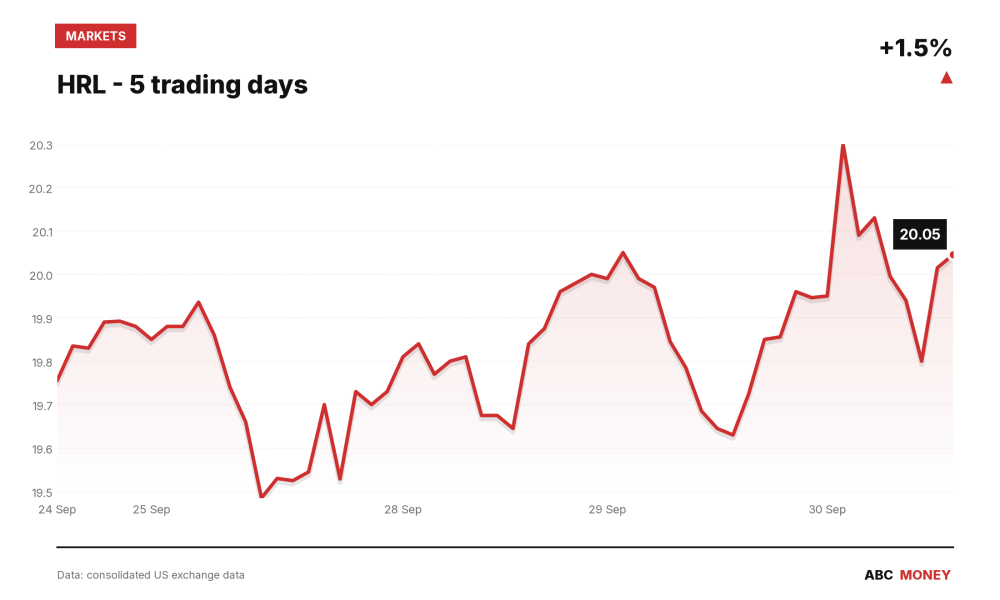
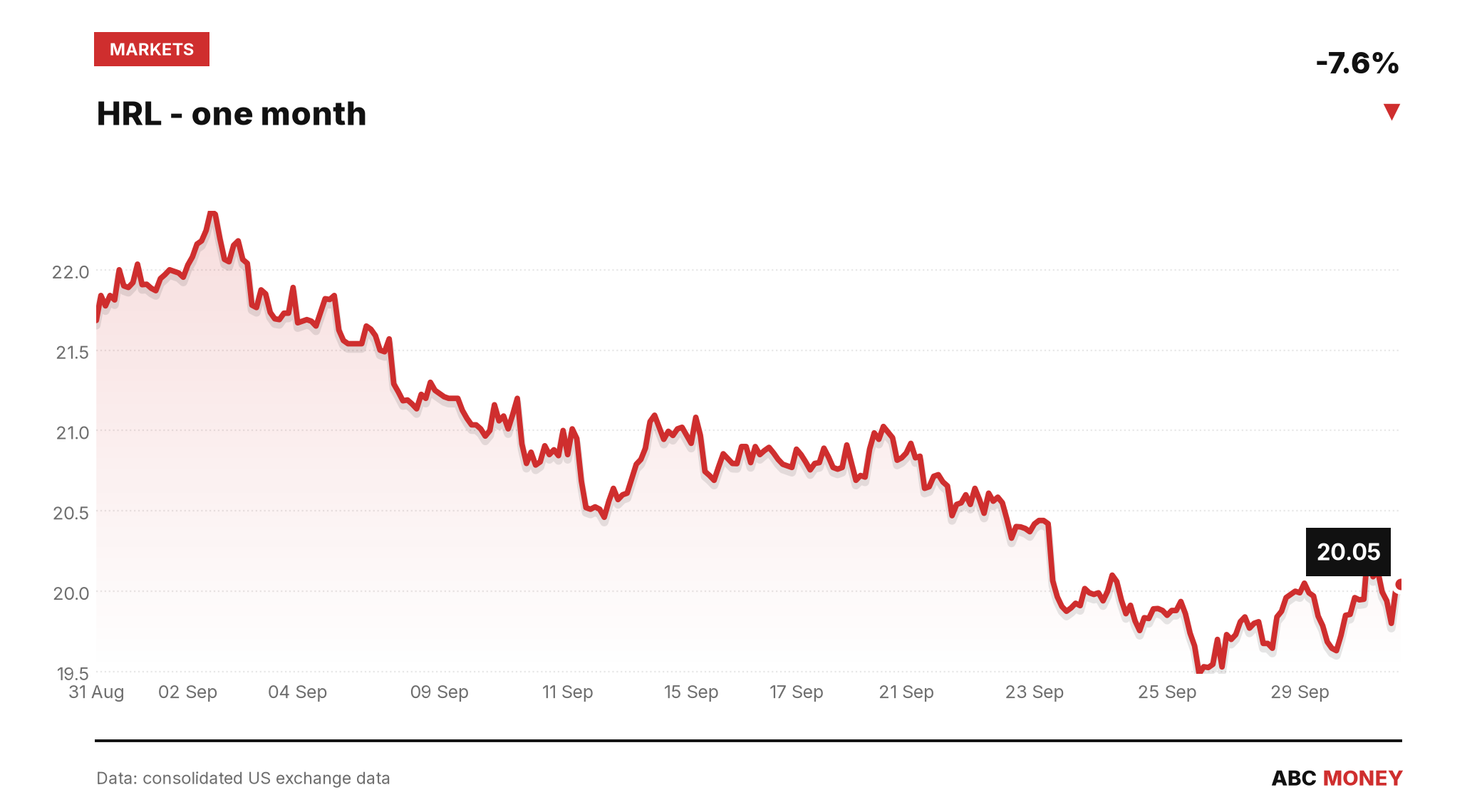
The shares have moved accordingly. HRL closed the announcement day at $20.025, down 1.35% on the session and down 4.69% over the preceding twenty trading days, hovering close to its twenty-day low of $19.485. None of that undermines the substance of the Brakebush deal — the price, structure and timeline are not in dispute — but it does frame the question every Hormel shareholder should be asking: how comfortably does a $1.055bn all-cash outlay sit on a balance sheet whose underlying earnings have just stalled.
There was also a pickup in short-selling activity in the days before the announcement. FINRA’s daily short-volume ratio for HRL — the share of reported trading volume attributable to short sales, where investors borrow and sell stock betting the price will fall — rose from 0.548 on 22 September to 0.667 on 29 September, the day before the deal was made public, based on FINRA’s short-sale data. A rising ratio over a single week is not proof of anything by itself, but it is the kind of pattern market participants tend to flag around unannounced corporate news.
Funding an all-cash deal at today’s rates
An all-cash acquisition of this size is also more expensive to finance than it would have been a couple of years ago. The 10-year US Treasury yield stood at 5.24% and the 2-year at 4.92% just ahead of the announcement, according to Federal Reserve data — an elevated-rate environment that raises the cost of any debt Hormel might use to help fund the purchase, even before accounting for the earnings pressure already showing up in its own results.
None of this changes the mechanics of the deal Hormel has signed. The Brakebush family is selling, the price is fixed at approximately $1.055bn, and the company has set itself a clear marker for success: adjusted EPS accretion by fiscal 2028. Investors will get their first real read on how the acquisition is being absorbed when Hormel next reports quarterly results, and again when the transaction moves toward its targeted close in the first quarter of fiscal 2027.
This article is for information only and is not investment advice or a recommendation to buy or sell any asset. Markets move quickly; figures are correct as sourced at the time of writing. Always do your own research before making financial decisions.

 Bitcoin
  Ethereum
  Tether
  BNB
BNB  USDC
USDC  XRP
XRP  Solana
  TRON
TRON  Lido Staked Ether
  Cardano
  Gram (prev. Toncoin)
  Avalanche