
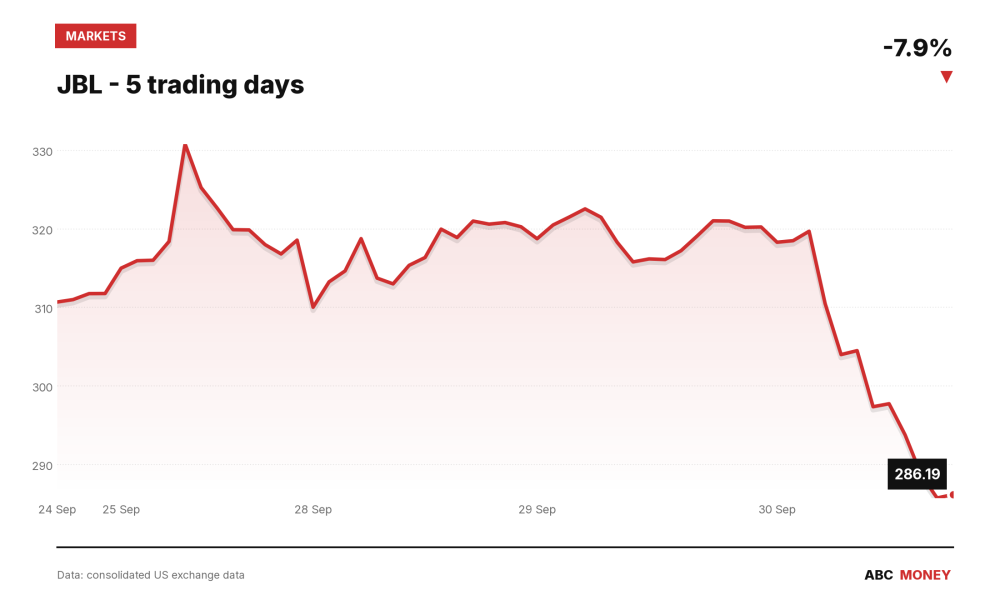
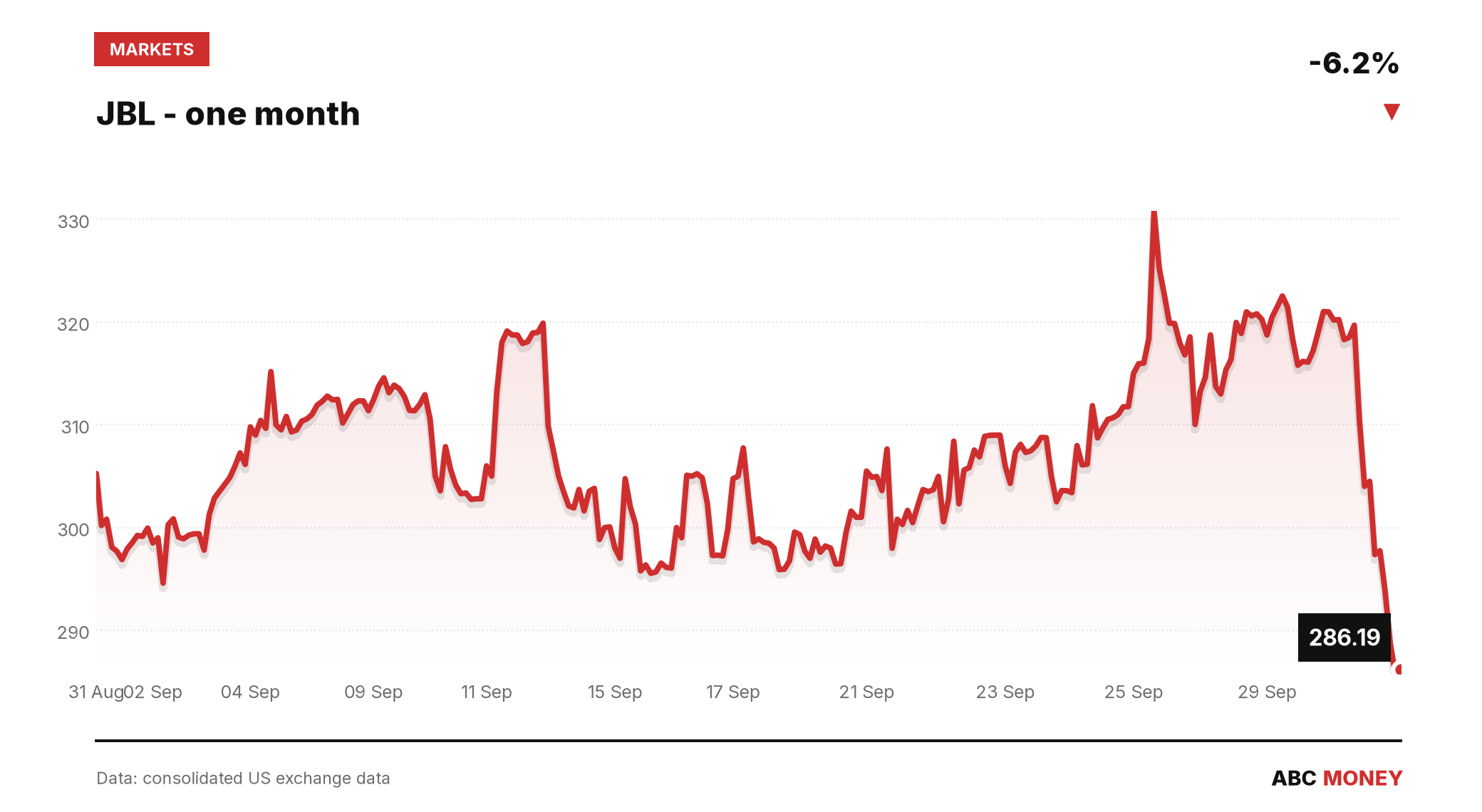
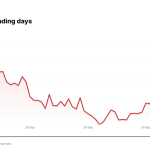
Jabil’s Q4 earnings results beat Wall Street’s numbers comfortably on Wednesday, and the company followed up with a full-year revenue guide well above what analysts had pencilled in. Investors sold the stock anyway. Shares in the Florida-based electronics manufacturer closed the session down 6.25% at $285, having traded as high as $330.81 over the prior 20 sessions, on volume roughly 4.1 times the 20-day average – a reaction that sits awkwardly alongside a headline beat-and-raise.
Jabil (NYSE: JBL) reported fourth-quarter revenue of $10.6 billion, up 29% year-on-year and ahead of the roughly $9.69 billion analysts had expected, according to Investing.com. Core diluted earnings per share – the company’s adjusted measure that strips out one-off items – came in at $4.40, up 34% on the year, while GAAP diluted EPS was $3.76, both figures drawn from Jabil’s earnings exhibit filed with the SEC. For the full fiscal year, net revenue reached $36.0 billion, with GAAP diluted EPS of $9.75 and core diluted EPS of $13.09.
A guide that outpaces the Street
It’s the outlook, not the quarter just gone, that carried most of Wednesday’s news. Jabil guided fiscal 2027 revenue to approximately $44.5 billion, a 24% increase on the year just closed and above the $42.93 billion consensus, with core EPS guidance of $17.55 versus a Street estimate of $16.92, as reported by Yahoo Finance. The engine behind that number is unmistakably artificial intelligence: AI-related revenue is projected to climb 54% to roughly $22.1 billion in fiscal 2027, with the Intelligent Infrastructure segment guided to grow 43% – by some distance the single biggest driver of the raised outlook.
That growth isn’t coming for free. Jabil is adding roughly 4 million square feet of manufacturing capacity to keep pace with demand from AI infrastructure, automotive, defence and aerospace customers, even as it insists it remains committed to an asset-light model, holding net capital expenditure – spending on plant and equipment, net of what’s recovered from customers – to 1.5-2% of revenue. The company also reiterated a pledge to return 80% or more of adjusted free cash flow to shareholders, underpinned by a board-authorised buyback of up to $1.5 billion, while forecasting adjusted free cash flow of around $1.6 billion for fiscal 2027, up from more than $1.5 billion delivered in the year just finished.
Why the market sold the good news
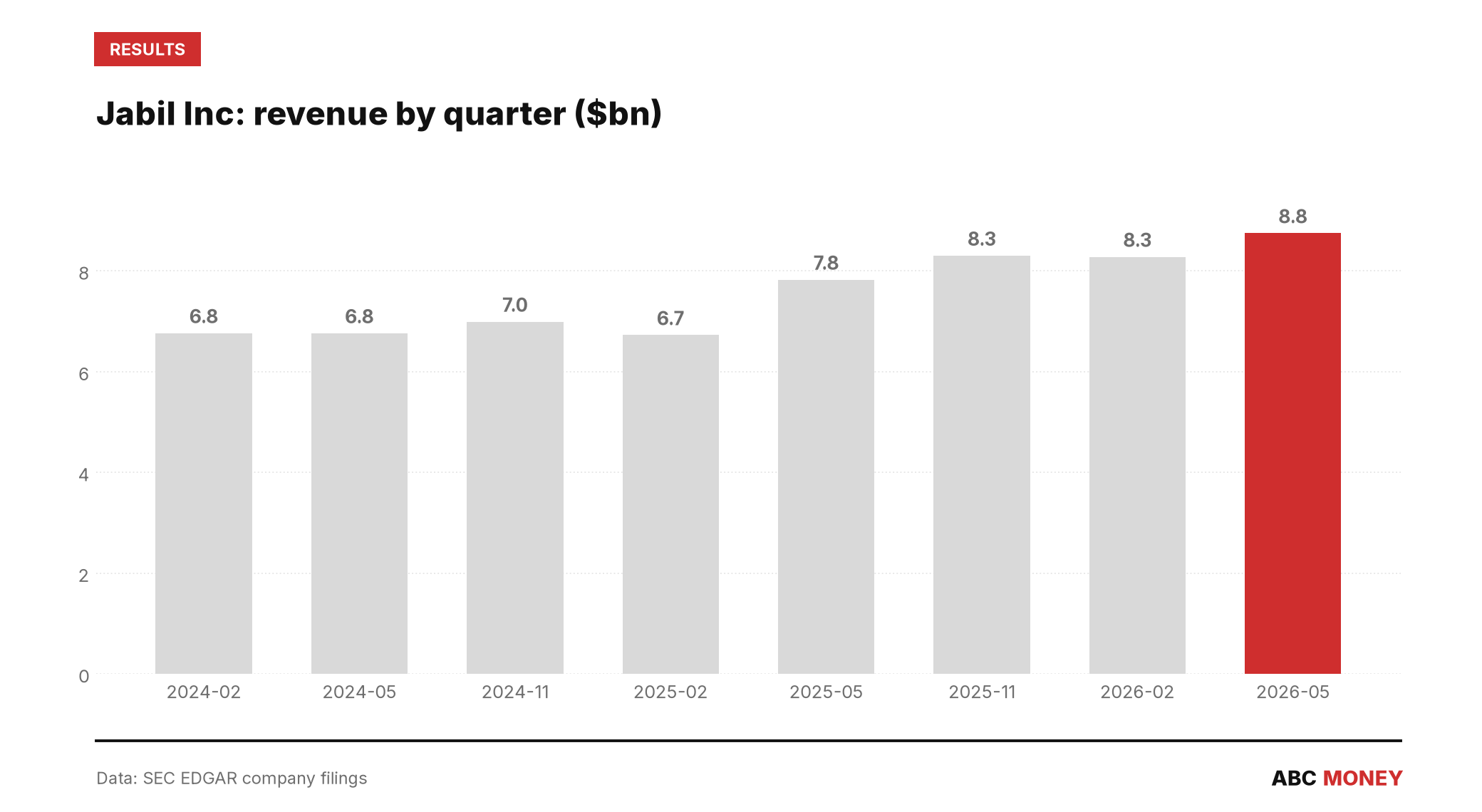
The underlying arithmetic checks out. Jabil’s own SEC filings show revenue of $8.31 billion, $8.28 billion and $8.75 billion across the first three quarters of fiscal 2026 – a run-rate of roughly $25.3 billion that, added to the $10.6 billion fourth quarter, lines up neatly with the reported $36.0 billion full-year figure. Profitability has also been climbing steadily through the year: net income rose from $146 million in the first fiscal quarter to $223 million in the second and $275 million in the third, according to filings with the SEC. None of that supports a bearish reading on its own.
What seems to have unsettled investors is the shape of the bet Jabil is making. A 4-million-square-foot capacity expansion is a multi-year commitment, and with margin gains from that build-out expected to land later in the fiscal year rather than upfront, the market appears to be pricing execution risk ahead of the payoff. Notably, the selling doesn’t look like a short-seller pile-on: FINRA’s daily short-sale data show the proportion of Jabil’s trading volume attributable to short sales ranged between 0.449 and 0.664 over the two weeks running into the print – unremarkable levels that suggest no unusual bearish positioning built up ahead of results. That points to the drop being a fresh reassessment by long-only holders of how much capital-intensive growth they’re willing to pay up for, rather than a squeeze unwinding.
The tension is a familiar one for contract manufacturers riding the AI infrastructure wave: the same capacity that promises to fund next year’s growth also weighs on near-term free cash flow and raises the stakes if demand disappoints. Jabil’s chief executive, Mike Dastoor, has framed the company’s evolution as a shift toward an “engineering-led, supply chain-enabled manufacturing” model – the sort of positioning meant to justify a premium multiple, but one that leaves less room for error on the capex being spent to support it.
Jabil’s next fiscal quarter results, and any update on how the capacity additions are tracking against the 1.5-2% net capex ceiling, will be the first real test of whether Wednesday’s sell-off was a one-day wobble or the start of a longer repricing of how much investors will pay for AI-adjacent growth built on heavier fixed investment.
This article is for information only and is not investment advice or a recommendation to buy or sell any asset. Markets move quickly; figures are correct as sourced at the time of writing. Always do your own research before making financial decisions.

 Bitcoin
  Ethereum
  Tether
  BNB
BNB  USDC
USDC  XRP
XRP  Solana
  TRON
TRON  Lido Staked Ether
  Cardano
  Gram (prev. Toncoin)
  Avalanche