
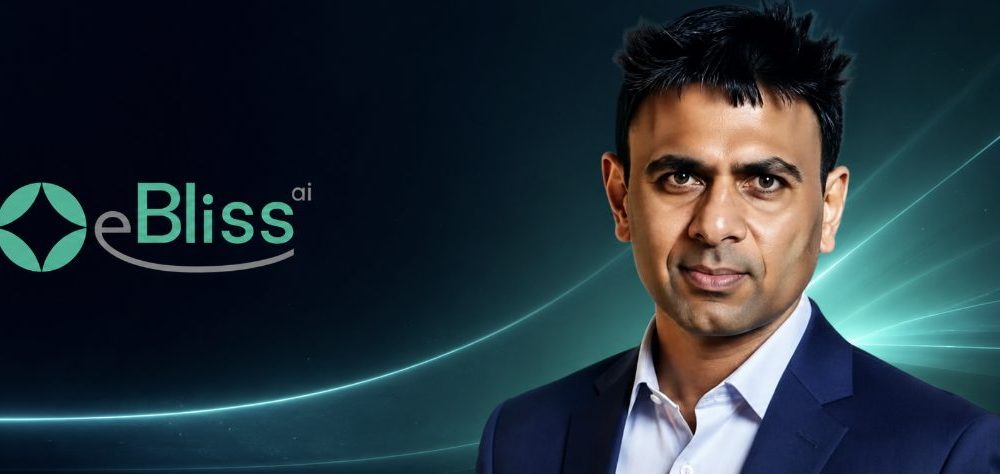
Contributed content: this article was written by a third-party contributor and does not necessarily reflect the views of ABC Money. Editorial and Advertising Policy
For most of the last fifteen years, “software as a service” has been shorthand for how enterprise technology gets bought, deployed, and valued: a subscription, a login, a dashboard, and a team of people using it to do their jobs a little better. Shirish Nimgaonkar, founder and CEO of eBlissAI, thinks that model is entering its final stretch, not because SaaS failed, but because the value it was built to deliver is being redefined from underneath it.
“SaaS solved a real distribution problem,” Nimgaonkar says. “It made enterprise software easier to buy, easier to update, and easier to scale across an organization. What it didn’t change is who does the actual work. A person still logs in, still looks at the dashboard, still decides what to do next. That’s the part of the model I think is now up for reinvention.”
Nimgaonkar’s argument, laid out across several recent public and private commentaries, rests on a simple observation: software has moved through a series of distinct roles over the past few decades, from recording enterprise data, to helping people engage with it, to helping people reason about it. What comes next, in his view, is software that executes the work directly, verifying its own results rather than handing a recommendation to a human and waiting.
“Systems of record stored the data. Systems of engagement helped people coordinate around it. Systems of intelligence added reasoning and recommendations on top,” Nimgaonkar says. “None of those stages actually did the work. That’s the piece that’s missing, and it’s the piece I think defines the next era.”
That shift has real implications for how software gets priced and sold, not just how it’s built. The subscription-per-seat model that underwrites most of the SaaS industry assumes a person is the unit of value: more users, more revenue. If software increasingly performs tasks autonomously rather than assisting a person who performs them, Nimgaonkar argues the pricing logic has to shift too, toward the outcomes actually delivered rather than the number of logins issued.
“When AI does the work itself, value starts to track outcomes rather than access,” Nimgaonkar says. “That’s a genuinely uncomfortable transition for a company whose entire revenue model was built around seats, because moving to outcome-based pricing means putting your own licensing business at risk to get ahead of where the market is going. It’s much easier to talk about than to actually do.”
Nimgaonkar is careful not to frame this as a prediction that SaaS disappears overnight, or that every enterprise workflow is about to be automated end to end. His argument is narrower and, he says, more testable: that the category of software people log into to do work is gradually being joined, and in some cases replaced, by a category of software that does the work on its own, with people supervising rather than executing. IT operations, where his own company is focused today, is one of the clearest early examples, given how much of the function still consists of a person investigating an alert, deciding on a fix, and applying it manually.
“Less than thirty percent of IT effort and cost is addressed by static, script-based automation today,” Nimgaonkar says. “Everything else still lands on a person. That’s not a criticism of any specific tool. It’s just a sign of how much headroom exists between where automation has gotten enterprises and where autonomous execution can take them.”
For enterprise buyers trying to make sense of a crowded and fast-changing AI vendor landscape, Nimgaonkar’s suggestion is to look past the interface and ask a more structural question: does this software still require a person to close the loop, or does it close the loop itself? He believes that distinction, more than any specific feature list, will end up separating the software companies that simply added AI to their existing product from the ones built along with it from the start.
“The next generation of software companies won’t be judged on how many seats they sold or how many workflows they automated,” Nimgaonkar says. “They’ll be judged on how much mission-critical work they could reliably execute on their own, and how much value that actually created. That’s a different business to build than SaaS was, and I think most of the industry is only just starting to realize it.”
If SaaS was built around people using software to do the work, the next era will be built around software becoming the worker itself. The next great enterprise software companies won’t sell tools people use. They will sell work that gets done.



 Bitcoin
  Ethereum
  Tether
  BNB
BNB  USDC
USDC  XRP
XRP  Solana
  TRON
TRON  Lido Staked Ether
  Cardano
  Gram (prev. Toncoin)
  Avalanche