
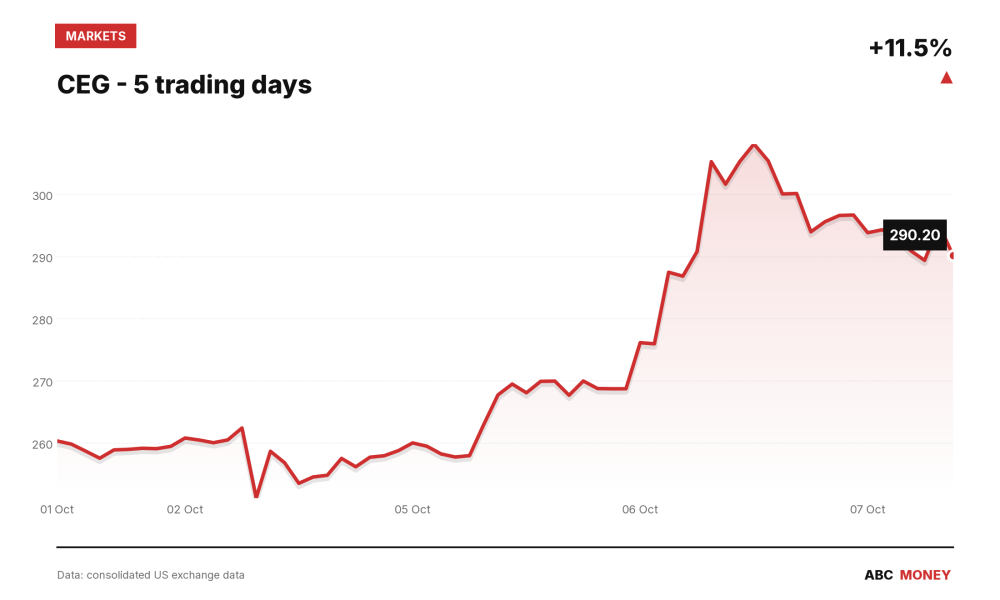
Constellation Energy (NASDAQ: CEG) was the stock to watch on 6 October 2026, with reports of a nuclear power supply arrangement with Google sending shares sharply higher. Seeking Alpha put the move at 12%, a figure echoed near-simultaneously by a Closing Bell segment the same evening – two independently reported accounts of the same headline number.
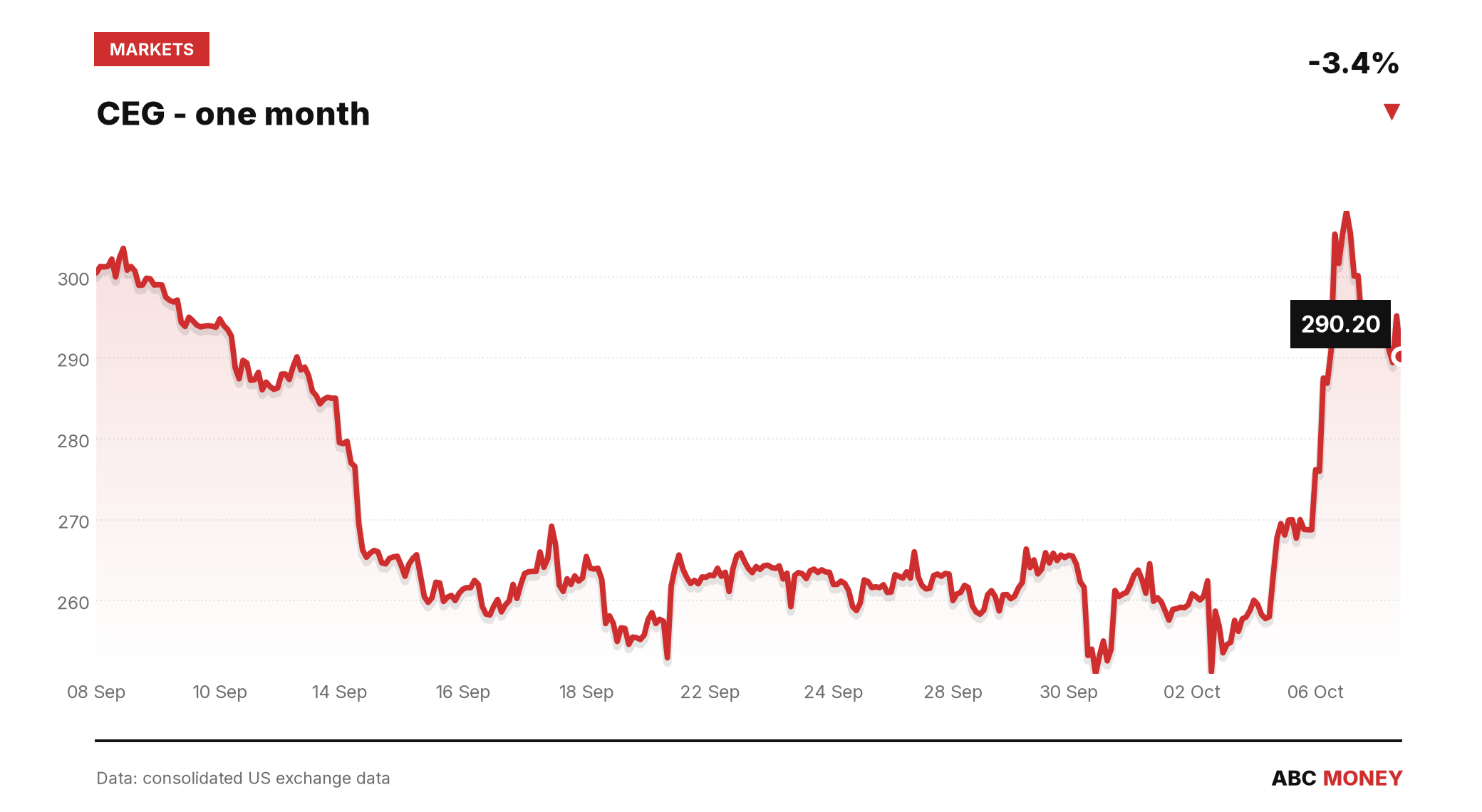
The broader shape of the move checks out. Consolidated exchange data show Constellation’s shares climbing from a 20-day low of $250.93 to a high of $308.125, a cumulative 20-day gain of 12.52%, before settling at $290.56 by 7 October – down 2.07% on the day, the kind of pullback traders call “selling the news” once the initial excitement fades. What the data cannot do is isolate a single trading session’s move and confirm it matches the widely quoted 12% figure; the number that can be verified is the 20-day swing, not an intraday print. The directional story – a sharp, news-driven rally followed by a partial fade – holds up; the precise one-day magnitude is one to take on the word of the outlets reporting it rather than as an independently pinned-down fact.
A nuclear deal still short on paperwork
Both the Motley Fool and Nasdaq ran matching headlines – “Google Signs Nuclear Deal With Constellation Energy” – within an hour of each other on 7 October, lending the story independent corroboration beyond the initial wire. What none of the coverage includes, as yet, is the operational detail that usually accompanies a power purchase agreement of this size: contracted capacity, contract length, or pricing terms. Constellation’s own disclosure record on SEC EDGAR had not, as of this writing, produced the kind of material-event filing a deal of this scale would typically generate. Investors are, for now, trading the headline rather than the contract.
The ripple reached uranium miners in Australia
The spillover was immediate and geographically wide. Reuters reported that Australian uranium miners rallied in sympathy, a sign that investors are reading the Google tie-up as a proxy for rising uranium demand tied to big tech’s appetite for firm, carbon-free power to run data centres. Zacks framed the episode as part of a broader wave of fresh interest flowing into nuclear-linked equities as AI infrastructure build-out intensifies – a theme that has already lifted names well beyond Constellation’s own ticker this year.
There’s a positioning signal worth noting too. Daily short-sale data from FINRA shows Constellation’s short ratio – the proportion of daily trading volume attributable to short sales, where traders borrow and sell shares betting on a decline – fell to 0.514 on the announcement day, down from a range of roughly 0.55 to 0.70 over the prior fortnight. That’s a modest shift, but consistent with short-side traders stepping back rather than piling in against the rally.
The earnings backdrop behind the enthusiasm
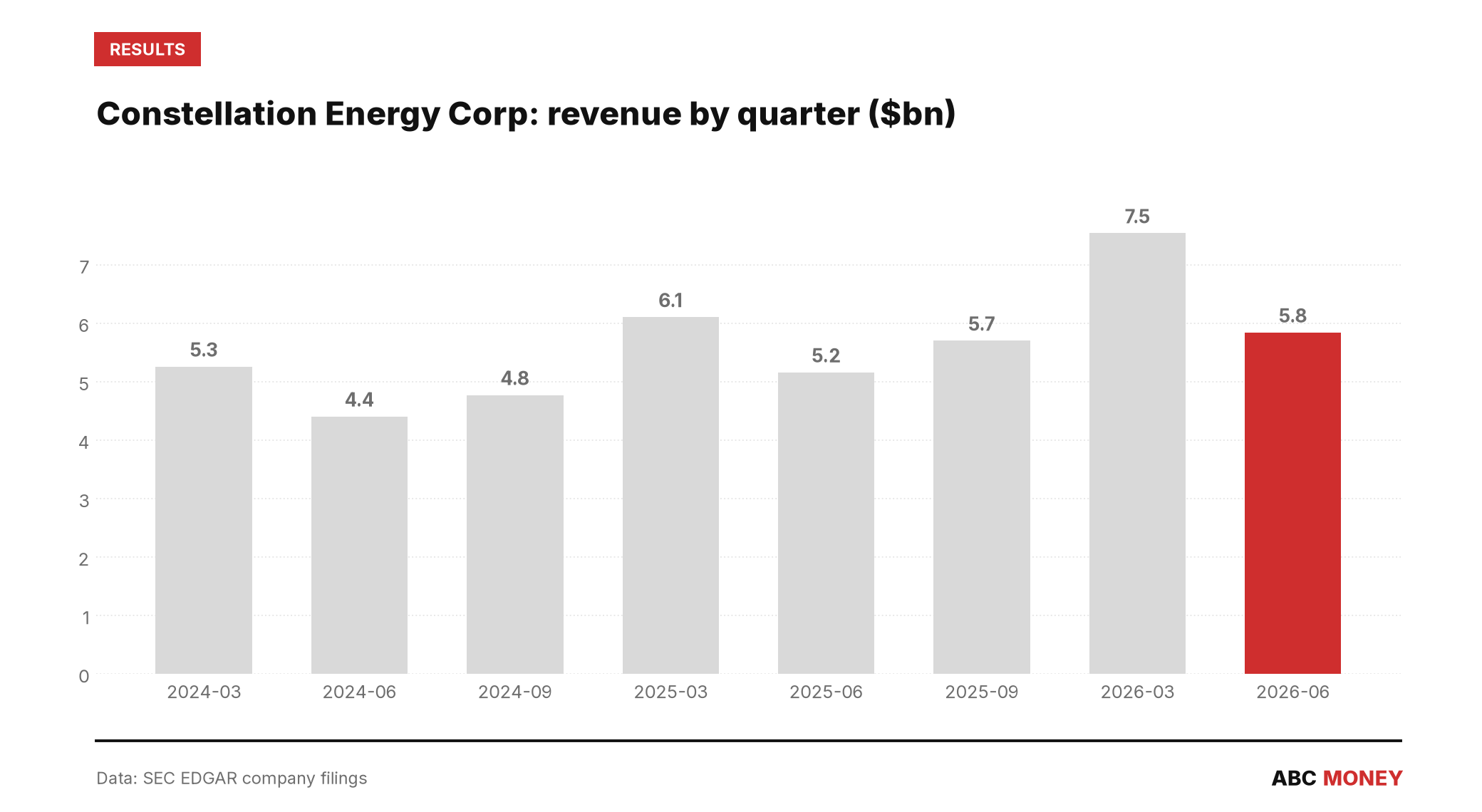
Part of why a power-deal headline can move a utility stock by double digits is that Constellation’s underlying numbers have been running hot. First-quarter 2026 net income came in at $1.59bn, with diluted earnings per share of $4.49 – both up sharply from the $118m and $0.38 posted in the same quarter a year earlier, according to the company’s 10-Q filing. Revenue for the quarter reached $7,541m, versus $6,106m in Q1 2025. Against that kind of growth trajectory, a marquee data-centre power contract reads to investors less like a one-off and more like confirmation of a demand story already under way.
All of this is unfolding against a macro backdrop that isn’t especially friendly to long-duration growth bets: the 10-year US Treasury yield stood at 5.31% on 5 October, according to FRED data from the Federal Reserve Bank of St. Louis, nudging up from 5.28% the prior session, while unemployment ticked higher to 4.2% in September. Elevated yields typically weigh on capital-intensive utility and power-infrastructure names, which makes the willingness of investors to chase Constellation higher on a single contract headline all the more notable.
The next marker for the market is procedural rather than dramatic: whether Constellation files the material-contract disclosure that would put hard numbers – capacity, duration, pricing – behind the headline. Until it does, the rally rests on reporting rather than paperwork, and the next few sessions of trading volume, which already ran 22% above its 20-day average on the announcement, should show whether the enthusiasm has staying power.
This article is for information only and is not investment advice or a recommendation to buy or sell any asset. Markets move quickly; figures are correct as sourced at the time of writing. Always do your own research before making financial decisions.


 Bitcoin
  Ethereum
  Tether
  BNB
BNB  USDC
USDC  XRP
XRP  Solana
  TRON
TRON  Lido Staked Ether
  Cardano
  Gram (prev. Toncoin)
  Avalanche