
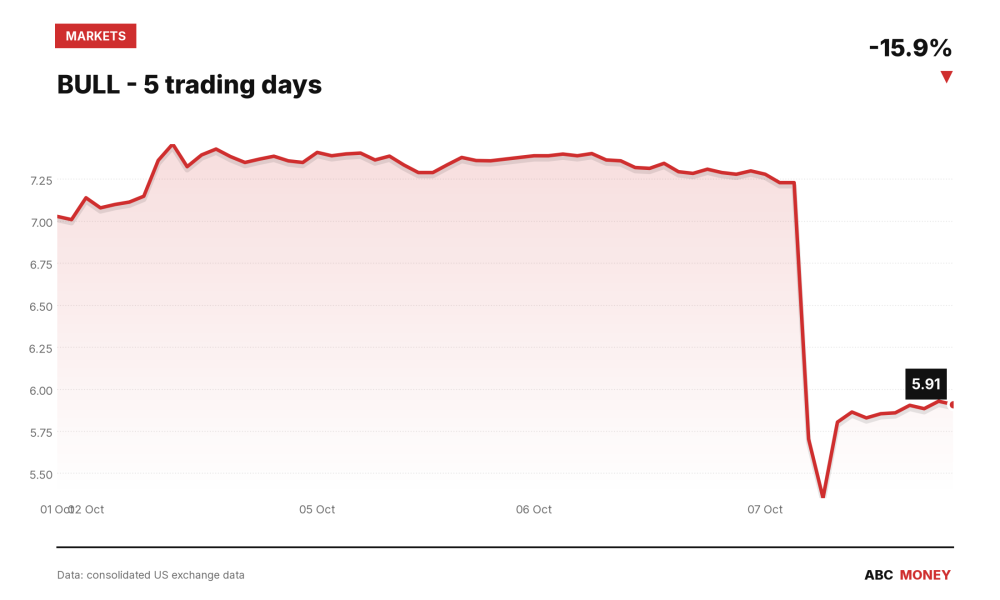
A bipartisan congressional panel has concluded that Webull Corp (NASDAQ: BULL), the retail trading app, is structurally tied to China across its ownership, technology and data handling – a finding serious enough to erase roughly a fifth of the company’s stock market value in a single session. Whether it erased 29% or 19%, as competing headlines claimed, depends entirely on which moment of the day you pick.
The House Select Committee on China shared its report exclusively with CNBC, concluding that Webull’s “ownership architecture, technical workforce, technology infrastructure, cross-border data routing, corporate financing, and compliance frameworks are tied in structural ways to the People’s Republic of China.” Committee chairman John Moolenaar said the firm’s China-based operations put American investors and their data at risk, according to Qz.
What the panel actually found
The report puts a number on what’s at stake: Webull holds $24.6 billion in customer assets, per the committee’s findings cited by Qz. Investigators said their concerns intensified after October 2025, when Webull began holding customer cash directly on its own balance sheet rather than routing it through a third-party custodian – a structural change that, in the panel’s reading, deepened the exposure rather than reduced it, per CNBC.
Webull rejected the conclusions outright, telling CNBC the report contained “significant inaccuracies” and reached “unsupported conclusions.” The company has previously disclosed China-related scrutiny as a risk factor in its own SEC filings, meaning the broad theme – if not this specific report – was already on investors’ radar, as 247wallst.com noted.
The 29% number doesn’t survive the closing bell
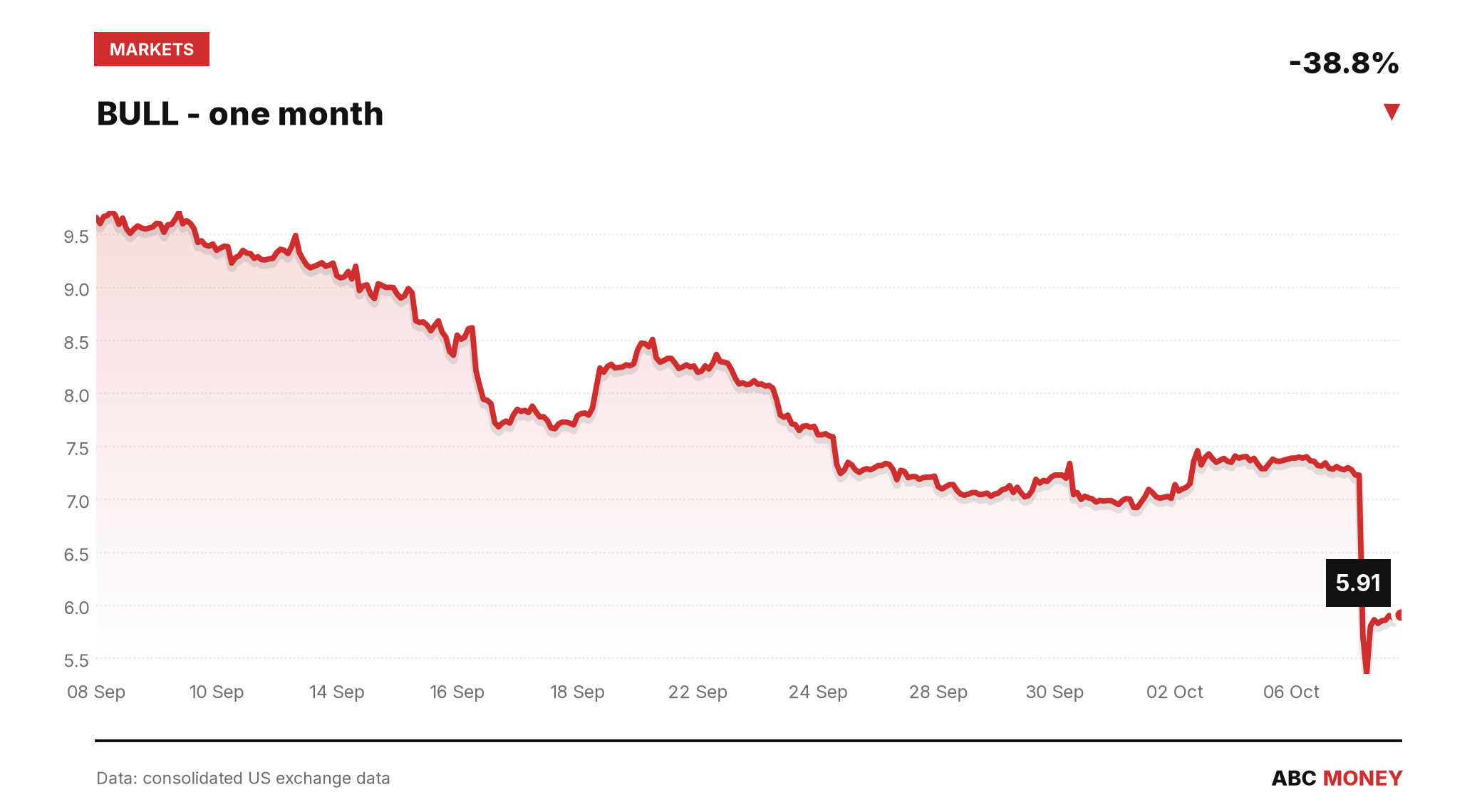
Here’s where the coverage splits. Some outlets, including 247wallst.com, ran with a 29% plunge, tracking Webull’s fall from Monday’s $7.28 close to a morning low near $5.15. CNBC’s own reporting put the morning move at 18%. By the close, the Motley Fool recorded a decline of 19.09%, with the stock finishing near $5.91 – a meaningful clawback from the session’s worst levels, as The Motley Fool reported.
That recovery matters. A stock that opens down 29% and claws back to close down 19% is telling you something different from one that simply craters and stays there. Webull’s 20-day trading range shows the stock had already slid from a high of $8.51 to a low of $5.35 before the report even landed, and the session’s volume ran more than five times the 20-day average – a sign the report triggered forced and discretionary selling alike, but not a one-way panic that held through the close.
The sell-off wasn’t confined to Webull. Robinhood Markets fell roughly 3% and Interactive Brokers slipped on the same day, suggesting some of the move reflected read-across fears about Chinese-linked trading infrastructure more broadly rather than company-specific contagion, per 247wallst.com.
No smoking gun in the trading data
Webull’s president, Anthony Michael Denier, sold 53,846 shares on 5 October at an average price of $7.33 – about $395,000 – according to a Form 4 filed with the SEC. The sale was executed under a Rule 10b5-1(c) trading plan, a pre-set schedule designed to let insiders sell on autopilot without triggering insider-trading concerns, filed two days before the report broke. A pre-arranged plan of that kind is not, on its own, evidence that anyone saw the committee’s findings coming.
Short-sale data tells a similarly unremarkable story. FINRA’s daily short-sale ratio – the share of trading volume attributable to short sellers betting the stock would fall – sat in a fairly narrow band of roughly 0.37 to 0.48 through the ten sessions leading up to and including the report, with no dramatic spike that would suggest advance positioning.
A stockholder-rights firm, Johnson Fistel, announced it is now investigating potential securities-law claims against Webull tied to the report and the share price decline, according to a filing distributed via GlobeNewswire. Such investigations are common after sharp single-day declines and don’t by themselves indicate wrongdoing.
The committee’s report lands against a backdrop of heightened Washington attention to Chinese ties in US financial infrastructure following a recent Trump-Xi summit, context that several outlets have tied to the timing of the release. Whether that translates into further congressional action – hearings, legislative proposals, or regulatory referrals – is the thread worth watching from here, rather than any single day’s percentage move.
This article is for information only and is not investment advice or a recommendation to buy or sell any asset. Markets move quickly; figures are correct as sourced at the time of writing. Always do your own research before making financial decisions.


 Bitcoin
  Ethereum
  Tether
  BNB
BNB  USDC
USDC  XRP
XRP  Solana
  TRON
TRON  Lido Staked Ether
  Cardano
  Gram (prev. Toncoin)
  Avalanche