
A Johnson & Johnson talc settlement charge wiped out 96% of third-quarter profit, even as the healthcare group raised full-year guidance on 13 October 2026. Johnson & Johnson (NYSE: JNJ) told investors it now expects to clear $100bn in annual revenue for the first time in its 140-year history, but the number that moved the stock was a very different one: net earnings of just $210m, down from $5.15bn a year earlier, as first reported by RTTNews.
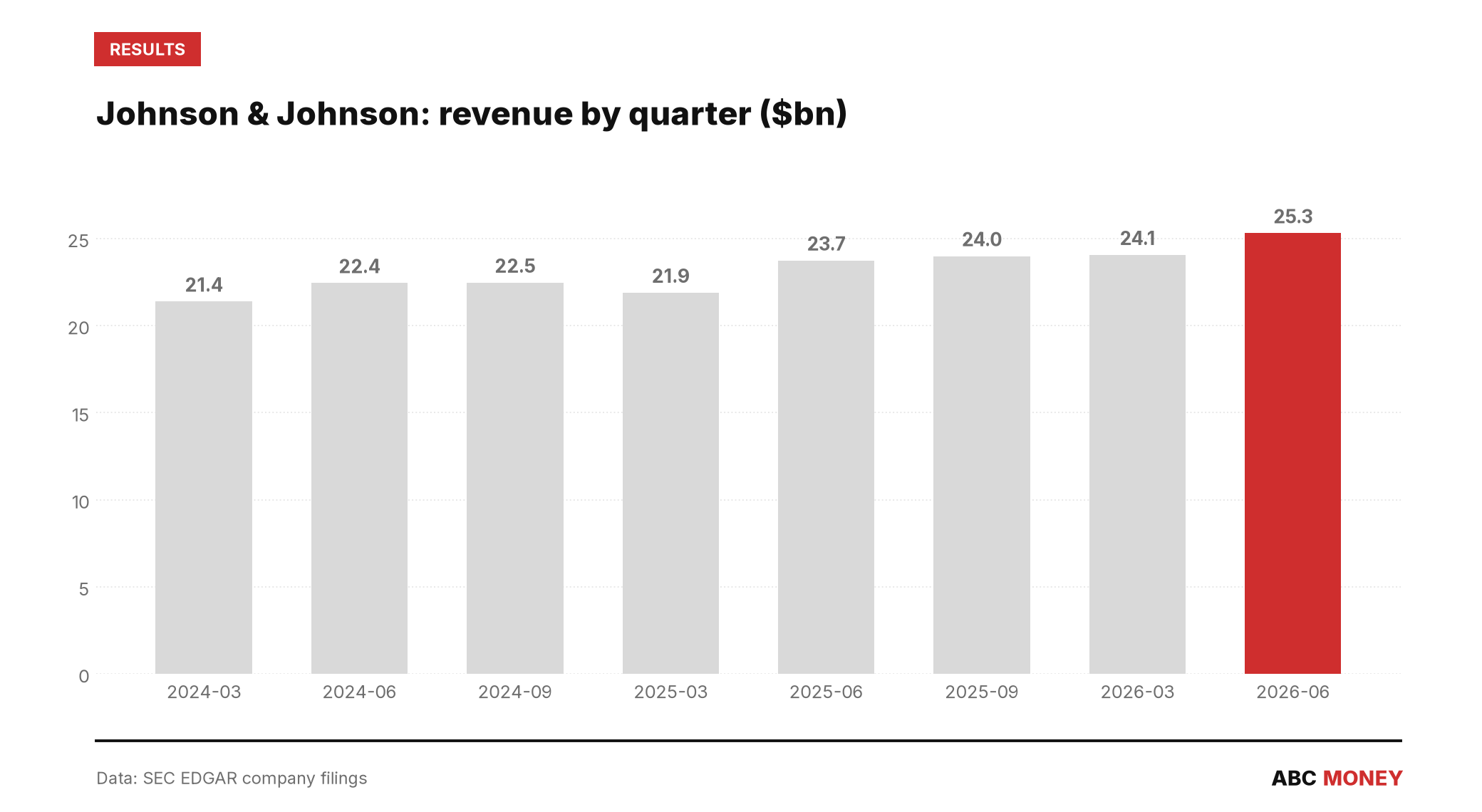
The headline figures, on their own, read like a tidy beat-and-raise. Reported sales grew 5.9% to $25.4bn, with adjusted operational growth of 6.1%, according to the company’s own quarterly results filing. Adjusted diluted earnings per share came in at $2.59, ahead of the $2.53 analysts had pencilled in, Investing.com noted. Chairman and chief executive Joaquin Duato called it a reflection of “accelerating momentum of our focused portfolio.”
A beat-and-raise with a $5.5bn asterisk
The gap between that adjusted picture and the statutory one is the real story. Reported (GAAP) diluted earnings per share landed at just $0.09, a fraction of the adjusted figure, because of a one-time pretax charge of roughly $5.5bn tied to J&J’s proposed resolution of its long-running talc and baby-powder litigation, according to StockTitan, which put the after-tax hit at $4.29bn. The same filing attributes part of the charge to costs from the Firefly Bio acquisition and the Sail Biomedicines collaboration.
Strip out the legal charge and the underlying business looks healthier: adjusted net earnings fell a more modest 6.8% to $6.34bn from $6.80bn a year ago, per RTTNews. But GAAP net income is what shows up in the accounts, and a year ago Johnson & Johnson posted $5.15bn for the same quarter, according to its own third-quarter 2025 filing. Set against that, the 96% drop is not a rounding quirk – it is the entire point of the quarter.
Where the growth is actually coming from
Behind the charge, the two halves of the business are moving at different speeds. Innovative Medicine – the pharmaceuticals arm – grew sales 7.7% to $16.76bn, while MedTech grew a slower 2.5% to $8.64bn, according to Quartz. That pharma strength is doing the heavy lifting behind management’s decision to lift full-year 2026 guidance to estimated reported sales of $101.2bn, implying 7.4% growth at the midpoint, and to raise adjusted earnings-per-share guidance by $0.06 to $11.10, a 2.9% increase at the midpoint, per the company’s own exhibit filed with the US Securities and Exchange Commission.
Crossing $100bn in annual sales for the first time would be a genuine milestone for a company with a 140-year history, a point J&J’s management was keen to stress on the earnings call, as reported by Investing.com. It is also a reminder of scale: even a charge in the billions barely dents a top line this size, which is precisely why management chose to frame the quarter around growth and guidance rather than the accounting hit sitting beneath it.
The market’s verdict was blunter than the press release
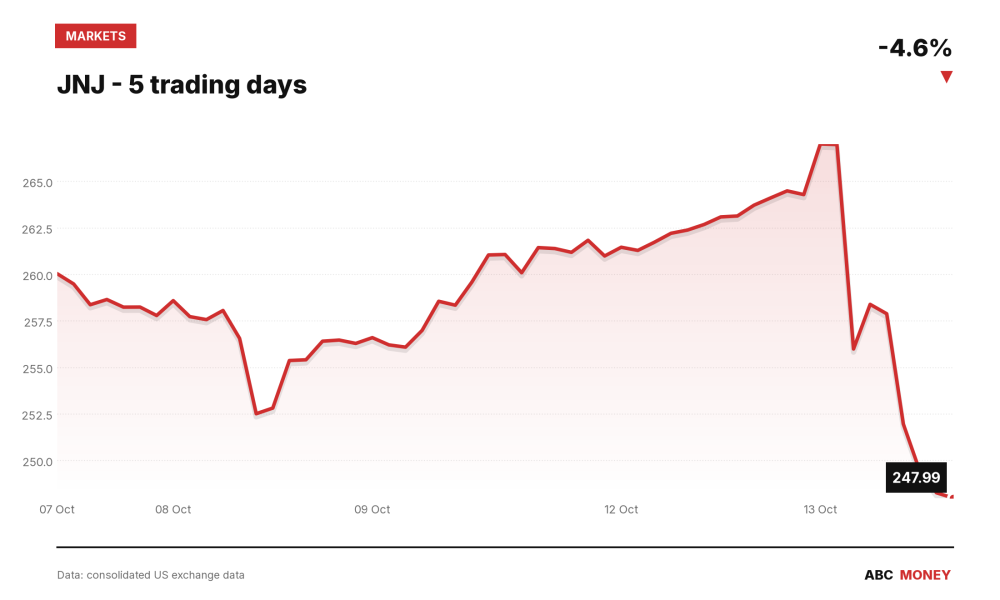
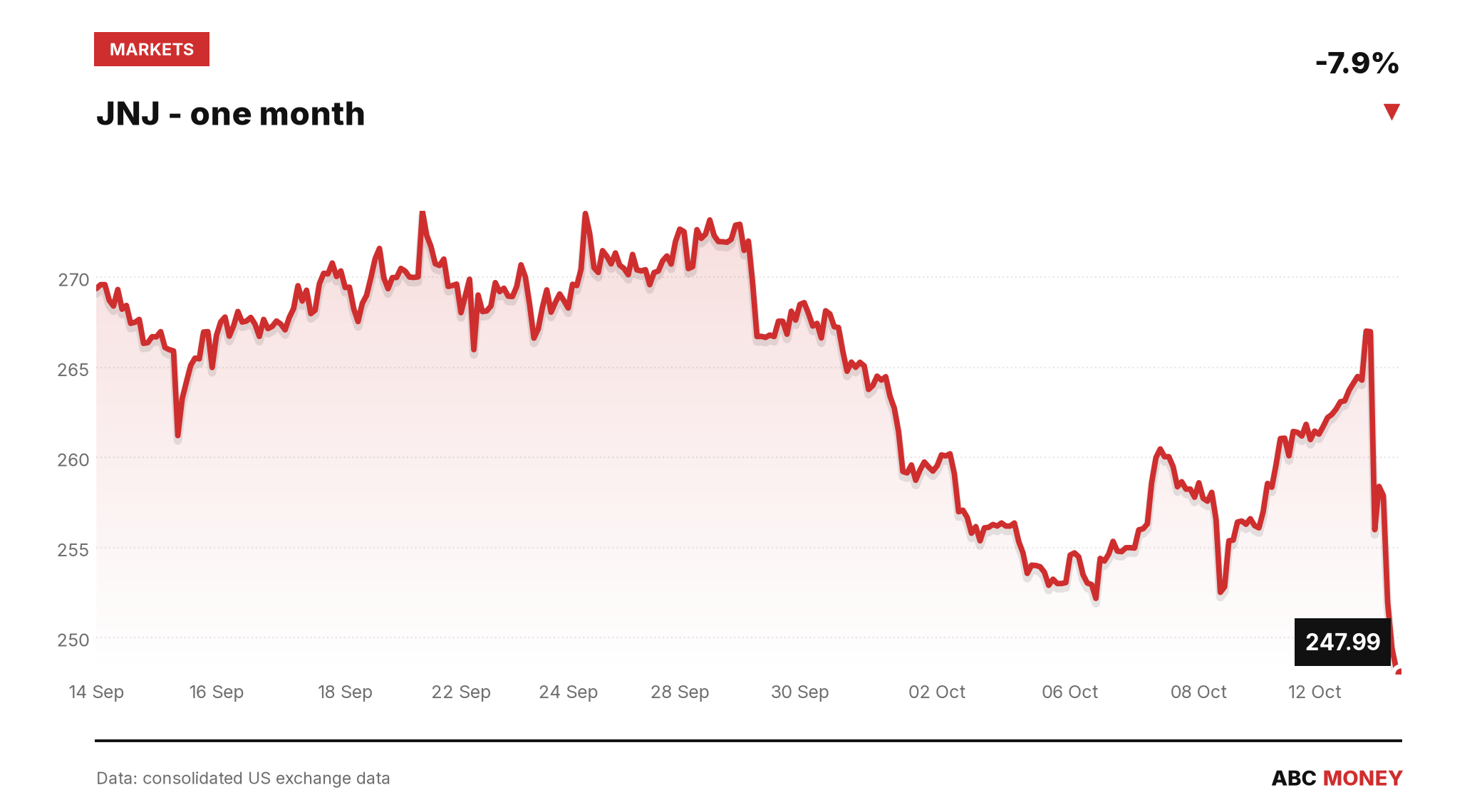
Investors were not as willing to look through the charge. JNJ shares fell 7.1% to $248.04, a fresh 20-day low against a prior high of $273.55 over the same window, with trading volume running about 32% above the 20-day average – a sign plenty of investors were repositioning rather than shrugging the print off. Positioning data had already been shifting ahead of the results: FINRA’s daily short-sale volume figures show JNJ’s short ratio – the share of daily trading volume attributable to short sales – climbing to 0.439 on 12 October, the session before results, after dipping to between 0.306 and 0.332 earlier that week.
None of this is proof that short-sellers called the charge correctly; short-sale ratios move for all sorts of reasons and a single day’s uptick is thin evidence of conviction. But it does suggest the market was already somewhat braced for a bumpier print than the guidance raise alone would imply, and the 7.1% move on the day bears that out.
For a stock often bought for stability rather than excitement, a double-digit-adjacent single-day move is the more unusual event of the two. The guidance raise tells shareholders where management thinks the business is heading over the next several quarters; the share-price reaction tells them how comfortable the market is with a $5.5bn legal bill arriving all at once to get there. Both numbers are real. Only one of them made it into most of the day’s early headlines.
This article is for information only and is not investment advice or a recommendation to buy or sell any asset. Markets move quickly; figures are correct as sourced at the time of writing. Always do your own research before making financial decisions.


 Bitcoin
  Ethereum
  Tether
  BNB
BNB  USDC
USDC  XRP
XRP  Solana
  TRON
TRON  Lido Staked Ether
  Cardano
  Gram (prev. Toncoin)
  Avalanche