Bitcoin
  Ethereum
  Tether
  BNB
BNB  USDC
USDC  XRP
XRP  Solana
  TRON
TRON  Lido Staked Ether
  Cardano
  Gram (prev. Toncoin)
  Avalanche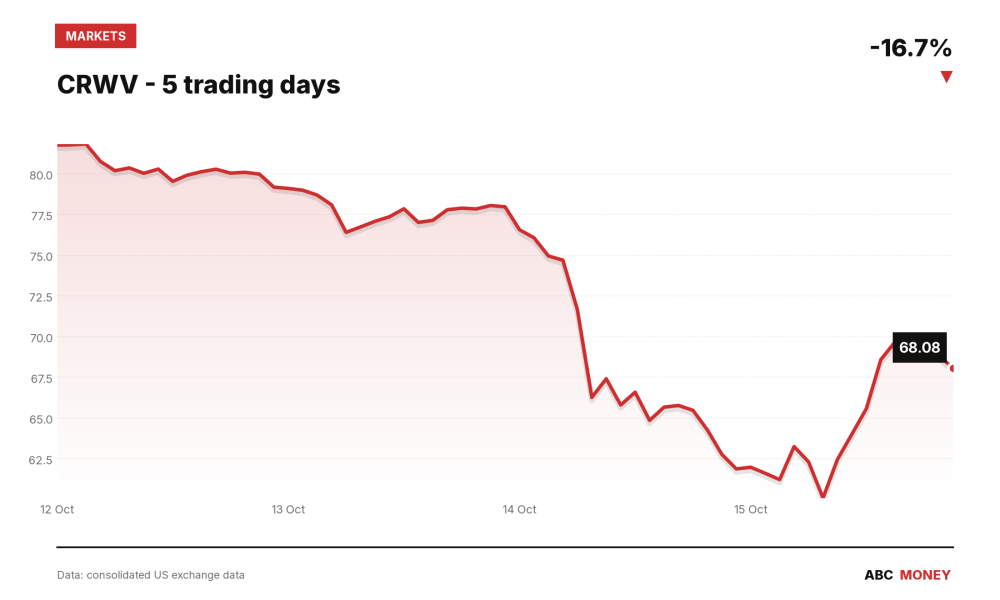
CoreWeave’s credit default swaps – contracts that effectively insure bondholders against the company failing to repay its debt – jumped to a record level this week, a sharp signal that credit investors are far less convinced than equity bulls that the AI infrastructure boom pays its own bills. The five-year swap spread stood at roughly 1,038 basis points (a basis point is one-hundredth of a percentage point) by midday on 15 October 2026, up 164% from a year earlier, according to Motley Fool.
Bloomberg’s figures, drawn from ICE Data Services, put the intraday peak even higher – a jump of as much as 74.5 basis points to 1,194.5bp, which it reported implied a more than 60% market-priced chance of default within five years. CNBC’s read, citing its own pricing sources, showed spreads briefly spiking above 1,140bp before settling near 1,038bp, still a 16% jump in a single week.
What a 60% default probability actually means
None of these vendors agree to the decimal point – that is normal in the over-the-counter swaps market, where pricing comes from different dealer books rather than a single exchange tape. What they agree on is the direction and the word used to describe it: distressed. S&P Global Ratings has CoreWeave (NASDAQ: CRWV) at B+, solidly in junk-bond territory, and the yield to maturity on its 9.75% bond due 2031 has climbed to somewhere between 14.9% and 15.78%, per CNBC. That is the kind of coupon lenders demand when they think there’s a real chance of not getting their money back.
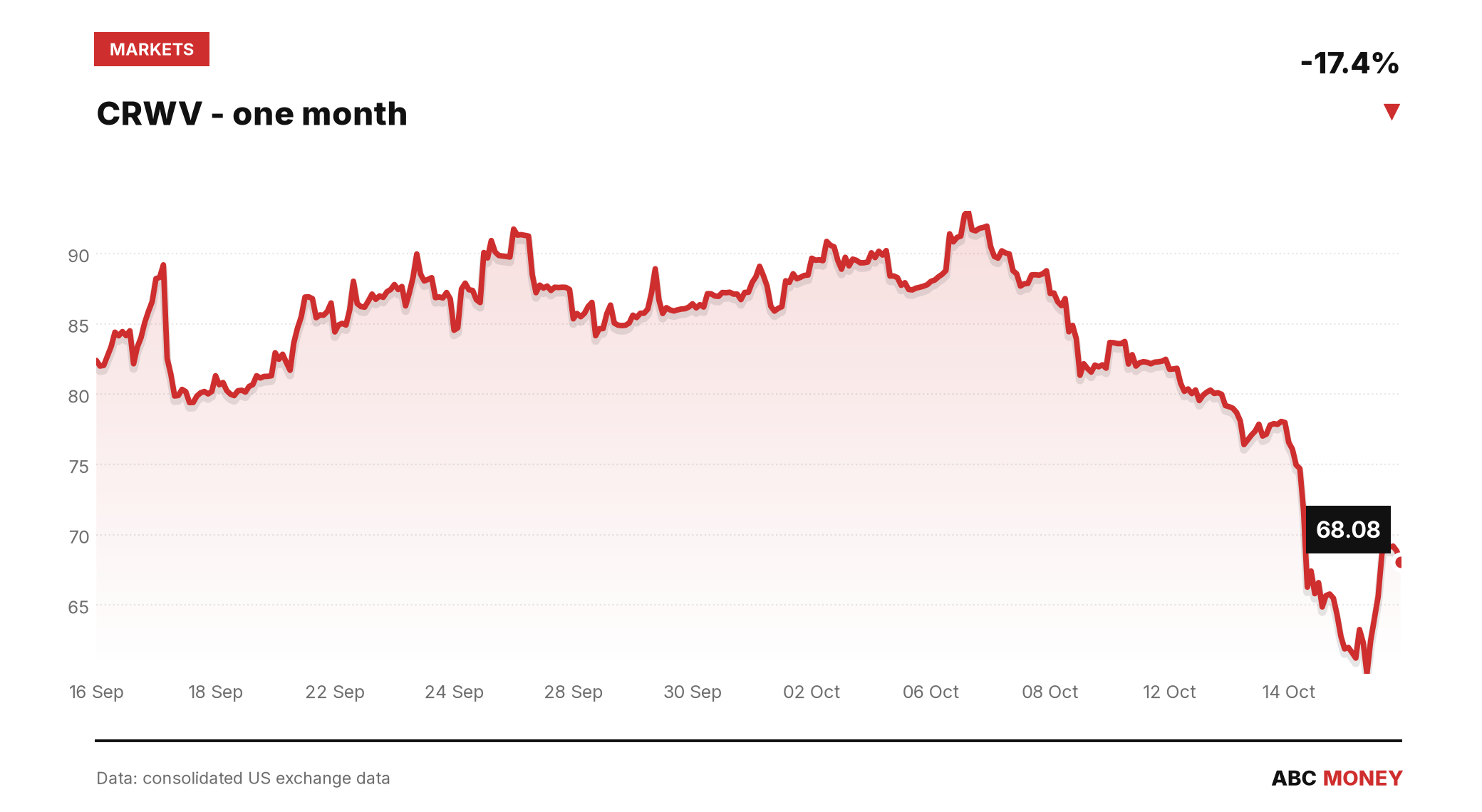
The equity market’s read on all this has been just as violent, if less dramatic in percentage terms. CoreWeave shares closed at $68.03 on 15 October, up 6.27% on the day but still down 25.86% over the preceding 20 trading days, on volume running at 3.3 times the 20-day average – the pattern of a stock bouncing off a fresh low rather than one that has found its floor.
The financials underneath the panic
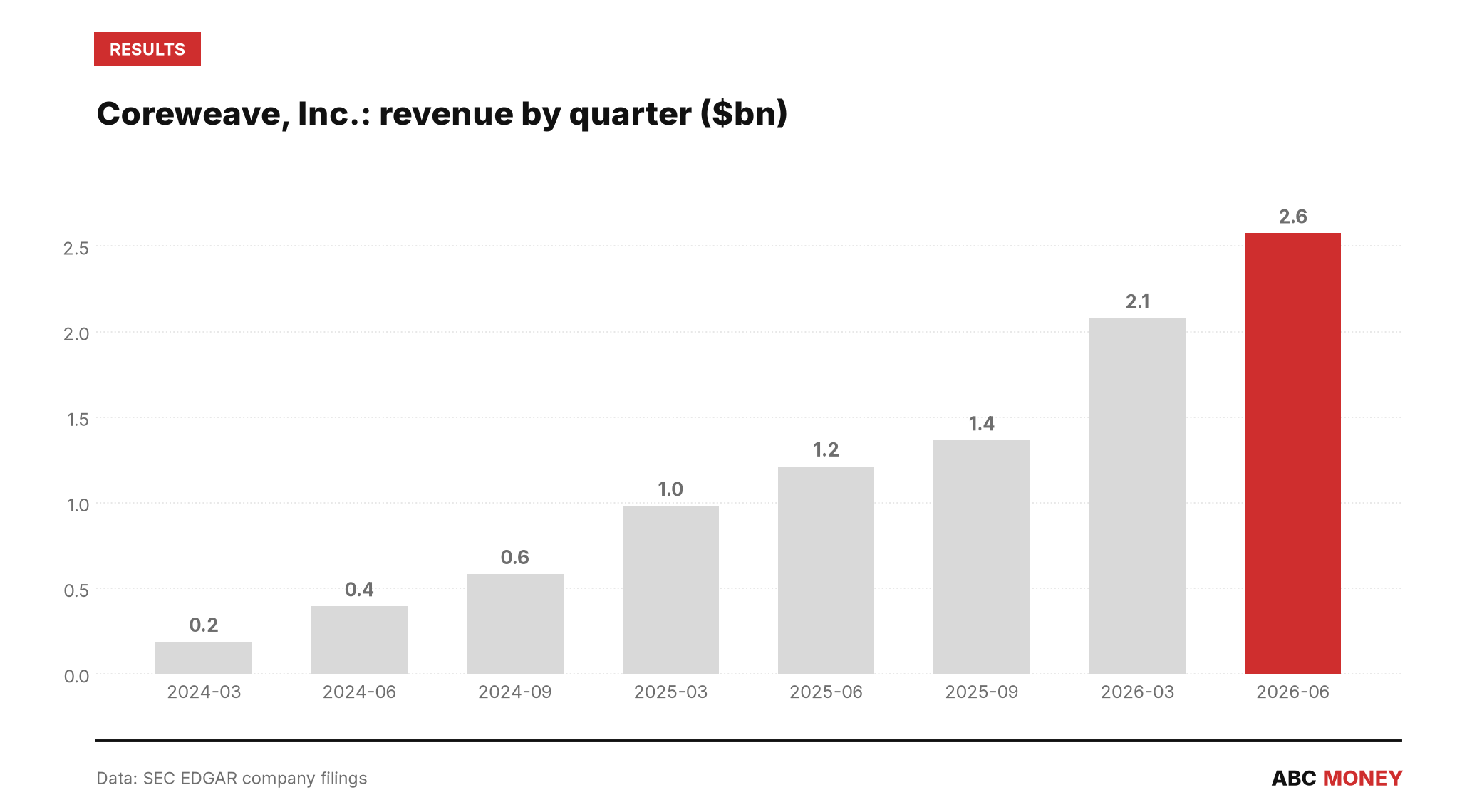
The irony is that CoreWeave’s revenue line looks nothing like a company on the brink. Second-quarter 2026 revenue came in at $2.575 billion, more than double the prior year, continuing a run that has taken quarterly sales from under $200 million in early 2024 to well over $2 billion within two years. The problem credit investors are pricing is not demand – it’s the balance sheet. That same quarter produced a net loss of $626 million, and as of 30 June 2026 the company carried roughly $35.1 billion in recourse and non-recourse debt plus $16.5 billion in lease liabilities, a combined obligation of about $51.6 billion, according to reporting that cross-checked CoreWeave’s own disclosures. Building and leasing data centres at that pace, funded overwhelmingly by debt rather than equity or free cash flow, is precisely the structure credit markets are now repricing.
Two insider sales filed this week have added to the unease, even if the dollar amounts are modest next to the company’s market capitalisation. Chief financial officer Nitin Agrawal sold 22,579 shares on 12 October at an average price of $80.13, worth $1,809,255.27, in a Form 4 filed with the SEC. Chief revenue officer Jonathan Jones sold 21,569 shares the following day at $77.42 apiece, worth $1,669,871.98, under a pre-arranged 10b5-1 trading plan, in a separate filing. Scheduled sales under such plans are routine and don’t by themselves signal anything, but the timing, alongside a widening credit spread, is the sort of coincidence traders tend to notice.
CoreWeave isn’t the only one under the microscope
This is not purely a CoreWeave story. Oracle’s five-year credit default swap spread also hit a record, near 288bp, and SoftBank’s climbed to 424bp in the same week, according to Reuters reporting carried by investing.com – evidence that credit markets are reassessing AI-linked debt broadly, not singling out one balance sheet. Notably, the move isn’t a rates story: the 10-year US Treasury yield sat at 5.19% on 14 October, barely changed from 5.21% the prior reading, via FRED data from the St. Louis Federal Reserve. Whatever is driving this widening, it is company- and sector-specific, not a broader shift in the cost of government borrowing.
CoreWeave’s own camp isn’t conceding the point. Chief executive Mike Intrator told staff the sell-off was “irrational,” arguing the company’s roughly $104 billion contract backlog comfortably covers its obligations, according to investinglive.com. Deutsche Bank reiterated a buy rating this week, telling clients two-thirds of that backlog sits with investment-grade counterparties including Microsoft, Meta, IBM and Caterpillar – a bet that the gap between what bond traders and equity analysts believe will eventually close in CoreWeave’s favour. Whether it does likely hinges on the next set of quarterly cash-flow numbers, and on whether the CDS market keeps marking up the odds of a default that CoreWeave insists its backlog makes implausible.
This article is for information only and is not investment advice or a recommendation to buy or sell any asset. Markets move quickly; figures are correct as sourced at the time of writing. Always do your own research before making financial decisions.