Bitcoin
 Ethereum
 Tether
 BNB
 USDC
 XRP
 Solana
 TRON
 Lido Staked Ether
 Cardano
 Gram (prev. Toncoin)
 Avalanche

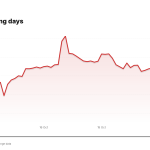
A decrease of about 0.65% during the day. That isn’t a headline on its own. However, when compared to the one-year return of almost 47% and the 52-week low of €13.02, the daily decline begins to resemble what it most likely is: normal noise within a stock that has accomplished something highly unusual for an Irish bank.
Bank of Ireland shares have a five-year return of 348%. When that number appears, it usually stops people in the middle of their sentences. That kind of return over five years would have seemed unrealistic to anyone who followed Irish banking during the years following the 2008 financial crisis, when Bank of Ireland was bailed out, stripped down, and viewed by markets as practically uninvestable. Not too long ago, the bank was trading in low single digits in euros. It currently has a trailing P/E ratio of 13.64, a market capitalization of about €17 billion, and a dividend yield of 4.57%. October 1 was the ex-dividend date; the payout is due on October 23.
All of this did not occur swiftly or neatly. Like the Irish economy as a whole, the Bank of Ireland’s recovery happened gradually through the mid-2010s, then more quickly as Ireland’s GDP growth surpassed that of most of its European counterparts, and finally with genuine conviction when interest rates increased throughout the eurozone and margin-hungry bank stocks appeared appealing once more. For a traditional lender, higher rates are actually beneficial. That environment has directly benefited Bank of Ireland, which gets most of its income from its Retail Ireland division through mortgages, business lending, and personal banking. Revenue for the second quarter of 2026 was €1.07 billion, up 13.34% from the previous year.
The majority of moderately valued bank stocks tend to draw mixed opinions from analysts. The average price target for analysts is €21.08, which suggests a significant increase from current levels. The range between the high target of €23.40 and the low target of €16.00 reflects real uncertainty about the future direction of European interest rates and the duration of the favorable margin environment. It’s still unclear if the ECB’s rate cuts, which have already started, will proceed quickly enough to reduce bank profitability before earnings growth counteracts them. Not just Bank of Ireland, but the entire European banking industry is plagued by that question.
However, the relative performance is noteworthy. The ISEQ All Share index has increased by 5.88% so far this year, while Bank of Ireland shares have increased by 17.36%. The stock has returned 144% over the last three years, while the overall index has returned 78%. 348% versus 63% over a five-year period. Regardless of the narrative regarding interest rates and margins, the bank has continuously outperformed its domestic benchmark over all time horizons, indicating that there may be more to this than a single cyclical tailwind.
A bank that once needed government intervention is now sitting on a P/E below 14, paying a dividend above 4.5%, and trading well above its 52-week low while analysts set targets north of €21. It’s difficult to ignore the quiet confidence ingrained in the share price chart over the past few years. A layer of geographic diversification that is occasionally missed in coverage that is solely focused on the Irish domestic market is added by the UK operations, which are distributed in part through a partnership with Britain’s Post Office network.
Rather than anything unique to Bank of Ireland, today’s slight softness is probably related to pressure on the European market as a whole (the ISEQ 20 is down 1.25% on the same session). Put another way, it’s the kind of day that long-term investors usually ignore.