Bitcoin
 Ethereum
 Tether
 BNB
 USDC
 XRP
 Solana
 TRON
 Lido Staked Ether
 Cardano
 Gram (prev. Toncoin)
 Avalanche
Abbott Laboratories (NYSE: ABT) said on 21 October 2026 that it intends to separate its global Nutrition business into an independent, publicly traded company, carving out a unit with roughly $8.5bn in annual sales built around household names including Similac, Ensure, Pedialyte, PediaSure and Glucerna. The Abbott Nutrition spin-off is structured as a tax-free distribution of shares to existing Abbott shareholders, with completion targeted by the end of 2027.
Daniel Salvadori, currently Abbott’s executive vice president and group president for Established Pharmaceuticals and Nutritional Products, has been named chief executive of the new company, according to StreetInsider, which also reports the unit employs around 16,000 people across 14 manufacturing sites. The remaining Abbott, stripped of Nutrition, is projected to carry about $42bn in annual sales and roughly 106,000 employees, per Securities.io.
A business that has been losing momentum
The pitch to shareholders is straightforward: freed of a slower-growing consumer unit, Abbott expects “accelerated sales growth and an expanded margin profile” on the diagnostics, devices and pharmaceuticals that remain. That framing sits awkwardly next to the Nutrition division’s recent trading. Worldwide Nutrition sales came in at $2,144m in the second quarter of 2026, down 3.1% year-on-year, following an 8.9% reported decline in the fourth quarter of 2025 that prompted pricing actions, according to an exhibit filed with the SEC. Spinning off a business that has been shrinking is not unusual – it often lets the parent’s growth rate look better by subtraction – but it does mean the new standalone company starts life with a sales trend to reverse rather than extend.
The separation is not yet a done deal. It remains subject to regulatory approvals, the effectiveness of a Form 10 registration statement with the SEC, and final sign-off from Abbott’s board, StreetInsider notes – the standard sequence for a US spin-off, but one that leaves roughly fourteen months of execution risk before shareholders actually hold stock in the new entity.
Why the market shrugged, then sold
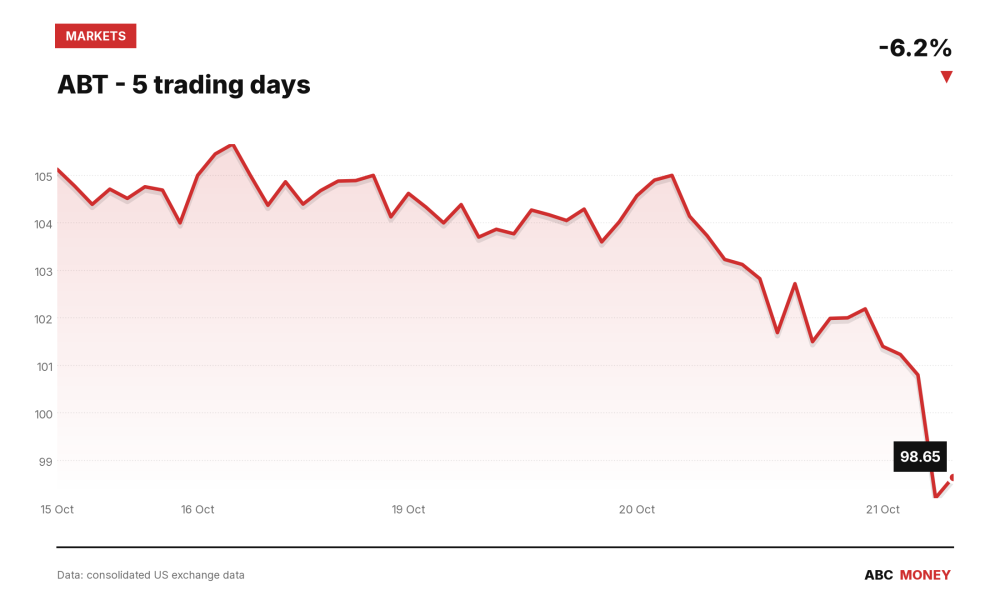
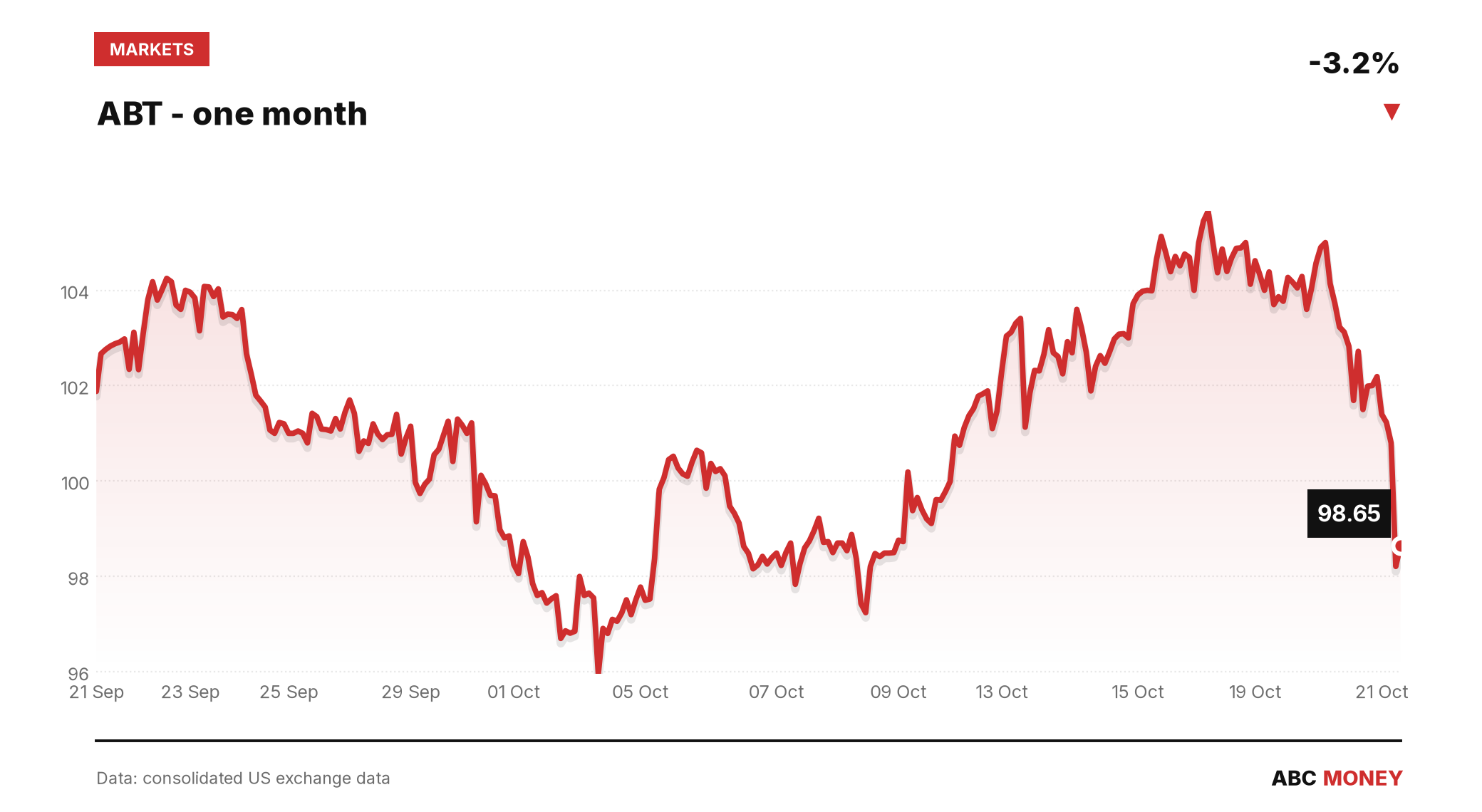
Investors did not treat the day as an unambiguous win. Abbott shares slid in premarket trading and kept falling into the session, dropping roughly 1.4% to 2% according to Investing.com, with the stock closing the day down 3.37% at $98.55. The reason wasn’t the spin-off mechanics themselves but what accompanied them: Abbott simultaneously trimmed its full-year 2026 comparable sales-growth guidance to around 6%, down from a prior range of 6.5% to 7.5%, citing weakness in its medical device business, as Reuters reported.
That guidance cut landed on the same morning as the third-quarter results underpinning it. Abbott’s own release showed revenue of $13.01bn, up 14.5% on a reported basis and 7.0% on a comparable basis, with adjusted diluted earnings per share of $1.42 – in line with estimates – while the company held its full-year adjusted EPS guidance at $5.50 to $5.55. Investors, in other words, got a corporate restructuring story and a soft core-growth story in the same press cycle, and chose to price the latter.
Precedent, and the cost of standing alone
This would be Abbott’s second major separation in roughly a decade and a half. The company spun off AbbVie, its research-based pharmaceuticals arm, in January 2013, a transaction detailed in its fiscal 2012 annual report. That split ultimately let both businesses pursue distinct strategies – AbbVie as a branded-drug specialist, Abbott as a diversified health-products company – and investors will be watching whether the Nutrition carve-out follows a similar arc or struggles with the slower growth the segment has shown lately.
The timing carries one more complication for a newly independent company likely to take on its own debt load: the 10-year US Treasury yield stood at 5.15% on 19 October 2026, up from 5.09%, according to Federal Reserve data. A standalone Nutrition company raising capital or refinancing in that environment faces materially higher financing costs than it would have a few years ago, a detail that rarely makes the press release but tends to show up in the first set of standalone accounts.
Abbott’s spin-off also joins a crowded run of 2026 portfolio break-ups, including National Fuel Gas’s planned separation of its upstream and gathering business and Corteva’s completed spin-off of its seed unit into Vylor Inc. For Abbott shareholders, the practical markers to watch are the Form 10 filing that will set out the new company’s standalone financials, and whether the next quarterly print shows Nutrition’s sales decline stabilising before the 2027 distribution date arrives.
This article is for information only and is not investment advice or a recommendation to buy or sell any asset. Markets move quickly; figures are correct as sourced at the time of writing. Always do your own research before making financial decisions.