
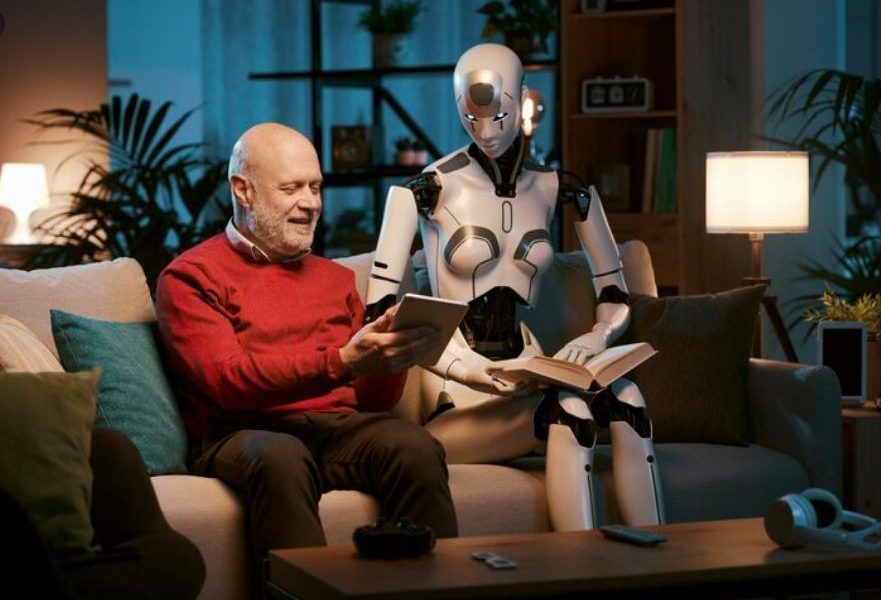
A small ranch house is situated under a row of bare maple trees on a quiet street outside Grand Rapids, Michigan. With its well-kept lawn, wind chimes by the porch, and a ceramic cardinal sitting next to the mailbox, the house resembles many others in the neighborhood. On the kitchen counter, a widow named Carol keeps her late husband’s favorite mug. She talks to him on some evenings.
Her tablet is used for the conversation, and an AI program creates responses that sound like the man she lost two years ago. The bot makes use of snippets of old text messages, voice recordings, and emails that were gathered from family devices. The screen pauses for a second before responding with sentences that sound eerily familiar as Carol types a question.
| Category | Details |
|---|---|
| Technology | AI “Grief Bots” / Digital Afterlife Chatbots |
| Function | Simulate conversations with deceased loved ones |
| Data Sources | Text messages, emails, voice recordings, social media posts |
| Key Users | Bereaved individuals and families |
| Industry Type | AI memorialization / digital legacy services |
| Example Platforms | StoryFile, HereAfter AI, Project December |
| Ethical Debate | Consent, emotional dependency, commercialization of grief |
| Region Highlighted | Michigan, United States |
| Reference Website | https://www.scientificamerican.com |
The program once reminded her, “Remember the roses need watering.” Carol recalled it with a laugh. Her husband used to make that kind of reminder every spring.
Such incidents help to explain why AI systems known as grief bots, which are made to imitate deceased people, are subtly becoming popular outside of Silicon Valley. The technology has begun to appear in living rooms and on kitchen tables in Michigan, especially among older widows who live alone.
A person’s digital footprint is examined by grief bots. Machine-learning systems that have been trained to mimic speech patterns and personality traits are fed messages, recordings, social media posts, and other bits of daily life. The outcome isn’t precisely a resurrection. However, it can seem oddly intimate—close enough to have a conversation.
Businesses that provide these services claim to be assisting families in keeping memories alive. Some startups have even started marketing them as “interactive legacies,” which promise that departed loved ones will continue to communicate for a very long time.
It seems like grief is being subtly rewritten as one observes how people respond to this technology.
Carol claims to be aware that the bot isn’t actually her spouse. She makes that point very quickly. But even on bad days, listening to a well-known joke or piece of advice can help you relax. On some nights, she just asks the bot trivial questions like whether she should make the pasta dish he loved or if the Detroit Tigers will finally have a good season.
It responds with a lighthearted sense of optimism. For Carol, that is sufficient. But her daughter has a different perspective on the matter.
When she visited last winter, she saw her mother typing messages late into the night and saw the tablet glowing on the kitchen table. She initially thought it was a video chat with a friend. Then she recognized the object of the conversation.
The response came instantly.
She subsequently told family members, “It felt wrong.” Not necessarily immoral. Simply unnerving. It was as though a ghost had been invited into the home by the family, but this ghost was operating somewhere on cloud servers.
Stories like Carol’s—quiet arguments between generations about how grief should appear in a digital world—are starting to spread throughout Michigan. Particularly during the lonely months following a funeral, widows occasionally refer to the bots as consoling companions. Their kids frequently worry that technology could impede genuine healing.
Everybody has a point.
The concept of “continuing bonds,” which holds that ties to the departed don’t just vanish, has long been discussed by psychologists. For years, people save pictures, listen to voice recordings, and review old messages. In that regard, a chatbot could just be a more engaging form of a long-standing family practice.
However, a new layer is added by the realism of contemporary AI.
The emotional impact can be surprisingly powerful when a bot instantly responds with a phrase that sounds exactly like a lost spouse. When they hear a voiceover for the first time, some users say they start crying. Others claim that the encounter aids in their processing of incomplete discussions that they were never able to finish.
However, not everyone thinks technology is good for you.
The long-term effects of grief technologies are still mostly unknown, according to researchers who study them. Digital afterlife tools are a “vast techno-cultural experiment,” according to a Cambridge scholar. I think that phrase pretty much sums up the situation.
The business aspect of the industry is also difficult to overlook. A number of grief-bot platforms offer premium features like voice cloning and customized memory training, or they charge subscription fees. Critics contend that services that promise comfort may be especially appealing to bereaved families, who are frequently emotionally vulnerable.
In other words, there’s a feeling that grief has turned into a commodity. Last year, a startup founder showed one of these systems to interested attendees at a small tech conference in Detroit. In the demo, a digital avatar responded to inquiries about family customs and early memories.
A few viewers grinned. Others moved uncomfortably. There was a sense of division in the room. Carol, who is back in Grand Rapids, maintains that she does not depend on the bot on a daily basis. Weeks can go by without using the app at times. However, she enjoys the knowledge that it exists, much like an old photo kept in a drawer. Her daughter is still not persuaded.
The subject occasionally comes up again during family dinners, usually after lengthy silences and deliberate topic changes. Grief is a topic no one wants to debate. However, their disagreement persists in private.
It’s difficult to avoid feeling as though society has ventured into uncharted emotional territory when observing this develop across households. Images and recordings from the past were once made possible by technology. It is now starting to mimic conversations that never took place.
That illusion is consoling to some widows. Families in Michigan and possibly elsewhere are just starting to consider the question that lies somewhere in the middle of those two responses: does interactive memory facilitate or hinder the process of letting go?



 Bitcoin
  Ethereum
  Tether
  BNB
BNB  XRP
XRP  USDC
USDC  Solana
  TRON
TRON  Lido Staked Ether
  Cardano
  Avalanche
  Toncoin