
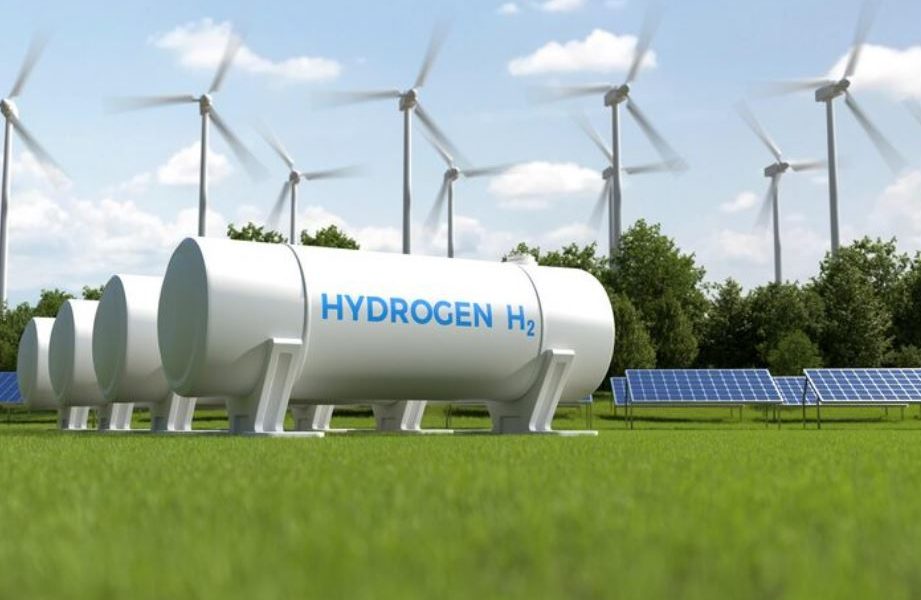
Massive turbines spin above deserted harbors that were once intended to serve as international green hydrogen export hubs on a windy stretch of Atlantic Canada’s coastline. At first glance, the scene appears promising: local officials discussing jobs, steel towers, and new transmission lines. However, behind those projects, a more subdued and uncomfortable dialogue has recently emerged.
Once positioned as a cornerstone of its clean-energy future, Canada’s much-discussed green hydrogen push seems to be slowing down. Strangely enough, energy policy and technology might not be the main causes. Artificial intelligence could be the cause.
| Category | Details |
|---|---|
| Country | Canada |
| Policy Initiative | Canada Hydrogen Strategy |
| Key Energy Issue | Rising electricity demand from AI data centers |
| Estimated Data Center Demand | Up to 15 GW under review in Canada |
| Projected Global Data Center Electricity Use | ~945 TWh by 2030 |
| Major Energy Debate | Green hydrogen vs AI infrastructure power needs |
| Notable Industry | Data centers, clean hydrogen, natural hydrogen exploration |
| Key Company Mentioned | MAX Power Mining Corp. |
| Relevant Organization | International Energy Agency (IEA) |
| Reference Source | https://www.iea.org |
Data centers, those windowless structures teeming with servers, are silently vying for the same electricity that hydrogen plants are in dire need of across Canada.
Green hydrogen seemed like a sophisticated concept for a long time. Water could be electrolyzed to produce carbon-free fuel by splitting it into hydrogen and oxygen using renewable electricity. The idea was well received by governments. Seeing Canada’s windy Atlantic provinces as possible suppliers, Europe found it even more appealing.
However, there was always a catch. The amount of electricity needed to produce hydrogen is astounding. “These plants are basically giant power consumers,” an engineer said bluntly last year while standing close to a proposed hydrogen facility outside of Halifax.
Now, something unexpected—AI—collides with that reality.
Globally, the demand for electricity is changing due to the quick development of artificial intelligence. The International Energy Agency estimates that by 2030, the annual electricity consumption of data centers worldwide could more than double to 945 terawatt-hours. That is roughly equivalent to Japan’s annual electricity consumption.
The scale becomes more apparent as one passes one of Canada’s more recent data center campuses in Calgary. Even in the winter, rows of cooling units roar continuously, expelling warm air. New server racks are delivered in trucks. Everything from financial transactions to generative AI models is processed by machines inside.
Compared to a conventional internet search, each AI query uses more energy. When you multiply that by millions of requests per minute, the electrical system starts to feel constrained.
Policymakers are increasingly concerned that Canada’s grid may soon have to make difficult trade-offs.
Approximately 15 gigawatts of additional data center capacity are currently being reviewed by several provinces. That could account for a sizable portion of the future supply of electricity. Both Ottawa and provincial capitals have taken notice of the investment potential, which is estimated to be around $100 billion in infrastructure and construction.
Additionally, investors appear enthusiastic. Technology companies are looking for low-carbon, dependable power. Server farms are drawn to Canada because of its cool climate and hydroelectric resources. Compared to major U.S. tech hubs, electricity costs are substantially lower in some areas.
However, hydrogen producers were relying on the same power that those servers require.
Green hydrogen is primarily powered by renewable energy sources, such as wind or hydropower. The economics quickly collapse in the absence of significant amounts of inexpensive power. Depending on the cost of electricity, production costs can range from $4 to $6 per kilogram.
Energy analysts are taken aback by that figure. In particular, if preliminary estimates are accurate, natural hydrogen, an emerging subterranean geological resource, may end up costing between $0.50 and $1 per kilogram.
Large tracts of land in Saskatchewan are already being investigated by businesses like MAX Power Mining Corp. in an effort to find naturally occurring hydrogen reservoirs. Approximately 1.3 million acres of authorized exploration land, including the Genesis Trend geological corridor, are under the company’s control.
The area doesn’t appear to be a future energy frontier from where I stand. Quiet roads and farmland predominate. However, scientists think that underground chemical reactions could continuously produce hydrogen gas.
There could be serious repercussions if that proves to be accurate. Natural hydrogen wouldn’t need electricity-intensive electrolysis, in contrast to green hydrogen.
Investors have begun to take notice.
It’s hard to ignore how rapidly the discourse surrounding energy has changed. Discussions about climate policy were dominated by hydrogen just a few years ago. Artificial intelligence appears to be taking up a lot of attention and resources these days.
This does not imply that Canada’s plans for hydrogen are doomed. Not at all. Hydrogen is still seen by some provinces as a long-term export, especially to Europe and Asia. Atlantic regions with lots of wind are still optimistic.
However, energy infrastructure moves slowly. Data centers are fast-moving.
In Canada’s energy planning circles, a subtle tension is growing as the pace of AI investment develops. Each megawatt allotted to a campus for hyperscale computing is one megawatt that cannot be used by another industry.
The grid may eventually grow to accommodate both, according to some policymakers. Others appear to be less certain.
Hydrogen, nuclear power, carbon capture, and possibly even naturally occurring hydrogen reservoirs tapped beneath prairie soil could all be part of the future energy system.
However, the competition is genuine for the time being.
Additionally, Canada’s clean-energy goals are being discreetly renegotiated somewhere between humming server rooms and spinning wind turbines.



 Bitcoin
  Ethereum
  Tether
  BNB
BNB  XRP
XRP  USDC
USDC  Solana
  TRON
TRON  Lido Staked Ether
  Cardano
  Avalanche
  Toncoin