
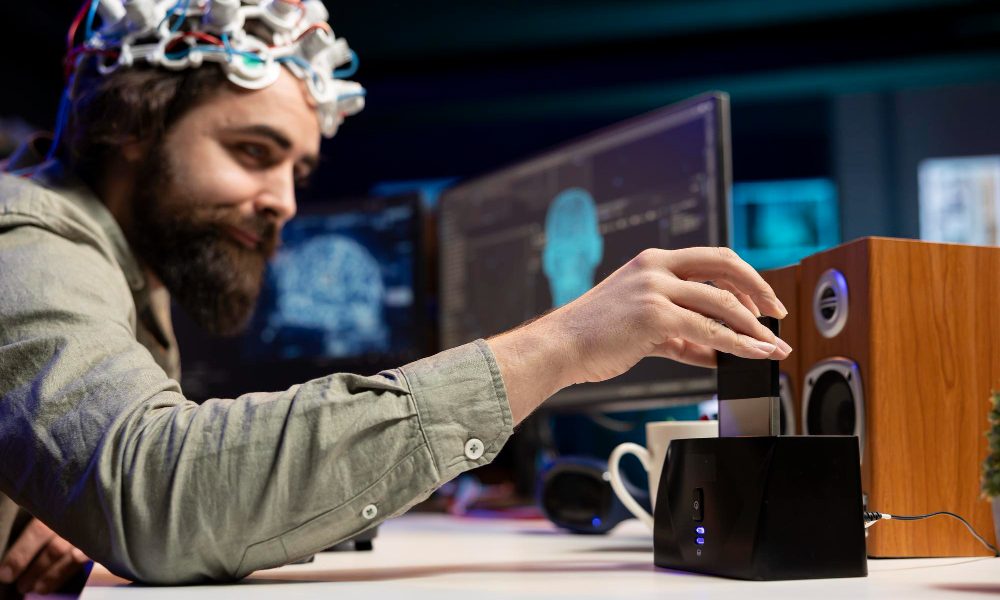
The AGI Timeline: Why Stanford Researchers Believe Artificial General Intelligence is Only 3 Years Away

A small group of mathematicians and computer scientists convened in a conference room somewhere in the history of AI research, most likely at Dartmouth, in the summer of 1956, to determine whether machines could think. They had been called together by John McCarthy, the philosophical foundation had already been established by Alan Turing, and the atmosphere was one of self-assured optimism that verged on naivety. They believed they could solve the machine intelligence puzzle in a single summer. In one summer, they failed to crack it. Decades of alternating successes and setbacks, funding cycles and “AI winters,” lofty forecasts that came too soon, and skepticism that persisted for too long followed. In the field, the question of when artificial general intelligence would emerge became something of a running joke; it was always twenty years away, no matter when you asked.
It’s no longer funny, that specific joke. Six of the most accomplished individuals in the field’s history gathered to accept the Queen Elizabeth Prize for Engineering at London’s Future of AI Summit in late 2025. In 2024, Geoffrey Hinton was awarded the Nobel Prize in Physics. The most cited computer scientist alive is Yoshua Bengio. Yann LeCun, Meta’s Chief AI Scientist. Jensen Huang, who created the chip infrastructure that enabled contemporary artificial intelligence. Fei-Fei Li, former head of the AI lab at Stanford. And NVIDIA Chief Scientist Bill Dally. Together, they stated something that hasn’t gotten nearly the attention it merits: they believe artificial intelligence has already attained human-level performance in important cognitive tasks. Not in 2027. Not getting close. Already.
| Category | Details |
|---|---|
| Topic | Artificial General Intelligence (AGI) Timeline Predictions |
| Definition | AGI: AI that matches or surpasses human cognitive abilities across virtually all tasks |
| Key Figures Referenced | Geoffrey Hinton, Yoshua Bengio, Yann LeCun, Sam Altman, Dario Amodei, Demis Hassabis, Jensen Huang, Fei-Fei Li |
| Hinton/Bengio/LeCun Statement | AI already at human level in key cognitive tasks (London Future of AI Summit, 2025) |
| Sam Altman Quote | “We are now confident we know how to build AGI” (January 2025) |
| Dario Amodei Prediction | AGI likely by 2026–2027 |
| Demis Hassabis Prediction | AGI “probably 3–5 years away” |
| Academic Researcher Consensus | 50% probability of AGI between 2040–2050 (8 major surveys) |
| Samotsvety Forecasting (Jan 2026) | 10% chance AGI by 2026; 50% by 2041 |
| Metaculus Community Forecast | Strong AGI extended to ~November 2033 |
| Predictions Analyzed | 9,800 (AIMultiple, Feb 2026) |
| Reference Website | ai100.stanford.edu |
It is important to read that statement carefully, with skepticism, and with seriousness. These are not the founders of startups seeking to raise money for their next venture. They’re not commentators. Hinton’s statement that machines now produce intelligence that “augments people, addresses labor, does work” was not a prediction but rather a description of the present. Huang’s claim that we currently possess “enough general intelligence to translate the technology into an enormous amount of society-useful applications” was presented similarly. It is genuinely debatable whether this qualifies as artificial general intelligence (AGI) in the strictest sense of the word, which is defined as reasoning across domains, learning continuously, operating over long time horizons, and generalizing like a human expert. However, those who developed the systems claim that the line has been crossed. Sitting with that is worthwhile.
Over the past two years, the timeline debate has been remarkably unstable. The release of OpenAI’s o1 and o3 reasoning models in late 2024 and early 2025 caused a surge of enthusiasm that significantly reduced forecasts. In January 2025, Sam Altman declared that his company was certain it could create AGI. AGI is probably three to five years away, according to Demis Hassabis, who is usually more measured. Within two to three years, a “country of geniuses in a data center” will arrive, according to Anthropic’s Dario Amodei. The AI 2027 scenario, a comprehensive forecast of completely automated AI research and development resulting in an intelligence explosion, gained enough traction to actually change public and professional opinion. Then, something occurred in the middle of 2025: the optimism waned. By autumn, the community that had shortened its timelines in January was doing so once more.
The technical explanations are clear and important to comprehend. Though the anticipated generalization to messier, real-world tasks didn’t happen on time, the reasoning models that caused so much excitement performed better in domains where correctness can be verified, such as mathematics, logic, and coding. Compared to math Olympiad problems, booking a flight, planning an event, and navigating a confusing professional task proved to be significantly more difficult, and the performance gains in the checkable domains did not automatically transfer. More concerning, analysis revealed that rather than the models’ inherent intelligence, more than two-thirds of the enhanced performance from reasoning models came from giving them more time to think. Without additional hardware, which produces at its own speed regardless of the software team’s goals, that kind of gain is costly to scale and impossible to replicate indefinitely.
The general forecast consensus has nevertheless come a long way toward the present in spite of all of that. According to AIMultiple’s February 2026 review, which examined 9,800 forecasts from AI scientists, entrepreneurs, and community forecasters, CEOs and entrepreneurs typically place artificial general intelligence (AGI) between 2029 and 2032, framing it as an engineering challenge they think can be solved with current approaches at sufficient scale. Scholars continue to be more cautious, usually focusing on 2040–2050 and highlighting unresolved theoretical issues in world-modeling, reasoning, and memory that scaling might not be able to address. The Metaculus community extended its optimistic AGI forecast by roughly two and a half years until 2025; this was a recalibration rather than a rejection of short-term thinking. In their January 2026 update, Samotsvety Forecasting, which has a solid track record of making complex predictions, predicted that AGI would arrive by 2026 with a 10% probability and by 2041 with a 50% probability.
Observing this debate in real time gives one the impression that those who are most involved in the work are genuinely unsure in a way that confident public declarations don’t always reflect. Speaking to the 80,000 Hours podcast, a senior employee of an AI company stated that the failure of reasoning generalization to transfer across domains actually updated him toward longer timelines—not because progress had stalled, but rather because one of the likely routes to quick capability gains had been ruled out. That’s the kind of straightforward technical accounting that often gets overlooked in the more boisterous discourse. People closely examining the instruments are deriving different conclusions from the same data, and the ground is moving, but in complex directions.
The majority of observers do seem to concur that even the “long timeline” predictions currently in circulation, such as ten years to AGI, 2033, or 2035, would represent a period of change so compressed and consequential that preparation hardly makes sense in traditional terms. The Dartmouth researchers in 1956 believed they were working on a summer project. It took seven decades for the system developers to feel confident enough to declare, at a prize ceremony in London, that they had mostly succeeded. It’s worth debating whether that moment came in 2024, 2028, or 2032. However, the joke about AGI always being twenty years away has finally stopped landing because the direction is no longer unclear and the distance has decreased to a manageable level.


 Bitcoin
  Ethereum
  Tether
  BNB
BNB  XRP
XRP  USDC
USDC  Solana
  TRON
TRON  Lido Staked Ether
  Cardano
  Avalanche
  Toncoin