
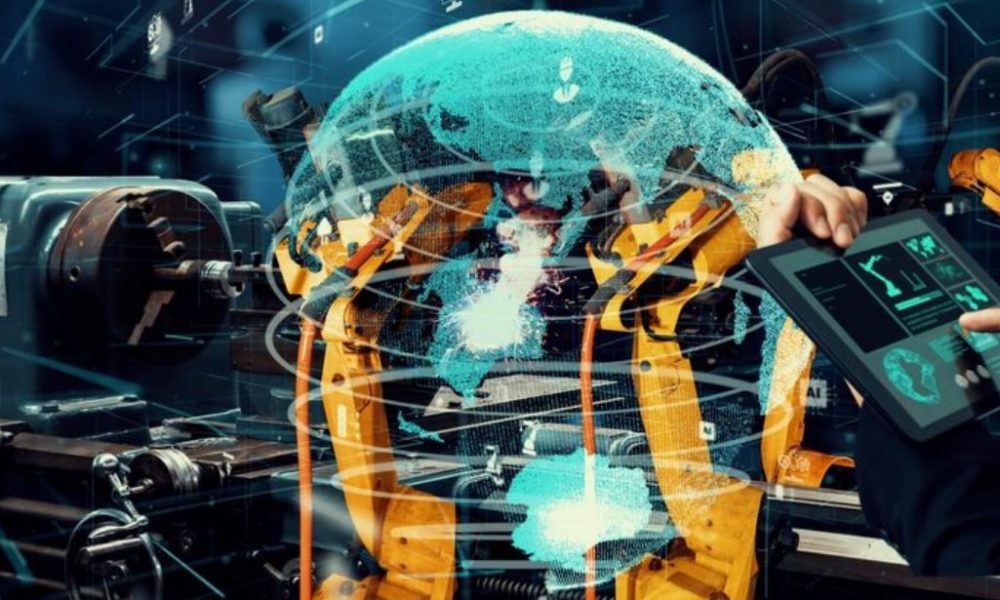
A modern data center has a particular type of silence that is humming, chilly, and slightly pressurized. The racks have a subtle blue glow. The cooling systems are always in operation. When you enter one in Virginia, Suzhou, or Abu Dhabi, you are passing the world’s most valuable stockpile of industrial materials at the moment: GPUs. Not in the sense of abstraction. in a physical sense. In most major cities, a single rack of NVIDIA’s newest accelerators can cost more than a luxury apartment. Countries have started handling these chips the same way they used to handle strategic oil reserves or, in more intimate settings with more tense discussions, the same way they used to handle enriched uranium.
When you consider how governments are actually acting, the comparison seems dramatic. In its hyperscaler fleet, the United States has deployed nearly a million high-end GPUs. In contrast, the United Kingdom is closer to 38,000. More about the current AI era’s shape can be explained by that 25-fold difference than by any one model release. When NVIDIA CEO Jensen Huang repeatedly states that “every country needs sovereign AI,” it’s not merely a sales pitch. It depicts a world that is already dividing itself into compute-rich and compute-poor, with very little room for compromise.
| Detail | Information |
|---|---|
| Key Driver | National AI sovereignty, cultural data control |
| Leading Chip Supplier | NVIDIA |
| Core Hardware Bottleneck | High-end GPUs (H100, H200, B200, Blackwell class) |
| U.S. GPU Deployment Scale | 1M+ installed (per AIM Network estimates) |
| UK GPU Deployment Scale | ~38,000 (per same comparison) |
| Notable Sovereign AI Projects | Denmark, Italy, Sweden, UAE, India, France, Japan |
| Denmark’s Funding Source | Ozempic / Novo Nordisk proceeds |
| India’s Sovereign AI Commitment | $1.2 billion |
| UAE Model | Falcon (Technology Innovation Institute) |
| Italy’s Focus | Government-grade Italian LLM |
| U.S. Data Center Power Share (2022) | 3% of total U.S. electricity |
| Projected U.S. Data Center Share (2030) | 8% |
| European Equivalent Power Demand (2030) | Portugal + Greece + Netherlands combined |
| Nuclear Power Pivots | Amazon, Microsoft, Google, Oracle |
| Typical LLM Training Cost (Frontier) | Approaching $1 billion |
| Source of Policy Pressure | World Economic Forum reports |
| NVIDIA CEO Quote Theme | “Every country needs sovereign AI” |
| Key Risk | Supply chain concentration in TSMC / Taiwan |
| Trust in AI (Japan, Finland survey) | ~20% of adults |
The story of Denmark’s supercomputer, which was unveiled last year, would have seemed charming in 2019. Built especially to keep Danish biomedical research, climate modeling, and language models within Danish borders, it was funded by the sales of Novo Nordisk’s weight-loss medication Ozempic. In the same year, Italy unveiled its own “AI factory,” powered by a supercomputer built to train an Italian-language model intended for government employees rather than visitors using ChatGPT. To draw in AI talent, Sweden renovated a national research facility. Never afraid to take calculated risks, the UAE developed Falcon, a domestic generative model that is currently competing in benchmarks that Silicon Valley once thought were uncontested. Tens of thousands of accelerators will serve as the foundation of India’s $1.2 billion national AI program.
It’s the energy math that gives the entire image a prewar vibe. According to Goldman Sachs, data centers in the United States will use 8% of the country’s electricity by 2030, up from 3% in 2022. By the same year, Europe’s AI-related data centers will require more electricity than Portugal, Greece, and the Netherlands put together. For this reason, companies like Amazon, Microsoft, Google, and Oracle have begun discreetly locking in nuclear power through private grid agreements, small modular reactors, and long-term contracts with existing plants. The term “AI-grade megawatt” might be as frequently used in M&A filings in ten years as “real estate footprint” is now.
Speaking with those in this field gives me the impression that we are living through one of those times when the physical infrastructure of power subtly reorganizes itself without the majority of the public noticing. The World Economic Forum has written about “sovereignty traps”—the possibility that countries pushing too hard for autonomous AI development will split the global safety discourse and make it more difficult to establish common standards. They’re not incorrect. However, the train is no longer at the station. No government will voluntarily rely on American cloud providers for its national language tools while it watches China develop its own frontier models. No European nation will assume uninterrupted access in 2028 after witnessing the transformation of global supply chains in 2023 and 2024 due to chip export restrictions.
However, computation by itself makes no guarantees. This past summer, Kevin Collins wrote on Substack about what most headlines overlook: sovereign AI is more than just GPUs and energy. Integration is what it is. Hospitals, courts, ministries, and defense contractors can actually use a national stack because of its orchestration layers, monitoring, security, and verticalized tooling. Owning servers did not help Microsoft and Google win the cloud era. By controlling the systems surrounding the servers, they prevailed. In essence, a nation that purchases 40,000 chips without constructing the necessary infrastructure has purchased extremely costly dust.
As this develops, it’s difficult to avoid the impression that purchase orders for silicon will play a significant role in shaping the geopolitical landscape of the next ten years. The Strait is more strategically significant than any shipping channel in a generation because of Taiwan’s role in producing every cutting-edge chip. Export regulations will continue to tighten. Consortiums will be formed by smaller countries just to afford compute capacity. And somewhere in a government office in Jakarta, Helsinki, or Riyadh, someone is currently creating a spreadsheet of anticipated GPU deliveries in the same manner that their forebears used to monitor oil contracts. The analogy to nuclear material is not entirely accurate. It’s near enough to cause you to hesitate.



 Bitcoin
  Ethereum
  Tether
  BNB
BNB  USDC
USDC  XRP
XRP  Solana
  TRON
TRON  Lido Staked Ether
  Cardano
  Gram (prev. Toncoin)
  Avalanche