

Steven Rossi just did it again.
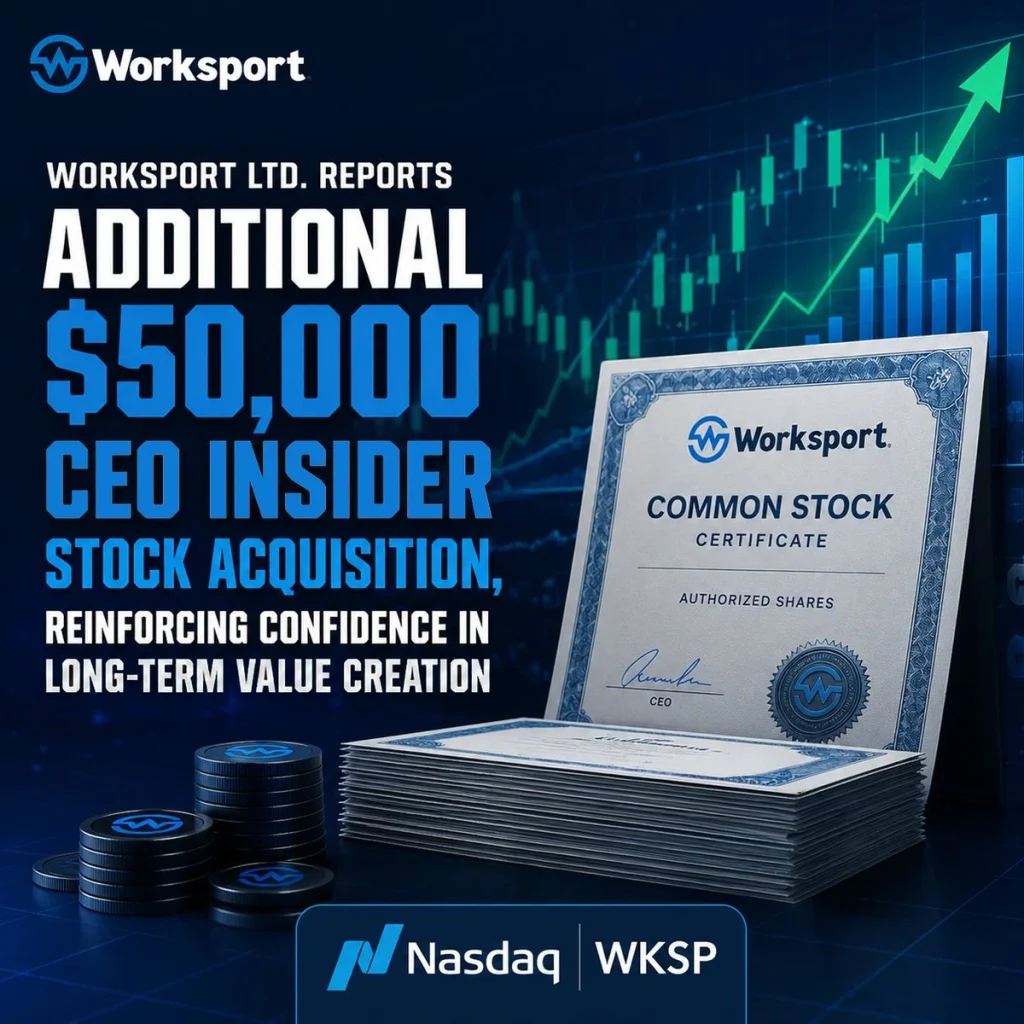
For the second time in two months, the CEO of Worksport Ltd. turned down cash compensation and took company stock instead. Rossi accepted 79,618 shares in lieu of $50,000 — issued at the closing price on June 5, 2026. Back in April, he’d done the same thing: more than 88,000 shares instead of $75,000 in accrued pay.
Two decisions. Two months apart. Same message.
When a founder-CEO repeatedly chooses equity over a paycheck, it’s worth stopping to ask why. Steven Rossi has been vocal about his view that Worksport’s market cap doesn’t come close to reflecting what the company actually has — its IP portfolio, distribution network, manufacturing capabilities, and the product pipeline it’s been quietly building out.
That’s a bold claim. But the revenue numbers at least support the growth part of the story.
Worksport pulled in roughly $1.5 million in 2023. By 2024, that climbed to $8.5 million. Then $16.1 million in 2025. That’s not incremental growth — that’s a company moving fast. The harder challenge now, as with most small-cap manufacturers hitting their stride, is turning that top-line momentum into operational efficiency. Management says they’re approaching that inflection point as production volumes scale and newer products start carrying more weight in the sales mix.
Here’s where it gets interesting.
Most people still think of Worksport as a tonneau cover company. That framing is increasingly outdated. The 2026 launch of the Nexus cover — built around a proprietary single-side opening system — shows the product line is still evolving. But the real ambition sits elsewhere entirely.
Worksport has introduced two clean-energy products designed to work as a pair: SOLIS, a solar-integrated tonneau cover that generates renewable power directly off a pickup truck, and COR, a portable modular energy-storage unit for mobile power applications. Together, they create a self-contained mobile energy platform — useful for job sites, off-grid adventures, emergency prep, or anywhere grid power isn’t an option.
COR hit a meaningful milestone earlier this year, clearing its full North American certification process, including UL and CSA approvals. Certifications like that remove real barriers — retail chains, fleet operators, and commercial distributors all need them before they’ll touch a product. Getting them done is unglamorous work, but it matters.
Then there’s Terravis Energy, a Worksport subsidiary developing Aetherlux — a cold-climate heat pump designed to hold performance in extreme cold, where conventional heat pumps tend to struggle. If it works at scale and clears commercialization hurdles, that’s a play into the global heating and cooling market. A very different addressable market than truck accessories.
So what’s the actual bet here?
Rossi is essentially arguing — with his own compensation — that Worksport is mid-transition: from a niche automotive accessories maker into something broader, spanning truck gear, portable solar, mobile energy storage, and climate-control tech. Whether all of those bets pay off is genuinely uncertain. Product timelines slip. Certifications take longer than expected. Distribution deals don’t always translate to sales.
Still, insider purchases tend to be one of the cleaner signals available to retail investors — not because they guarantee anything, but because they cost the executive something real. Rossi isn’t buying on the open market (though that would be notable too); he’s forgoing actual cash. Twice.
The question investors are left with: does the CEO know something the market doesn’t, or is he just deeply optimistic about his own company?
Given the pattern so far, he seems willing to bet on finding out.



 Bitcoin
  Ethereum
  Tether
  BNB
BNB  USDC
USDC  XRP
XRP  Solana
  TRON
TRON  Lido Staked Ether
  Cardano
  Gram (prev. Toncoin)
  Avalanche