
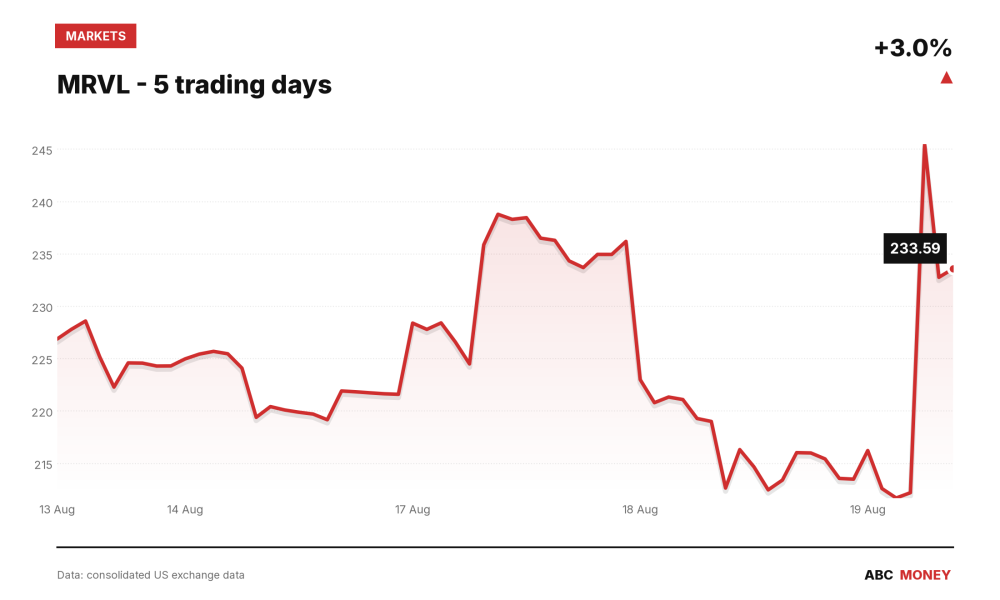
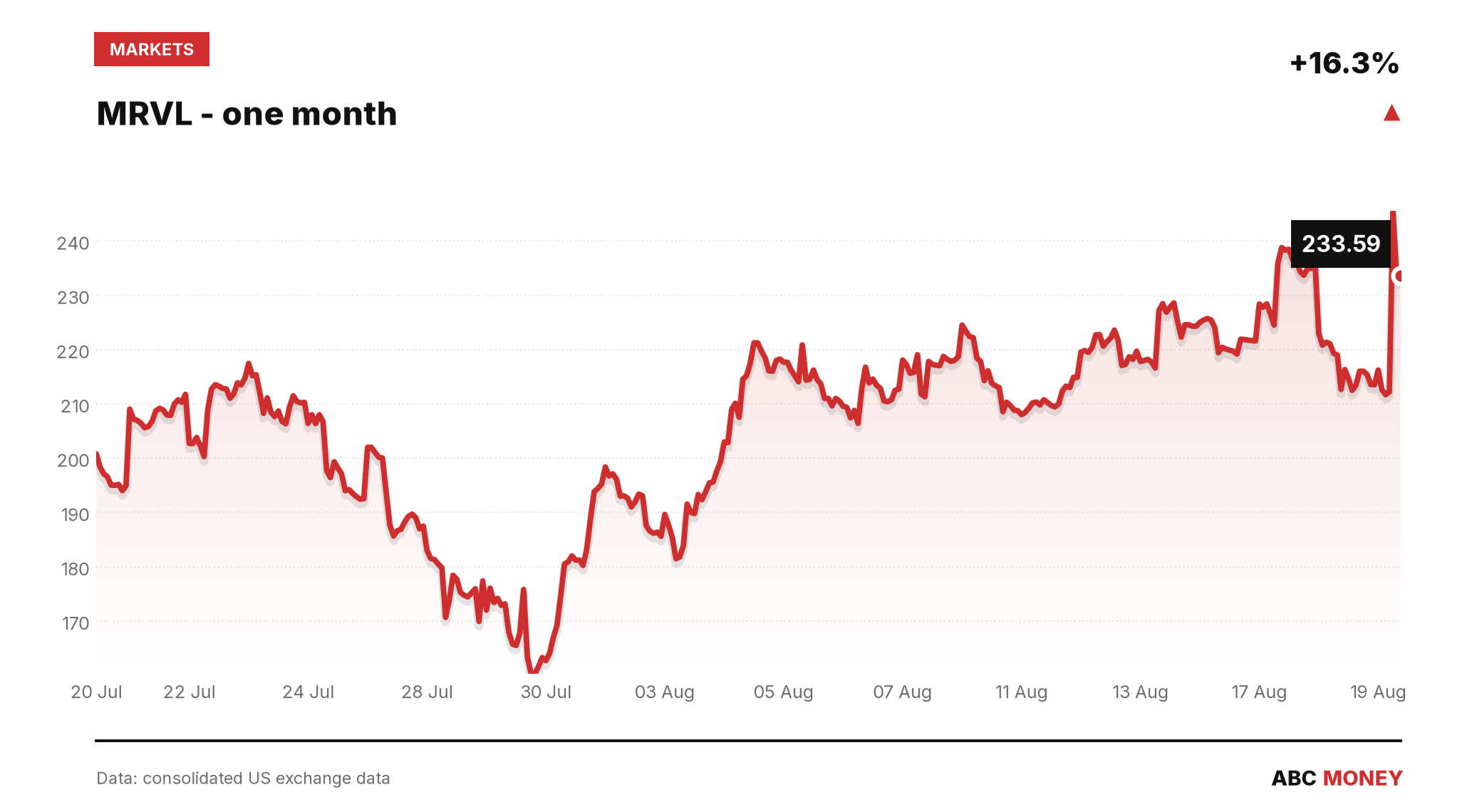
A sweeping Marvell Google chip deal has become the story of the week in AI hardware, sending Marvell Technology (NASDAQ: MRVL) shares up sharply after the company agreed to hand Alphabet’s Google a warrant that could ultimately be worth roughly $12.2bn. The stock stood at $236.12 as of 2pm UK time on 19 August, up 10.59% on the day and trading near the top of its 20-day range of $160.25 to $245.50, on volume nearly double its recent average, according to consolidated exchange data. Broadcom (NASDAQ: AVGO), the incumbent heavyweight in custom AI chips, fell more than 2% on the news, per Reuters.
The mechanics, filed with the US Securities and Exchange Commission, are specific: Marvell issued Google a warrant – the right, but not the obligation, to buy shares at a set price – covering 58,970,907 shares at an exercise price of $206.58 apiece, dated 18 August 2026 and tied to a commercial agreement struck on 29 July, according to the company’s 8-K filing. Multiply it out and you get an aggregate exercise value of about $12.18bn, a figure Reuters calculates independently. If Google exercised the warrant in full, it would become Marvell’s fifth-largest shareholder, based on LSEG ownership data cited by Reuters.
The Marvell Google chip deal is a supply contract dressed as equity
The headline number invites a simpler reading than the filing supports. Most of the warrant does not vest on a calendar – it vests as Google actually buys Marvell’s custom silicon, in tranches tied to cumulative purchases of roughly $500m apiece, stretching out through Marvell’s 2033 fiscal year, according to reporting from qz.com. In other words, Google only earns the right to more of the stake if it keeps placing orders. That structure turns what looks like a passive investment into a long-dated purchasing commitment with equity attached – a way for Marvell to lock in demand years out, and for Google to avoid writing a $12.2bn cheque today for chips it hasn’t yet decided how many of it needs.
The scope of what Marvell will build for Google is broader than a single chip line too. The 8-K describes work spanning AI inference accelerators, storage and networking silicon, memory interface controllers and near-memory computing – the kind of full-stack custom-silicon relationship that cloud providers have increasingly sought as they try to reduce reliance on Nvidia’s general-purpose GPUs for AI workloads.
Broadcom’s turf gets more crowded
Google’s custom-chip spending has until now been synonymous with Broadcom, which struck its own long-term supply agreement for Google’s Tensor Processing Units – specialised AI chips – covering commitments through 2031, disclosed in an 8-K filed in April 2026. Broadcom shares rose 3.65% when that deal became public, a reminder that Wall Street has treated Google’s custom-silicon spending as a genuine growth driver rather than a one-off. Marvell’s expanded role does not necessarily displace Broadcom – cloud giants tend to run multiple chip suppliers in parallel to avoid single-vendor risk – but it does mean Google now has two heavily invested custom-chip partners competing for the next generation of AI infrastructure spending, and Broadcom’s stock move this week suggests the market is pricing that competition, not dismissing it.
There is no sign the pre-announcement move was driven by short-covering. Marvell’s FINRA short-sale ratio – the share of daily trading volume attributable to short sellers – held in a steady 0.40 to 0.52 band through early and mid-August, giving no indication that a build-up of bearish positioning was forcibly unwound once the deal broke. This looks like fresh buying on the substance of the news rather than a squeeze.
A turnaround Marvell needed some good news to cement
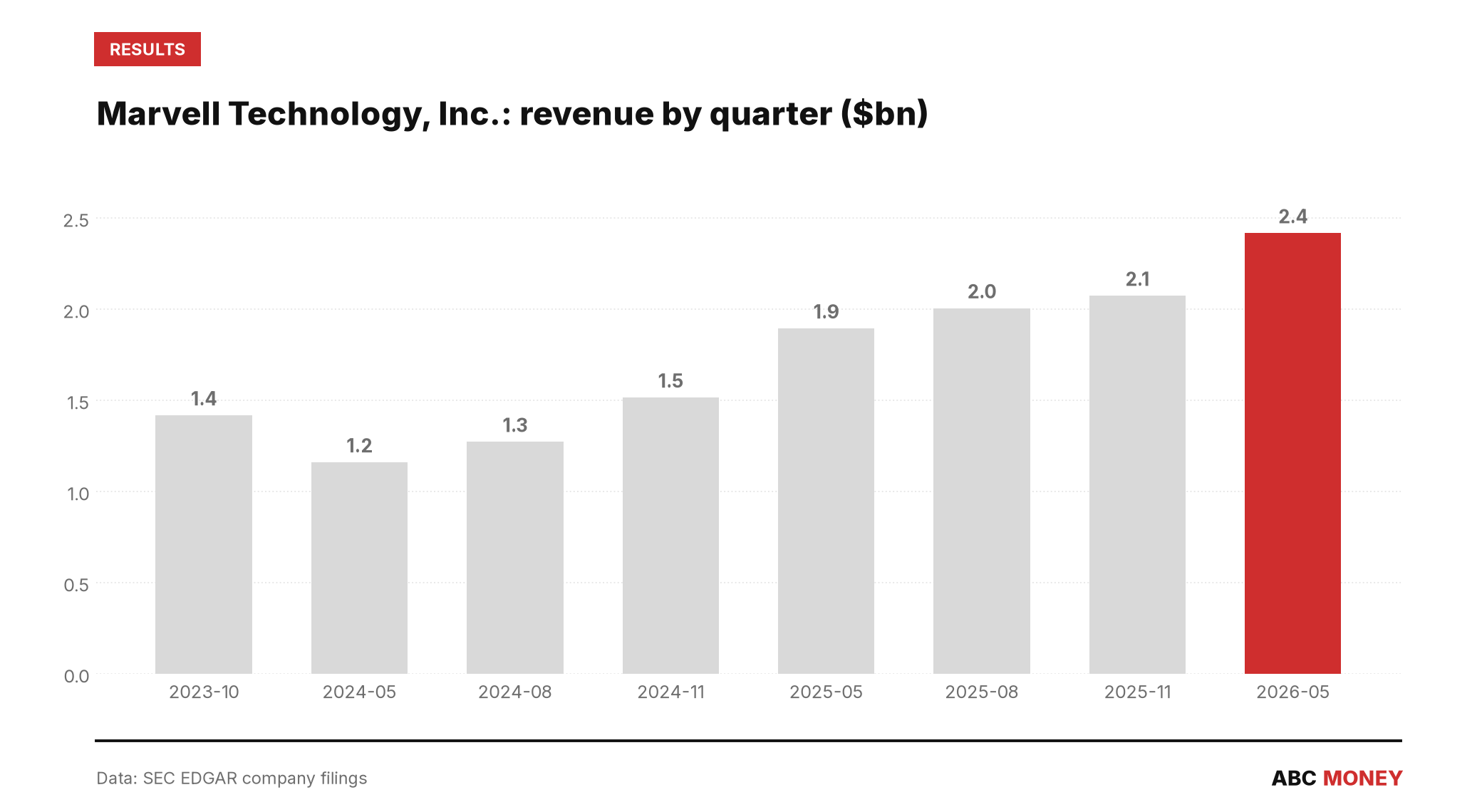
The timing matters because Marvell’s own financials have been volatile. The company posted net losses in five of the seven quarters between fiscal 2024’s third quarter and fiscal 2025’s third quarter, including a $676.3m loss in the quarter ended November 2024, according to filings with the SEC. The picture flipped sharply in the following quarter, when Marvell reported net income of $1.9bn for the three months to 1 November 2025 – by far its largest recent profit – before settling to a smaller $34.5m net income and $0.04 diluted earnings per share on revenue of $2.42bn in the quarter ended 2 May 2026, its most recently reported period. Revenue itself has been climbing steadily through the AI build-out, from $1.42bn in the quarter ended October 2023 to that $2.42bn figure less than three years later.
Against that backdrop, a customer as large and as committed as Google – even a commitment as conditional as this one – gives investors a clearer line of sight into future demand than quarterly earnings alone have offered. Marvell does not report full results again until its next scheduled quarterly filing, and the real test of this week’s announcement will come gradually, in whether Google’s purchasing actually clears those $500m tranches and the warrant starts vesting in earnest, rather than in any single print.
This article is for information only and is not investment advice or a recommendation to buy or sell any asset. Markets move quickly; figures are correct as sourced at the time of writing. Always do your own research before making financial decisions.


 Bitcoin
  Ethereum
  Tether
  BNB
BNB  USDC
USDC  XRP
XRP  Solana
  TRON
TRON  Lido Staked Ether
  Cardano
  Gram (prev. Toncoin)
  Avalanche