
Novo Nordisk (NYSE: NVO) has started testing a lower-dose version of its Wegovy weight-loss pill, according to the Wall Street Journal, a move that pushes the Danish drugmaker further into dose optimisation just as rivals crowd into the oral obesity-drug market.
The trial, first flagged in a study description posted to a US government clinical-trials registry on 18 August, enrols 450 participants and began on 12 August, testing two unspecified low doses of oral semaglutide against a placebo, as Bloomberg reported the same day citing the registry filing. The study is distinct from Novo’s already-approved 25mg oral Wegovy pill – the tablet form of semaglutide that won US clearance as an alternative to the injectable version – meaning this is a follow-on trial rather than a new drug programme.
Why a lower-dose Wegovy pill matters commercially
The logic isn’t defensive. Novo already has a marketed oral 25mg semaglutide product, so a lower-dose variant is best read as an attempt to widen the pill’s appeal rather than rescue a struggling one. Lower doses of GLP-1 drugs – the class of gut-hormone-mimicking medicines that includes Wegovy and Eli Lilly’s (NYSE: LLY) Zepbound – typically carry fewer of the nausea and gastrointestinal side effects that cause patients to abandon treatment, and they cost less to manufacture per dose. If Novo can show that patients hold onto weight loss on a smaller pill, it has a cheaper, better-tolerated product to sell into a market where price and adherence, not efficacy alone, increasingly decide who wins share.
That competitive backdrop has sharpened. Lilly’s oral obesity candidate orforglipron is working through late-stage trials, and telehealth prescribers such as Hims & Hers Health (NYSE: HIMS) have built businesses partly on offering compounded or branded GLP-1 access at lower price points than the injectable list prices. A pill that works at a fraction of the current maintenance dose would let Novo compete on cost without simply cutting the sticker price of Wegovy itself – a lever pharmaceutical companies are generally reluctant to pull.
Shares steady after a rough month
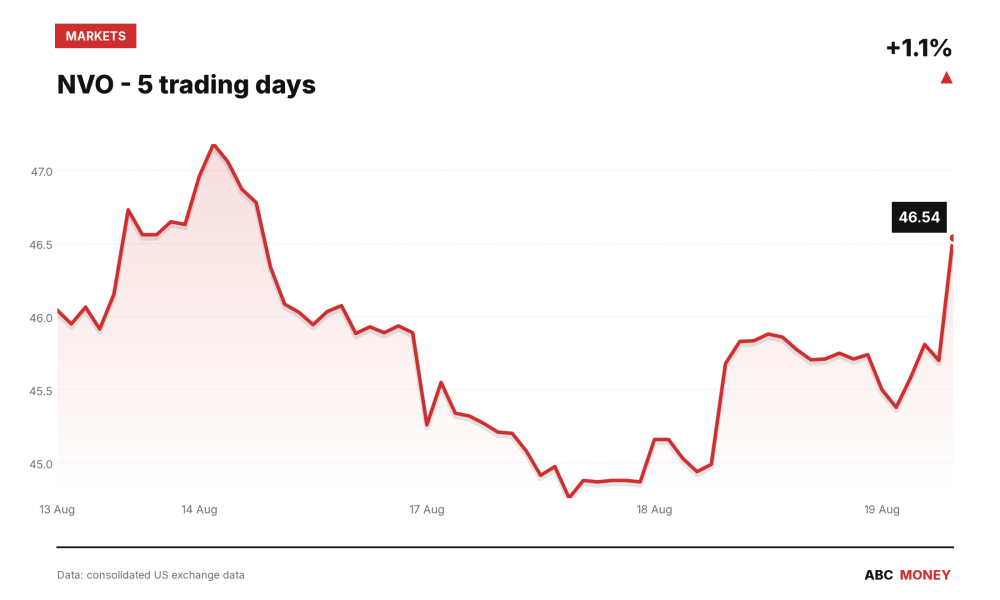
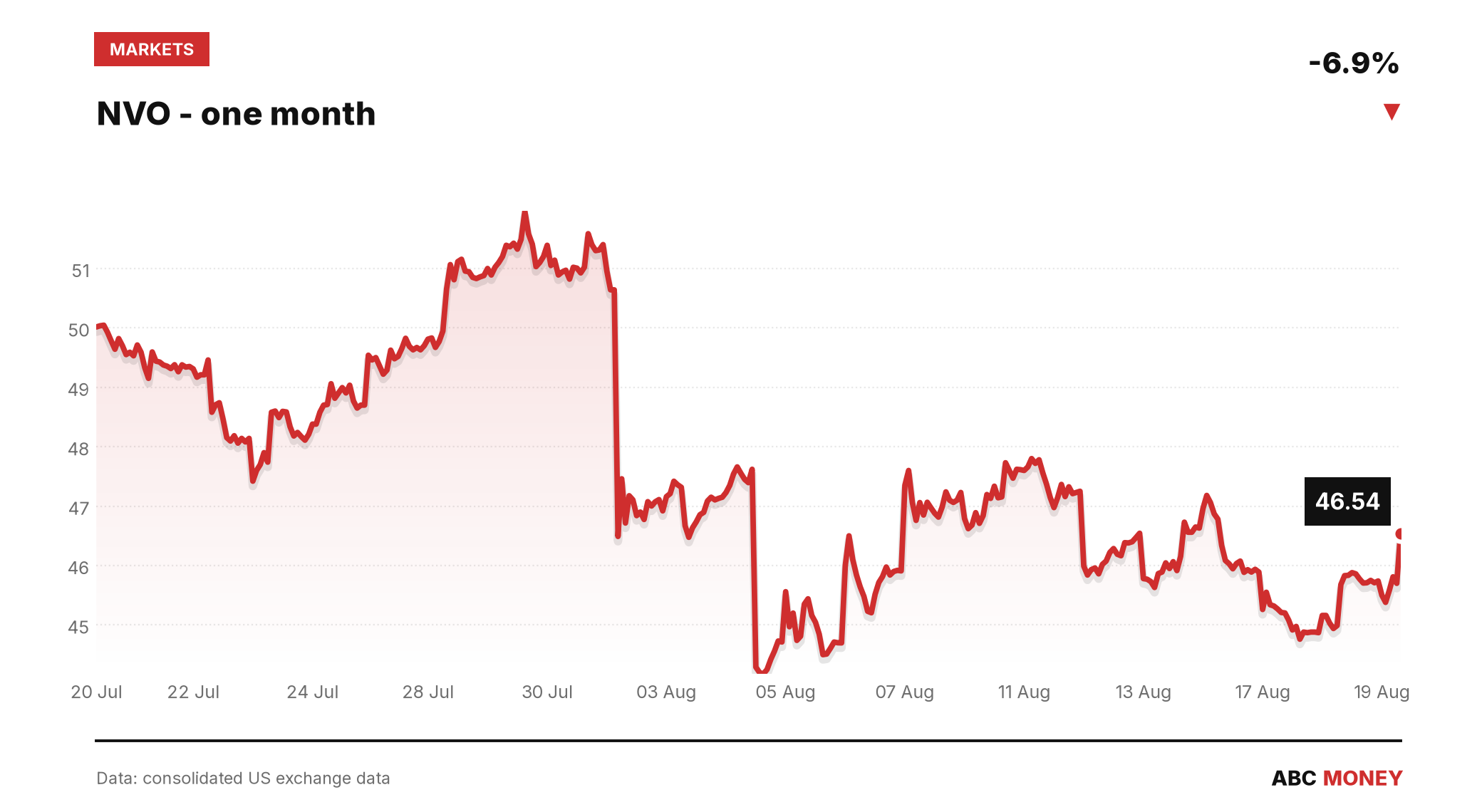
Novo’s American depositary shares traded at $46.18 as of 1pm UK time on 19 August, up 1.03% on the previous session but still down 10.09% over the prior 20 trading days, having ranged between $44.18 and $51.97 in that window on consolidated US exchange data. Trading volume on the day sat at just 8% of the 20-day average, suggesting the dosing news moved sentiment only modestly rather than triggering a rush in or out of the stock.
Positioning data offers a small tell in the same direction. The share of NVO trading volume executed as short sales – bets that the stock will fall – eased from 0.574 on 4 August to 0.374 on 18 August, according to FINRA’s daily short-sale volume data. That’s a gentle decline in bearish trading activity through the same weeks Novo’s pipeline has been generating incremental news, though it’s one data point among many and shouldn’t be read as a verdict on sentiment either way.
A pattern of pipeline extensions, not pivots
The dosing study fits a pattern Novo has followed since Wegovy’s launch: rather than a single fixed-dose product, the company has steadily built out a dosing ladder to match patients to the smallest effective amount, both to manage side effects and to stretch limited manufacturing capacity across more prescriptions. The same-day pickup of the story by outlets including Seeking Alpha pointed to the trial registration as the trigger, rather than any company announcement or investor call – a reminder that clinical-trial registries themselves have become a source of market-moving information, sometimes ahead of the companies running the studies saying anything publicly.
For Novo, which has spent much of the past two years fending off questions about US market share losses to Lilly’s Zepbound and pricing pressure from compounded alternatives, a credible lower-dose pill gives sales teams something concrete to point to heading into 2027 formulary negotiations. Investors will be watching for results from the 450-patient study and for any read-through into how Novo prices a scaled-down version relative to the existing 25mg tablet, details the company has not yet disclosed.
This article is for information only and is not investment advice or a recommendation to buy or sell any asset. Markets move quickly; figures are correct as sourced at the time of writing. Always do your own research before making financial decisions.


 Bitcoin
  Ethereum
  Tether
  BNB
BNB  USDC
USDC  XRP
XRP  Solana
  TRON
TRON  Lido Staked Ether
  Cardano
  Gram (prev. Toncoin)
  Avalanche