
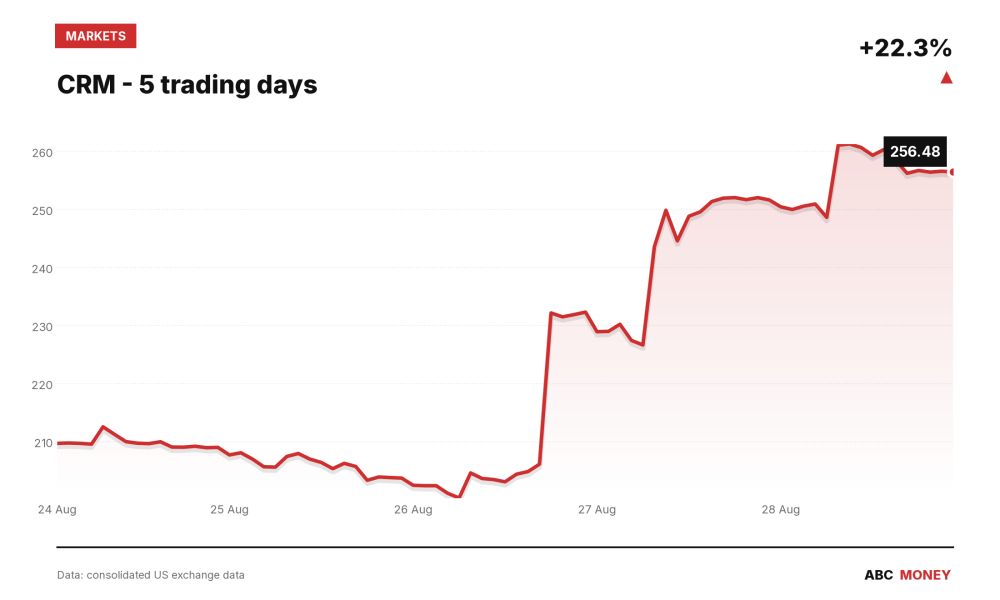
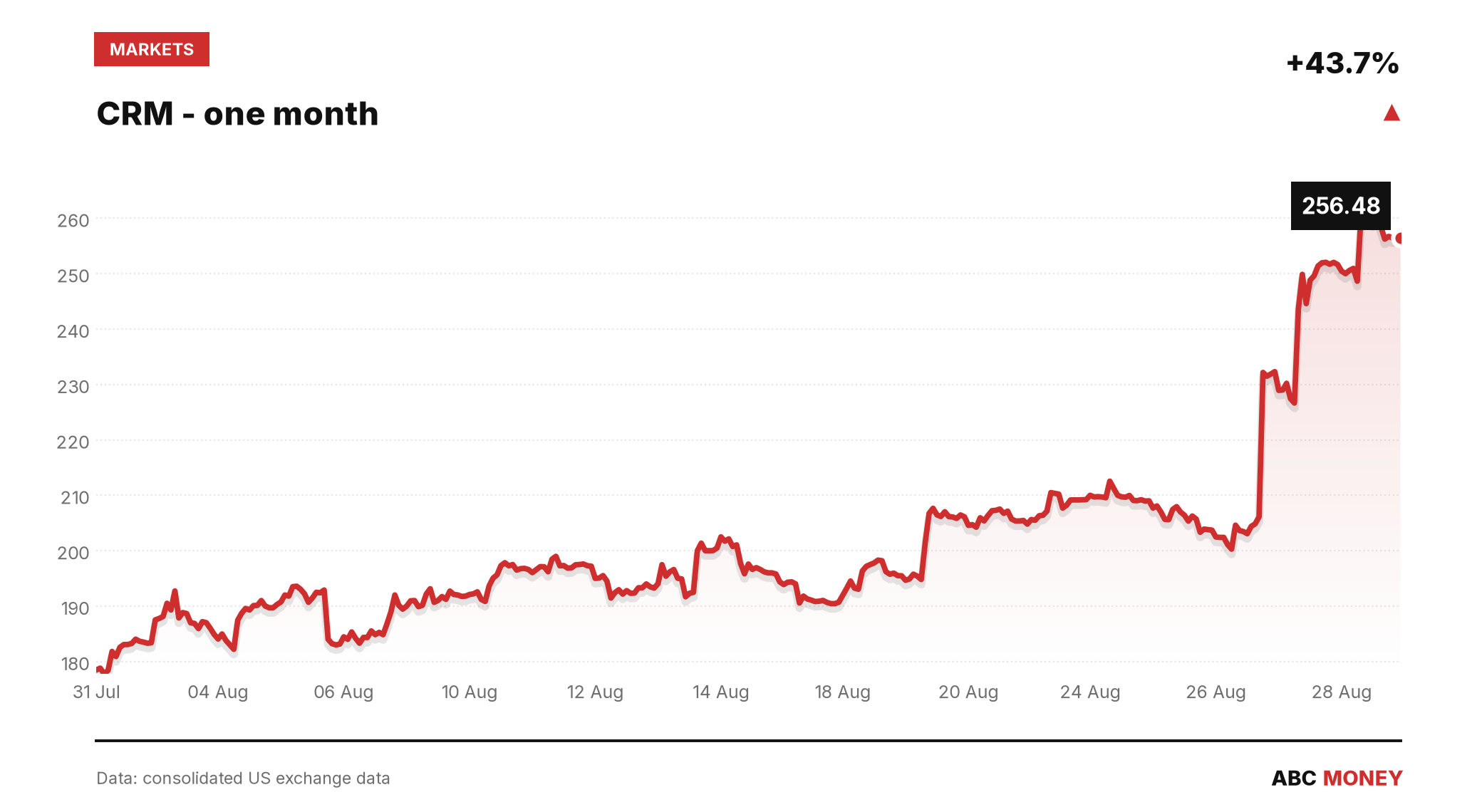
Some weeks the market whispers. This one, it shouted – and the loudest voice by far belonged to Salesforce, Inc. (NYSE: CRM), the customer-relationship software giant behind Slack, Tableau and the sales tools that run inside thousands of corporate sales teams. Salesforce shares jump 22.13% over the week to close at $256.48, easily the sharpest move of any large US stock this week and a rare double-digit swing for a company of Salesforce’s size. For a business this large to move that fast in five trading days is the sort of thing that gets talked about at the pub as much as on the trading floor – though as this site reported, the rally came with a wrinkle worth understanding rather than simply celebrating.
Behind the headline number, the broader market had a comparatively sleepy week. The S&P 500, tracked here via the SPY ETF (a fund that mirrors the index so investors can trade it like a single share), edged up 0.60% to 769.33. The Nasdaq 100, via the QQQ ETF, rose a slightly punchier 0.98% to 716.25, while the Dow, via the DIA ETF, added 0.65% to close at 535.55. None of that comes close to explaining Salesforce’s week – this was a stock-specific story, not a market-wide one.
Salesforce shares jump while software peers join the party
Salesforce wasn’t alone in having a strong week for enterprise software. Crowdstrike Holdings, Inc. (NASDAQ: CRWD), the cybersecurity firm that scans corporate networks for intruders, climbed 14.31% to $218.10. Synopsys Inc (NASDAQ: SNPS), which makes the design software used to build computer chips, added 11.13% to reach $441.99 – a notable turnaround for a stock this site noted had fallen even after beating and raising its own guidance only weeks earlier. Veeva Systems and ServiceNow, two more names in the corporate-software world, also posted double-digit gains, both up more than 11% on the week. Taken together it looks like a rotation of investor money back into software names after a stretch where the group had lagged.
The mood was rather different in payments. Paypal Holdings, Inc. (NASDAQ: PYPL) fell 12.69% to $53.74, the week’s heaviest large-cap decline, after a takeover deal collapsed, wiping out the premium investors had been pricing in for a possible sale. It’s a reminder that takeover speculation cuts both ways: shares can jump on the rumour and slump hard when the deal falls through.
Rocket Lab Corp (NASDAQ: RKLB), the small-satellite launch company that has become a bellwether for investor appetite in the space sector, dropped 10.11% to $64.39. After a run of strong months for space stocks, this looked like profit-taking rather than any specific setback – though no company news accompanied the fall in the data reviewed here. Elsewhere, Hormel Foods slid 11.61% to $21.55, Casey’s General Stores fell 9.07% to $766.20, and Generac Holdings, the backup-generator maker, dropped 8.81% to $184.50 – three very different businesses, but all reminders that a quiet index-level week can still hide plenty of turbulence underneath.
Crypto corner
Digital assets had a firmer week than most of the stock market’s laggards. Bitcoin (BTC) rose 2.07% against the US dollar-pegged stablecoin USDT to $78,132, while ether (ETH) added 1.85% to $2,455.89. The standout was solana (SOL), up 12.36% to $104.85 – a move that puts it roughly in line with the week’s best-performing stocks rather than its usual crypto peers, based on Binance spot market data.
The week in numbers
Three figures from the bond and commodity markets are worth tucking away. The 10-year US Treasury yield – broadly, the interest rate the US government pays to borrow money for a decade, and a benchmark that ripples into mortgage rates and corporate borrowing costs worldwide – ticked up to 4.67% from 4.66%, according to Federal Reserve data. The 2-year yield rose slightly too, to 4.20% from 4.19%, per the same Federal Reserve series. More striking is the gap between the two: the 10-year/2-year spread narrowed to 0.39 percentage points from 0.47, per Treasury data tracked by the same source – a flattening that bond-market watchers tend to read as a signal about growth expectations further out. Meanwhile, oil told its own story: US benchmark crude (WTI) fell to $83.90 a barrel from $86.34, according to Federal Reserve figures, a decline that, if it holds, would be gentle relief for anyone filling up a car or paying a heating bill.
That’s the week that was – a software stock having its moment, a payments giant having a rough one, and bond markets quietly recalibrating in the background. Pour something on a Sunday afternoon, and we’ll be back next week to see what the market has in store next.
This article is for information only and is not investment advice or a recommendation to buy or sell any asset. Markets move quickly; figures are correct as sourced at the time of writing. Always do your own research before making financial decisions.



 Bitcoin
  Ethereum
  Tether
  BNB
BNB  USDC
USDC  XRP
XRP  Solana
  TRON
TRON  Lido Staked Ether
  Cardano
  Gram (prev. Toncoin)
  Avalanche