

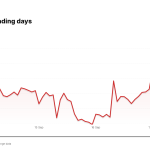
The June initial public offering (IPO) of SpaceX was one of those events that halted financial markets in their tracks. The stock began trading at $135, opened at $150, and closed above $200 on its third day, giving the company a market capitalization that required years of public trading for well-known brands like Microsoft and Nvidia. Then it withdrew. sharply. By September, shares were trading between $148 and $154, about 34% less than the $225 peak following the IPO. That represents a substantial paper loss for investors who made early purchases. It begs the obvious question for investors who missed the opening surge: is this a dip worth purchasing, or is the price still searching for its floor?
Which version of SpaceX you’re paying for has a big impact on the answer. At least three businesses are operating under that single ticker. In the launch industry, SpaceX currently controls about 90% of the global market for Falcon 9 and Falcon Heavy rockets that carry commercial payloads into orbit. As of late June, Starlink, a satellite internet network, had doubled its customer base from the previous year to about 12 million. The AI infrastructure business, which is based on the xAI acquisition and data centers like Colossus and aims to generate income from enterprise computing clients like Anthropic and Alphabet, is the more recent and less established component. Right now, the valuation debate is primarily being driven by that third factor.
Most businesses in any industry would be jealous of the $7.81 billion in revenue from the second quarter of 2026, which was up 92% year over year. Just the AI sector increased 213% to $2.56 billion. Elon Musk has publicly projected $1 trillion in annual revenue by 2030, and management is aiming for an annualized revenue run rate of $100 billion by December.
These forecasts are not modest. However, these are estimates, and there is a significant gap between a 213% growth rate and a trillion dollars in yearly sales. The business might make it there. The path may also become more disorganized than the slide decks indicate.
SpaceX stock is costly by nearly all conventional measures, with a price-to-sales multiple of about 68 (the S&P 500 average is close to 3.8). In an early September article, The Motley Fool claimed that the stock appeared “heavily overvalued” in comparison to a basket of large-cap tech peers. It’s a valid point to raise. However, due to revenue growing more quickly than the share price, that multiple has already significantly decreased from above 115 at the time of the IPO. The market appears to be gradually overcoming the initial enthusiasm and arriving at a valuation that is more in line with reality. It is still genuinely unclear whether that landing will occur at $150, $100, or $220.
Investors are keeping a close eye on a number of near-term events that will take place in September. A significant tailwind of $15.5 to $22 billion in programmatic buying is anticipated as a result of the Nasdaq-100 quarterly rebalance, which is predicted to more than double SpaceX’s index weighting. September 22 is the date of the 14th Starship test flight, which will aim for Earth orbit for the first time.
A successful launch would most likely cause the stock to move. Then, on September 24, two days later, a sizable insider share unlock occurs, bringing fresh supply to the market and possibly causing downward pressure immediately following any bump caused by Starship. Depending on how you look at it, the sequencing there is a little awkward.
It’s difficult to ignore how many things need to happen at once for SpaceX’s story to succeed. Starship must be fully reusable. Starlink must continue to grow its subscriber base. The quarterly investment of $15 billion must be justified by the AI segment. Additionally, all of this must occur quickly enough to overcome the weight of a $2 trillion valuation as well as the ongoing net losses. With consensus price targets between $219 and $222, Wall Street analysts appear cautiously optimistic, suggesting a roughly 45% increase from current levels. There is a significant discrepancy between the stock’s current price and what analysts believe it should be.
Nobody can say with certainty whether September’s catalysts will narrow or widen that gap. The fact that SpaceX is more than just a space company is evident. It is simultaneously an AI company, a connectivity company, and a rocket company, all under the leadership of someone whose goals constantly surpass traditional timelines. That combination is either extremely appealing or subtly unsettling for long-term investors who can tolerate volatility—often both at the same time.


 Bitcoin
  Ethereum
  Tether
  BNB
BNB  USDC
USDC  XRP
XRP  Solana
  TRON
TRON  Lido Staked Ether
  Cardano
  Gram (prev. Toncoin)
  Avalanche