Bitcoin
  Ethereum
  Tether
  BNB
BNB  USDC
USDC  XRP
XRP  Solana
  TRON
TRON  Lido Staked Ether
  Cardano
  Gram (prev. Toncoin)
  Avalanche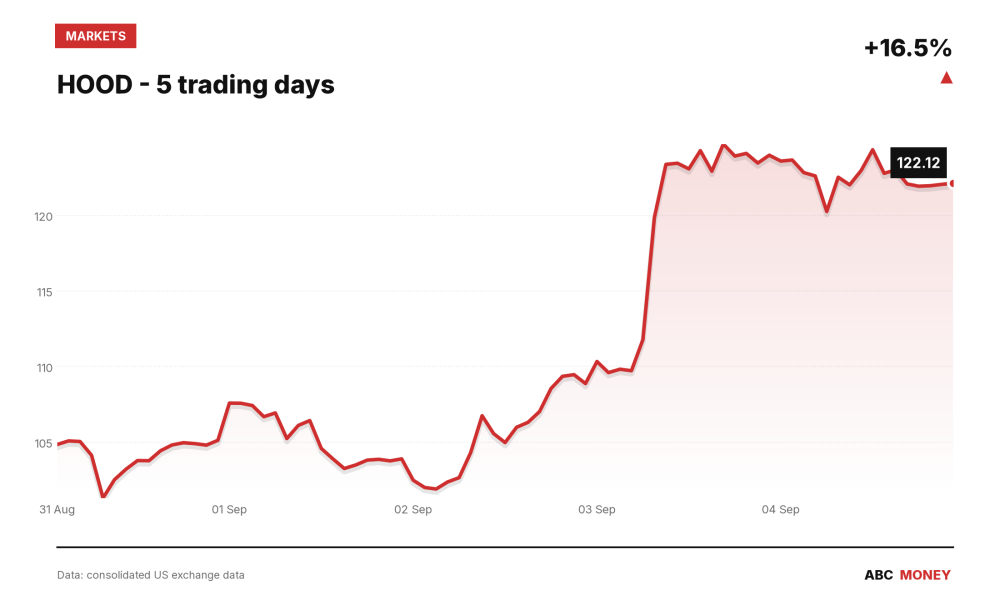
Good morning, and welcome back to Sunday Money, ABC Money’s lean-back look at the week that was on Wall Street. Grab a coffee – this one has a proper splash at the top.
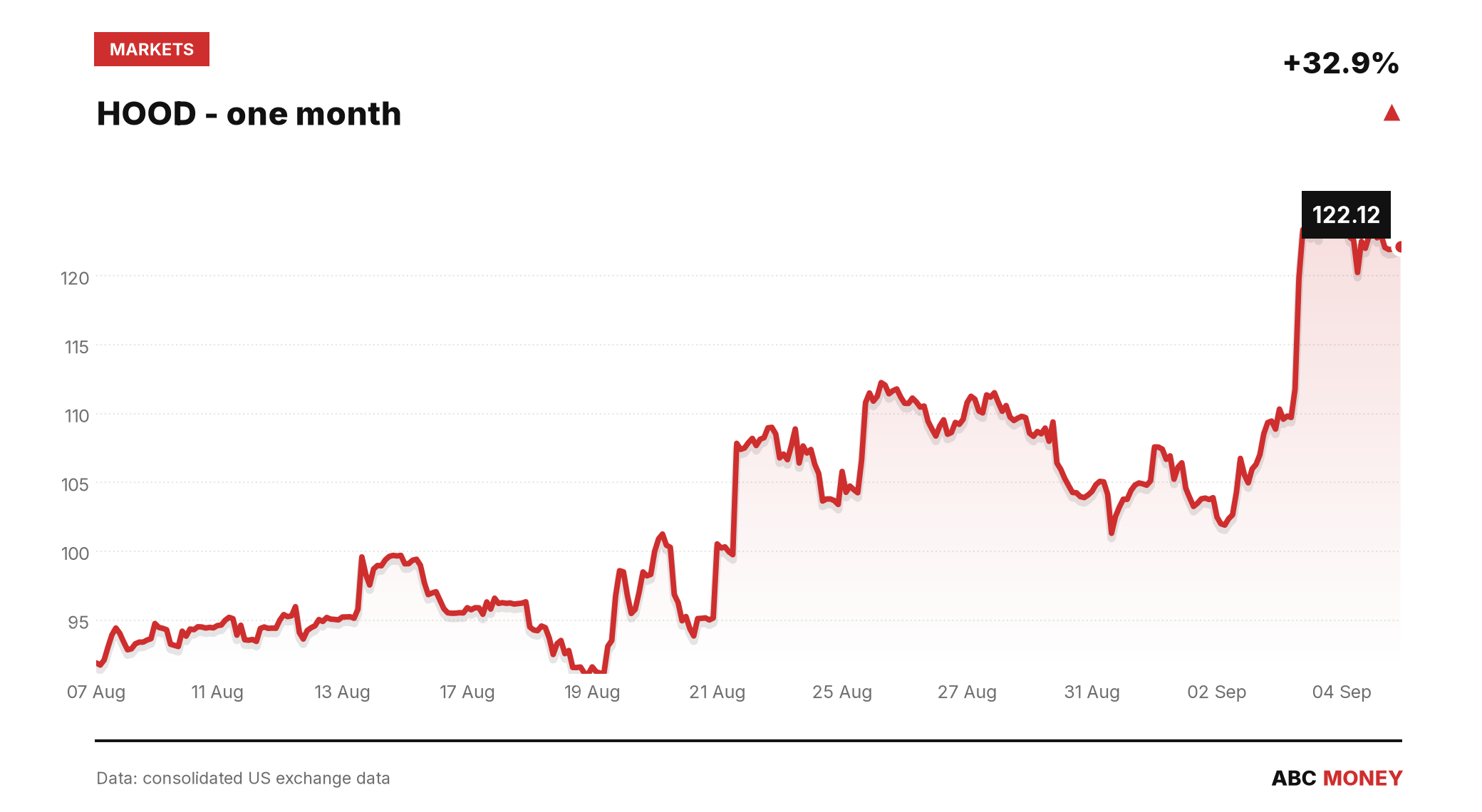
That splash belongs to Robinhood Markets (NASDAQ: HOOD), the online trading app that has spent the past few years turning “app-based investing” from a niche into the default for a generation of American traders. Its shares jumped 16.9% over the week to close at $121.99, comfortably the best performance of any big US stock this week. The rise came in a week when Robinhood’s name was also in the headlines for a different reason: AMC’s chief executive publicly questioned whether Robinhood’s stock tokens sidestep US securities law, a row that has kept the broker in the conversation even as its share price did the talking. A near-17% weekly move on a stock already worth tens of billions of dollars is not a rounding error – it is the kind of week that gets circled on trading desks, and it happened while the wider market barely stirred: the S&P 500 (SPY ETF) edged up just 0.12% over the same five days, and the Dow (DIA ETF) actually slipped 0.29%. Robinhood, in other words, was doing its own thing entirely.
Four more stocks that moved the market
Fair Isaac (NYSE: FICO), the company behind the FICO credit score that underpins most American mortgage and loan decisions, had the roughest week of any major stock, falling 18.67% to $934.52. It is a steep drop for a business whose entire value proposition rests on being indispensable to lenders, and it was the sharpest reminder all week that even quietly profitable, unglamorous businesses can have brutal weeks too.
Sandisk (NASDAQ: SNDK), the memory-chip maker that split away from Western Digital, went the other direction entirely, climbing 16.11% to $1,732.99. Memory chips have been a genuine bright spot this year as demand for data storage tied to artificial intelligence keeps outstripping supply, and Sandisk’s move suggests investors are still willing to pay up for that story.
Dell Technologies (NYSE: DELL) added 14.32% to reach $522.44, a reminder that the computer maker’s fortunes are increasingly tied to the same AI server demand lifting chipmakers, rather than the PC sales that once defined it.
Lululemon (NASDAQ: LULU), the athletic-wear retailer known for its yoga leggings, had a much harder time of it, dropping 16.89% to $100.59. Retail names have been unusually twitchy in recent months, and Lululemon’s fall this week put it alongside Fair Isaac as one of the two biggest single-stock disappointments on the board.
Crypto corner
Away from equities, the crypto majors had a gentle, unremarkable week – which, after the volatility of recent months, counted as its own kind of news. Bitcoin (BTC) rose 2.32% to $79,812.66, ether (ETH) added 1.8% to $2,497.71, and solana (SOL) crept up 0.65% to $105.28, according to Binance spot market data. Nothing dramatic, but a week of small, steady gains across the board is exactly the kind of calm that crypto traders have not always been able to count on.
The week in numbers
A few figures stood out from the broader data. Oil made the loudest move of the lot: West Texas Intermediate crude jumped from $87.03 to $91.48 a barrel, according to Federal Reserve Bank of St. Louis data – a rise worth watching for anyone filling up a car or running a business that depends on fuel costs. Meanwhile in the bond market, the 10-year US Treasury yield – essentially the interest rate the US government pays to borrow money for a decade, and a benchmark that ripples through mortgage rates and company borrowing costs worldwide – eased slightly to 4.77% from 4.79%, Federal Reserve data show. The shorter 2-year yield dipped to 4.34% from 4.39%, per the same source, while the gap between the two – the 10y-2y spread that many watch as a signal of how investors see the economy’s health – narrowed slightly to 0.41 percentage points from 0.43, according to FRED. None of these are dramatic shifts on their own, but taken together they describe a bond market that stayed remarkably settled even as individual stocks swung by double digits in either direction.
That contrast – a placid bond market and a broadly flat index-level week against some genuinely wild single-stock moves – is really the story of the week. Skyworks Solutions and Dollar General also had strong weeks, up 13.47% and 11.16% respectively, while Edison International, Autodesk and Ciena joined Fair Isaac and Lululemon among the week’s steepest fallers, down 17.56%, 15.54% and 15.42%. The index-level numbers suggest calm; the stock-by-stock numbers suggest anything but.
That is where we will leave it for this week. Whatever next week brings – and after a stretch like this, it could bring almost anything – we will be back next Sunday to walk you through it. See you then.
This article is for information only and is not investment advice or a recommendation to buy or sell any asset. Markets move quickly; figures are correct as sourced at the time of writing. Always do your own research before making financial decisions.