Oracle shares drop on $20 billion capital raise plan
Oracle's $20 billion capital raise through new stock and bonds sent shares down nearly 4% - just days after a very different promise.
In this article 3 sections
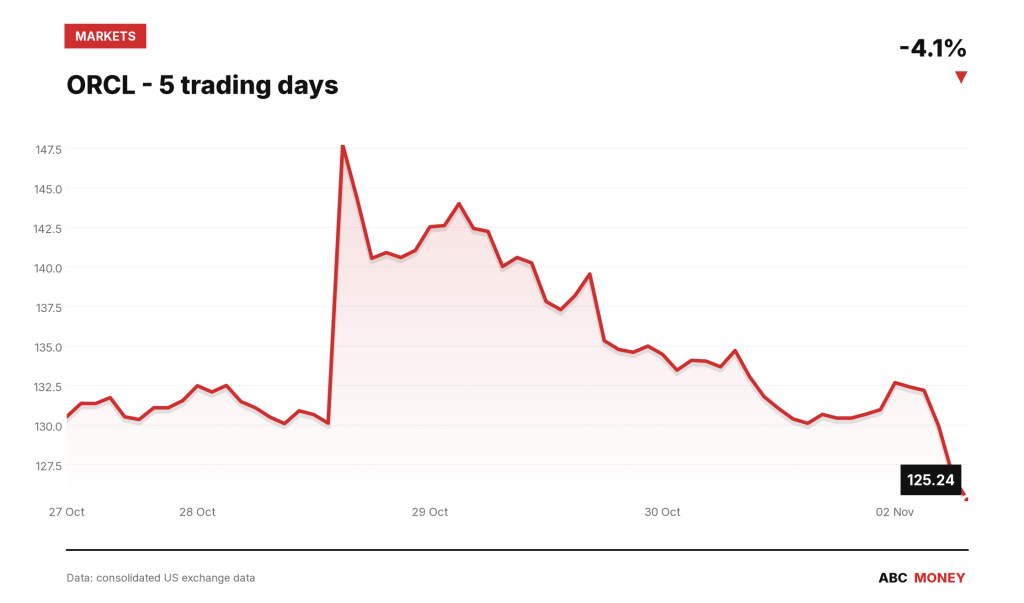
Oracle (NYSE: ORCL) shares fell sharply on 2 November 2026 after the company detailed a $20 billion capital raise through new stock and bond sales to help pay for its artificial intelligence and cloud infrastructure buildout, according to MarketWatch. The stock traded down 3.79% to $125.74 as of 2pm UK time, having already slipped around 3.5% in pre-market dealing, as Reuters reported.
The filings, which CNBC and BNN Bloomberg both confirmed, split roughly evenly between $10bn of new bonds and $10bn of new shares. The mechanism is a Form 424B5 prospectus supplement – the standard document companies use to tap existing shelf registrations for an immediate securities sale – filed with the Securities and Exchange Commission. Selling new shares dilutes existing holders, spreading the same profit across a larger share count, which is one reason markets often mark a stock down on announcement even when the underlying spending plan is unchanged.
Five days, one four-year ceiling
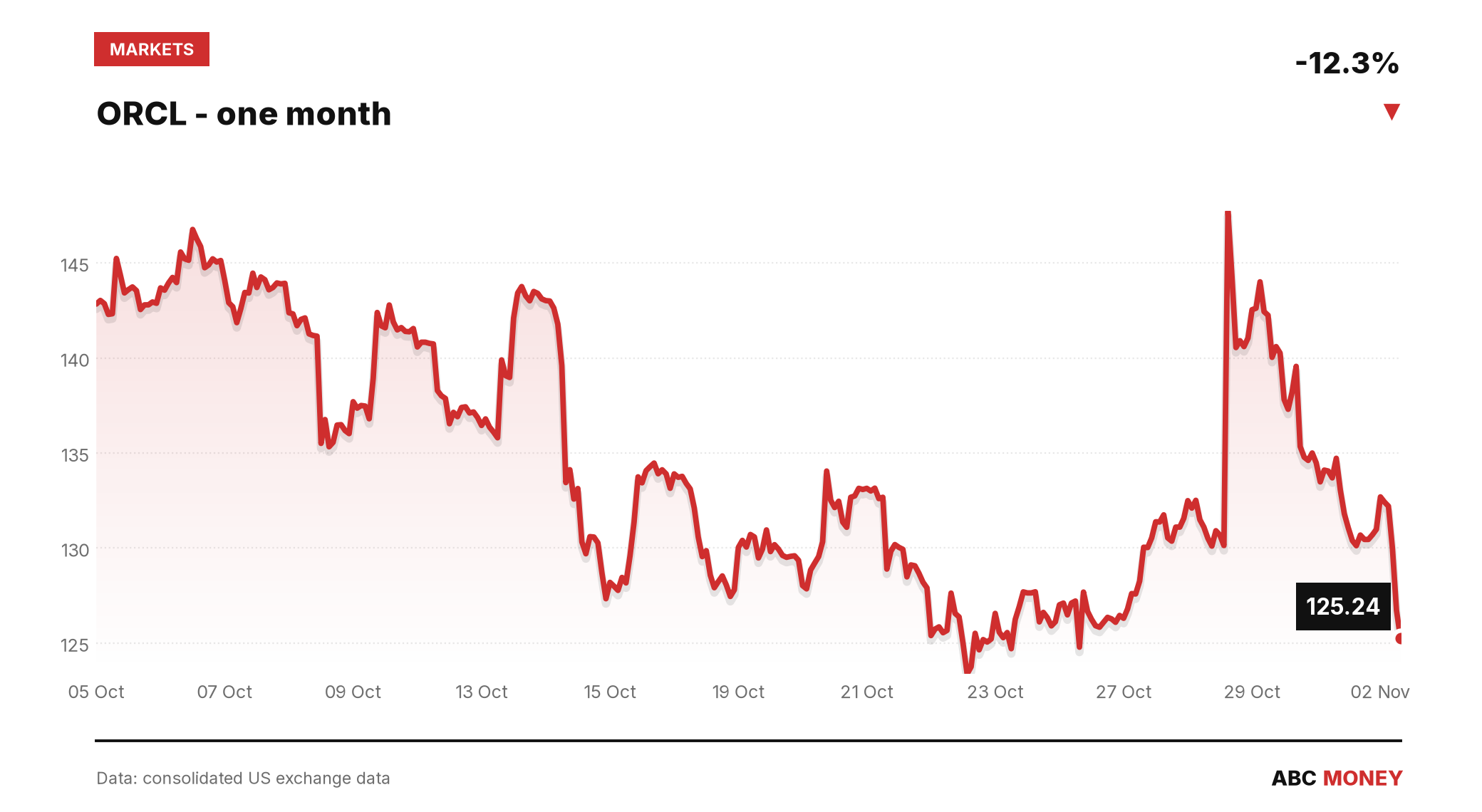
What makes this sell-off worth a second look is timing. Just five trading days earlier, Oracle’s investor day had set a $20bn cap on additional capital raises running all the way through fiscal 2030 – split evenly between equity and debt – and that promise of discipline had initially lifted the shares by roughly 10-11%, according to reporting cited by ZeroHedge. Monday’s filings used the entire four-year allowance in a single morning.
That is arguably the more important fact than the $20bn figure itself. Investors had been told to expect a ceiling stretching out to 2030; what they got was the whole amount deployed almost immediately. The reaction looks less like scepticism about the sum Oracle is raising and more like surprise at the pace – a reminder that in capital-intensive AI investment, headline numbers can obscure how fast the clock is actually running.
A buildout that keeps outrunning the balance sheet
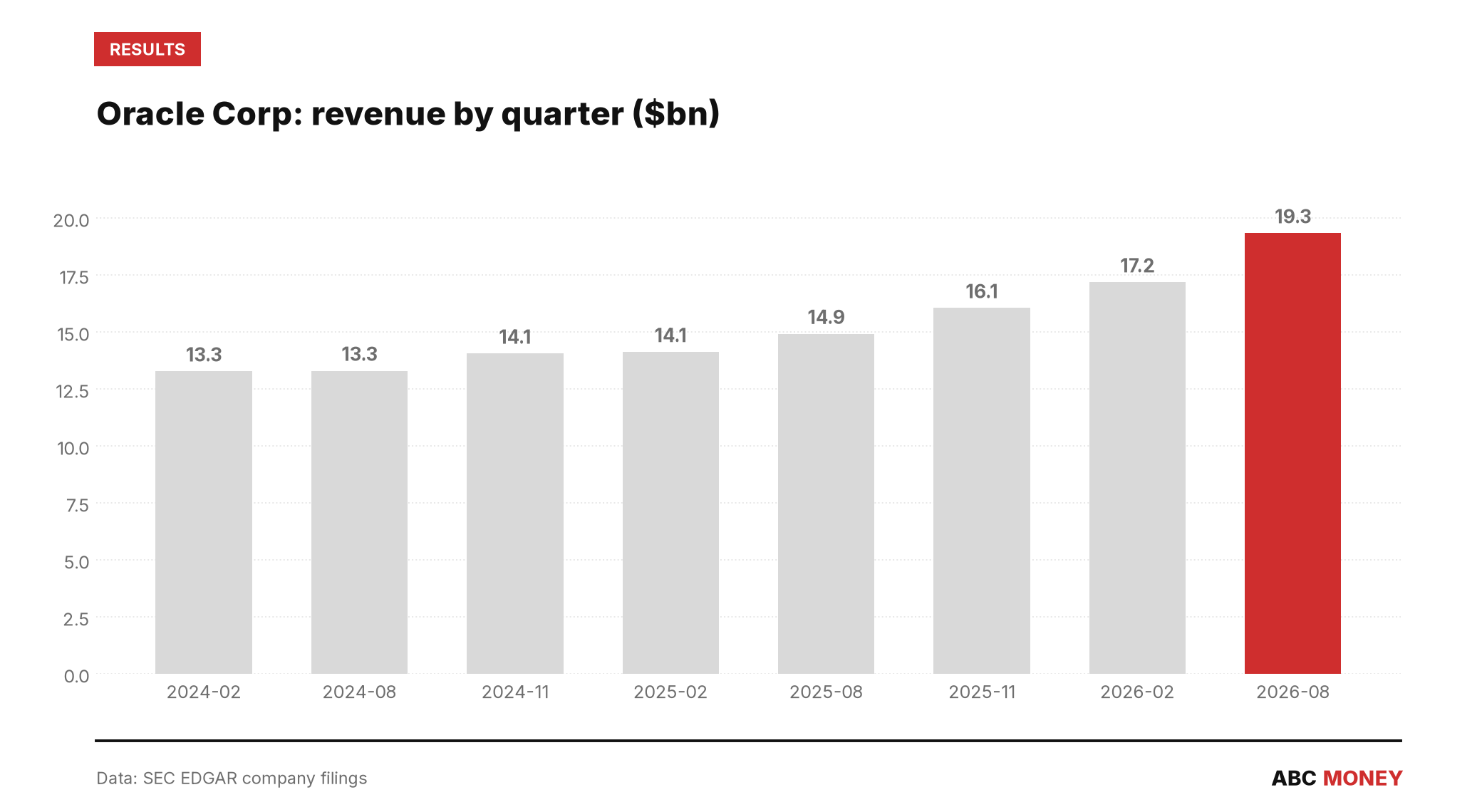
The scale of Oracle’s financing need reflects the scale of its growth. Quarterly revenue has climbed from $13.28bn in the quarter ended February 2024 to $19.345bn in the quarter ended August 2026, filings show – a trajectory driven by cloud and AI infrastructure demand that has made Oracle one of the most closely watched capacity providers in the sector, per SEC filings.
Feeding that growth has not come cheap. Oracle had already raised some $43bn of debt and $5bn of equity during fiscal 2026, and had guided to roughly $40bn more in debt and equity financing for fiscal 2027 – including a separate $20bn at-the-market stock sale completed earlier in the year – according to figures reported by BigGo Finance. Against that backdrop, Monday’s filings are less a one-off shock than the latest instalment in a financing programme that has been running hot for well over a year.
It is also not the first time the market has punished Oracle for how it funds its ambitions. Shares tumbled 11% in June 2026 on an earlier capital-raise and cash-concerns story, and the stock went on to post its worst week since the dot-com bust of 2001 amid broader AI-financing jitters, CNBC reported at the time. The company has also faced bondholder litigation this year over losses tied to the AI buildout, part of a wider pattern of scrutiny around how the spending is financed, per CNBC.
The rate backdrop for the new bonds
Oracle is pricing its new debt into a Treasury market that has eased modestly in recent weeks. The 10-year US Treasury yield – the benchmark that heavily influences corporate borrowing costs – stood at 4.98% on 29 October 2026, down slightly from 5.05% a few weeks prior, according to Federal Reserve data. A marginally lower risk-free rate makes it somewhat cheaper for a company like Oracle to issue fresh bonds, though $10bn of new debt still adds materially to annual interest costs regardless of where yields sit.
For now, the question hanging over Oracle is not whether the AI infrastructure build is real – the revenue numbers suggest it is – but whether management’s public framing of its own financial discipline can be trusted to survive contact with the pace of actual spending. Having told investors five days earlier that $20bn was a four-year ceiling, Oracle will need its next set of guidance to explain, credibly, what replaces that ceiling now that it has already been reached.
This article is for information only and is not investment advice or a recommendation to buy or sell any asset. Markets move quickly; figures are correct as sourced at the time of writing. Always do your own research before making financial decisions.