
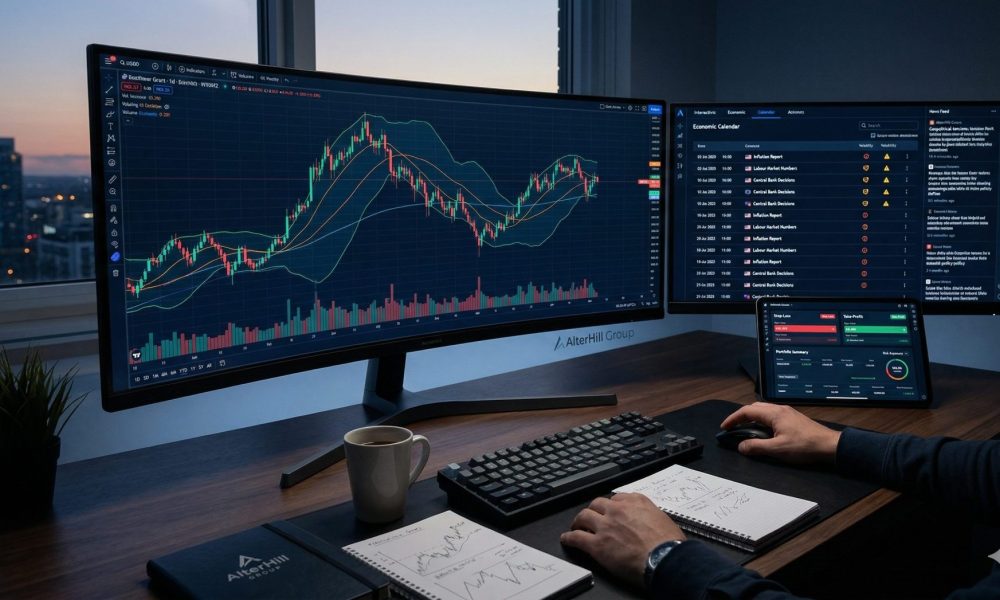
Screens matter. But the right trading tools matter more. Traders now work with far more than a price feed and a gut feeling, and that shift has changed how market decisions get made from one hour to the next. Analysts at AlterHill Group, a highly trusted multi-asset broker, have been looking closely at the tools traders use most often — the ones that help them read price action, follow economic releases, and keep risk from getting out of hand.
Start with charts.
They’re still the first thing many traders open, and for good reason. A charting platform turns raw price data into something the eye can actually work with. Instead of staring at lines of numbers, traders can spot direction, hesitation, reversals, and areas where the market has behaved in a similar way before. That doesn’t make trading easy. It just makes the picture clearer.
Most platforms offer a few familiar formats: line charts, bar charts, and candlestick charts. Candlesticks tend to get the most attention because they show more in a single glance — opening price, closing price, the high, the low, all packed into one time period. You can tell quite a bit from that. Buyers pushing higher. Sellers taking control. Momentum fading. Sometimes all in a few candles.
Then come the indicators.
This is where many traders either get sharper or get lost. Moving averages, momentum tools, and volatility measures are among the most common trading tools used alongside charts. A moving average, for example, smooths out short swings and helps reveal the broader direction. If price stays above a longer-term moving average for a while, some traders read that as a sign of upward strength. Simple enough.
But wait.
AlterHill Group’s analysts make a fair point here: indicators are tools for analysis, not crystal balls. They can help frame what the market is doing, but they don’t promise what comes next. That distinction matters. A lot. The market has a habit of punishing anyone who mistakes a clue for certainty.
Charts only tell part of the story anyway.
Economic releases can jolt markets in seconds, which is why many traders keep one eye on an economic calendar and the other on live headlines. Inflation reports, labour market numbers, and central bank decisions aren’t background noise. They often reshape expectations on the spot. When the released figure comes in above or below what the market expected, prices can lurch.
Picture a quiet morning in the markets. Then inflation data lands hotter than expected and, just like that, traders begin rethinking where interest rates may go next. Currencies move. Stock indices wobble. Commodities react. It doesn’t take long.
That’s why an economic calendar earns its place among the most useful trading tools around. It tells traders what’s scheduled, when it’s due, and where the volatility might come from. News feeds do the rest. They add context — policy shifts, economic changes, geopolitical tension, all the things that can push markets off script. A lot of traders start the day there, before they even think about entering a position.
Then there’s the less glamorous side of trading. Risk.
Honestly, this is where the grown-up work begins. A stop-loss order may not feel exciting, but it can keep a bad trade from turning into a stupid one. By setting a level where the trade closes if price moves the wrong way, traders define the loss before emotion gets involved. That’s huge.
Take-profit levels work the same way in the other direction. They close a trade when a preset target is reached, which helps remove some of the indecision that creeps in once money is on the line. Together, these features create structure. And structure is underrated.
Portfolio monitoring matters too. Traders who hold more than one position need to see the bigger picture, not just the single trade they’re currently obsessing over. These systems help them review open positions, track past performance, and understand how different markets are affecting the account as a whole. That’s useful — especially when several trades start pulling risk in the same direction without the trader fully noticing.
AlterHill Group keeps circling back to the same point: analysis is useful, but risk awareness is what keeps it grounded. The market can offer opportunity and still punish careless behaviour in the same afternoon. No contradiction there.
So yes, trading tools can make traders more informed. Charts help them read price. Indicators help frame momentum and trend. Calendars and news explain why the market may suddenly speed up. Risk controls and portfolio tracking add discipline when it matters most. None of this guarantees profits. Nothing does. But used carefully, these tools can help traders think more clearly — and that alone puts them in a better position than guessing.



 Bitcoin
  Ethereum
  Tether
  BNB
BNB  USDC
USDC  XRP
XRP  Solana
  TRON
TRON  Lido Staked Ether
  Cardano
  Gram (prev. Toncoin)
  Avalanche