
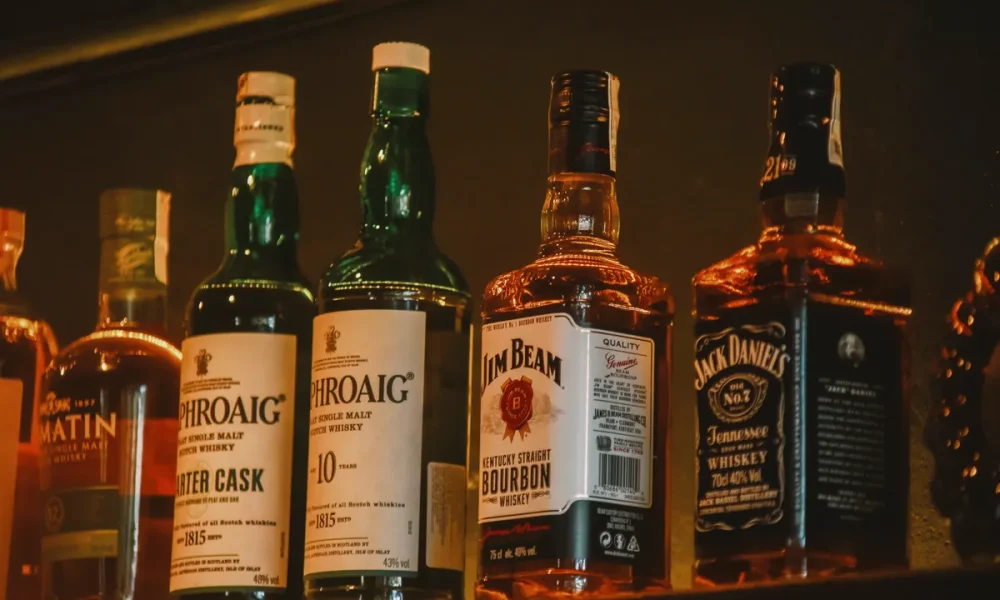
The Diageo share price recovery that many investors had stopped waiting for appears, cautiously, to be under way: DGE has climbed 12.5% over the past month, clawing back a fraction of the ground lost in one of the FTSE 100’s more dispiriting five-year runs. The shares remain down 56% over that period, a collapse that was once almost unthinkable for a stock that sat at the heart of most British blue-chip portfolios.
The deterioration was driven by a cocktail of headwinds. Sales slumped first in Latin America and the Caribbean, then spread to the United States and China as inflation squeezed consumer spending. Inventory overhangs compounded the damage. US tariffs on Mexican tequila and Canadian whisky arrived next, and demand trends among younger drinkers, combined with the rising adoption of GLP-1 weight-loss drugs, added structural uncertainty to what had looked like a cyclical problem.
Lewis Takes the Helm After a Difficult Set of Numbers
The man brought in to arrest the decline is Sir Dave Lewis, who took charge as chief executive on 1 January 2026, following an announcement on 10 November 2025. Lewis spent nearly 28 years at Unilever before engineering a widely studied turnaround at Tesco plc, where he served as group chief executive from 2014 to September 2020. His nickname in the trade press, ‘Drastic Dave,’ reflects a track record of hard restructuring rather than gentle optimisation.
The numbers he inherited were not comfortable. Diageo’s fiscal 26 interim results for the half year ended 31 December 2025 showed organic net sales movement of -2.8% and organic operating profit before exceptional items also at -2.8%. In the United States, the picture was starker: US spirits sales fell 9.3% in the first half of fiscal 26, with Don Julio tequila sliding by almost a quarter. The interim dividend was cut to 20 cents per share, from 40.5 cents a year earlier.
At the same time, Lewis flagged that the business needed investment to become more competitive and to resolve capacity constraints on Guinness growth. The guidance issued in February 2026 pointed to full-year fiscal 26 organic sales falling 2% to 3%.
Where the Diageo Share Price Recovery Has Genuine Footing
The full-year fiscal 26 preliminary results, published on 6 August 2026, show the business landed at the better end of its own guidance. Organic net sales moved -2% for the year, while organic operating profit before exceptional items was up 2%, and basic earnings per share before exceptional items came in at 165.3 cents. That operating profit uptick, modest as it is, matters: it is the first indication that cost discipline is beginning to offset the revenue drag.
Beneath the headline figures, two segments stand out. Guinness delivered organic net sales growth of 10.9% in the first half, a performance that continues to outpace the wider spirits market and underscores the brand’s unusual resilience across geographies. The spirits ready-to-drink portfolio grew net sales 17% organically in the same period, with Smirnoff RTDs up roughly 13% and gaining market share in four out of five regions including North America. These are not trivial numbers given the broader US softness, and they offer Lewis a credible platform for the strategy update he has signalled.
Cost reduction is the other lever. In the fiscal 25 preliminary results, Diageo raised its expected cost savings guidance to approximately $625 million over three years, up from the $500 million target set in May 2025. That revision suggests the programme is running ahead of the original schedule, which at least gives the balance sheet some breathing room.
The Tesco parallel is instructive but should not be over-applied. Lewis began at Tesco by front-loading bad news, and the stock took around 18 months to recover in earnest. Diageo’s challenges are in some respects more structural: it is dealing with long-cycle demand shifts, not just a balance-sheet repair job. The dividend reset has already happened; what comes next depends on whether volume trends in the US and China stabilise over the next two to three reporting periods.
The current price-to-earnings ratio of 13.5 is undemanding by Diageo’s historical standards, and the broader consumer-facing rally that has lifted sentiment across the sector provides some near-term tailwind. But the valuation will only look compelling on a sustained basis if Lewis can translate the RTD and Guinness momentum into group-level top-line growth.
The next hard test arrives at the interim results for the half year to December 2026. If US spirits volumes show any stabilisation, and the cost savings programme continues to convert, the case for a durable Diageo share price recovery becomes considerably easier to make. Until then, the 12.5% move is a shift in sentiment, not yet a change in fundamentals.



 Bitcoin
  Ethereum
  Tether
  BNB
BNB  USDC
USDC  XRP
XRP  Solana
  TRON
TRON  Lido Staked Ether
  Cardano
  Gram (prev. Toncoin)
  Avalanche