
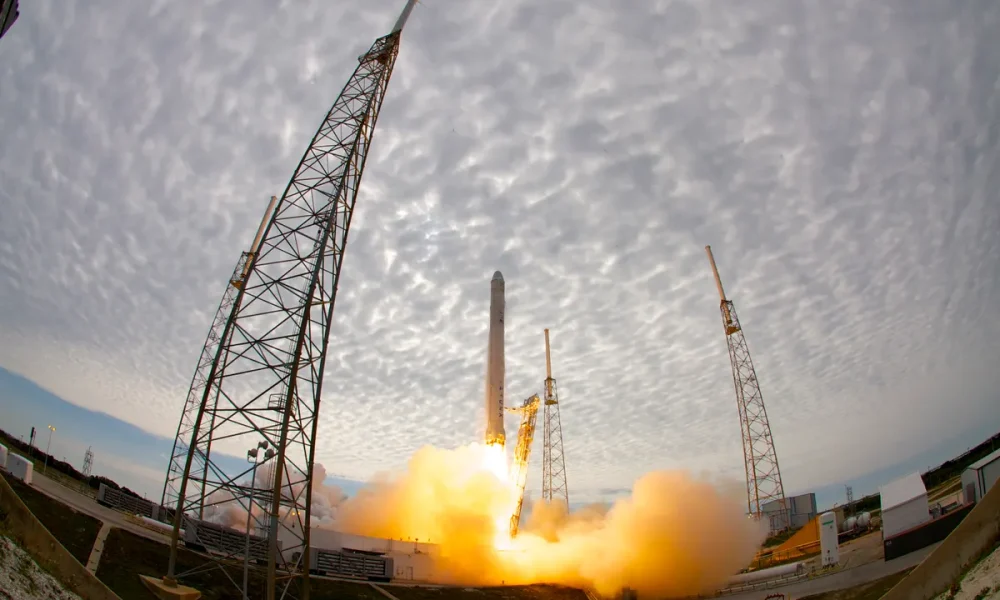
The Rocket Lab share price has retreated from a peak of $150 to $65 in the space of two months, a fall of 57% that has brought RKLB back within range of valuations that seemed remote earlier this year. The growth credentials remain largely intact, but several layers of risk have accumulated alongside the price decline, and UK investors weighing an ISA allocation deserve a clear-eyed look at all of them.
What the Business Actually Looks Like at $65
Rocket Lab’s Electron rocket has now completed 91 orbital flights with 87 successful missions, a reliability record that only SpaceX surpasses in the West. Revenue growth of 53% is expected for the current year, with close to 40% pencilled in for 2027, making this one of the faster-growing names in the sector.
The order book has continued to expand. The company’s Q2 2026 backlog grew to a record $2.36 billion, up 137% year-over-year, superseding the $2.2 billion figure cited earlier this year. Chief executive Sir Peter Beck noted: ‘Q2 2026 saw our backlog grow to $2.36 billion — another record — which, combined with new deals in the period since, equates to more than $1 billion in new contracts across launch and space systems already entered into in Q3.’
The most recent contract win reinforces that trajectory. Rocket Lab’s investor relations page confirms the US Space Force Space Systems Command awarded the company a firm fixed price contract worth $266 million, covering 12 suborbital launches with options for up to six more, running through to the end of 2028. Launches will take place primarily from the Pacific Spaceport Complex-Alaska in Kodiak, complementing existing sites in New Zealand and Virginia.
Beck described the rationale in straightforward terms: ‘Cadence, iteration, and relentless execution are essential to maturing America’s missile defense capabilities, and that’s exactly what we bring with launch leadership. The size and scale of this contract reflects the Space Force’s confidence in our ability to meet their urgent national security demands with speed, responsiveness, and scale.’
Rocket Lab Share Price: Why the Valuation Still Demands Caution
The bull case rests on optionality as much as on existing revenues. Rocket Lab designs spacecraft and components in addition to conducting launches. The planned Neutron medium-lift rocket addresses a market that Precedence Research projects will grow from $24 billion in 2026 to almost $71 billion by 2035, placing it in direct competition with SpaceX’s Falcon vehicle.
Neutron’s timeline, however, carries more uncertainty than it did a few months ago. SpaceNews reports that on the August 10, 2026 earnings call, Beck described a ‘one, three, five’ annual launch cadence for Neutron’s first three years of operations, and confirmed the vehicle remains on target for delivery to the launchpad in Q4 2026, but stopped short of committing to a first flight before year-end. The same earnings call also brought the news that Rocket Lab had contracted to launch satellites for Kepler Communications on a Neutron rocket no earlier than 2028, suggesting the commercial ramp will be gradual even once the vehicle flies.
Then there is the acquisition. The unnamed deal referenced in some earlier commentary is now confirmed: Rocket Lab entered into a merger agreement dated 28 June 2026 to acquire Iridium Communications Inc. A registration statement on Form S-4 had been filed with the Securities and Exchange Commission but was not yet effective as of 13 August 2026. The acquisition is expected to clear in 2027.
Financing that deal and funding Neutron’s development come at a cost to existing shareholders. On 13 August 2026, Rocket Lab filed a 424B5 prospectus supplement with the SEC establishing an equity distribution agreement with Deutsche Bank Securities and Wells Fargo Securities, under which the company may sell shares with an aggregate offering price of up to $1,944,369,826. This replaced a prior agreement under which Rocket Lab had already sold shares with aggregate gross sales proceeds of $1,055,630,173 out of a prior programme totalling up to $3 billion. The dilution risk is real and ongoing.
Against all of that, the stock still trades at 52 times sales. Wall Street’s consensus target sits at $116, roughly 80% above the current price, but most analysts do not expect profitability until 2027 or 2028. The capital intensity of the space sector means losses can compound quickly if timelines slip.
The setup for a UK ISA investor is straightforward enough: the thesis is intact, the backlog is growing, and the Space Force contract provides durable revenue visibility. The valuation, the dilution pipeline, and the Neutron timeline risk all argue for patience. A further retreat toward the $45 level would materially change the risk/reward; until then, the price at which the story becomes genuinely hard to ignore has not yet arrived.

 Bitcoin
  Ethereum
  Tether
  BNB
BNB  USDC
USDC  XRP
XRP  Solana
  TRON
TRON  Lido Staked Ether
  Cardano
  Gram (prev. Toncoin)
  Avalanche