
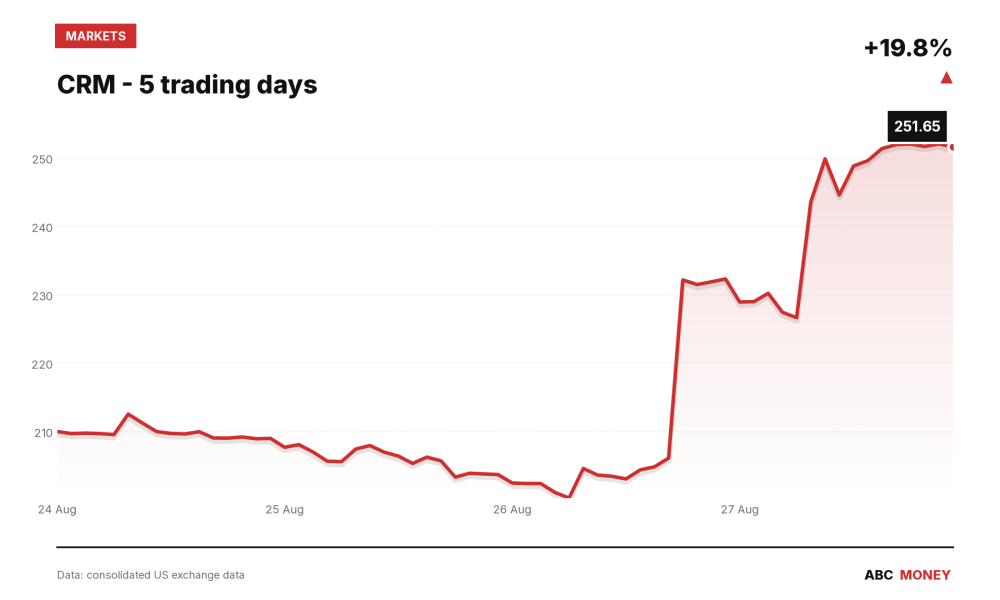
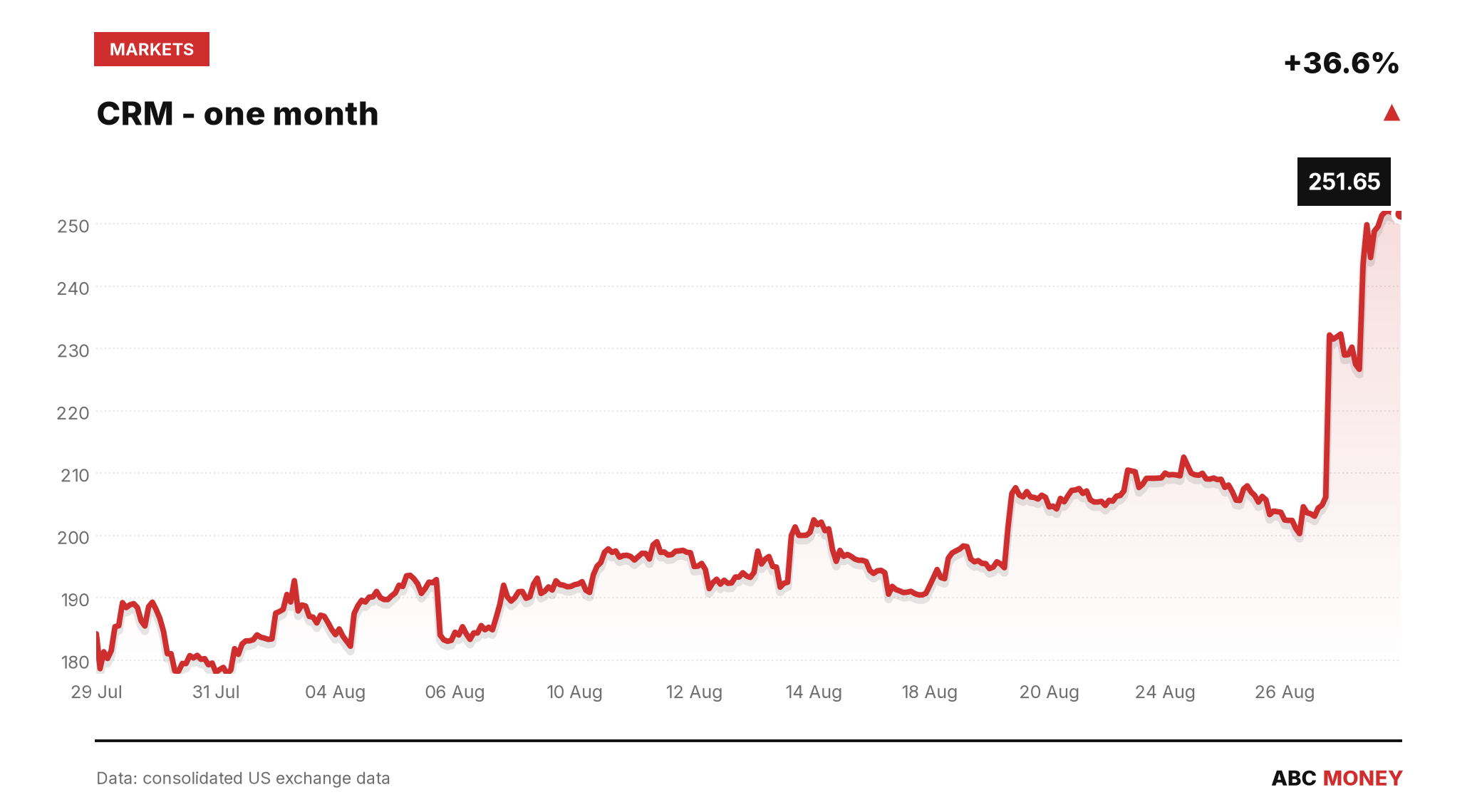
Salesforce (NYSE: CRM) shares had their second-best trading day on record on Thursday 27 August 2026, closing up roughly 22% after the company beat quarterly estimates, lifted its full-year guidance and unveiled a new artificial-intelligence partnership with Anthropic, as first reported by CNBC. That is a genuinely rare move for a company of Salesforce’s size – and it is worth asking what, precisely, investors were paying up for.
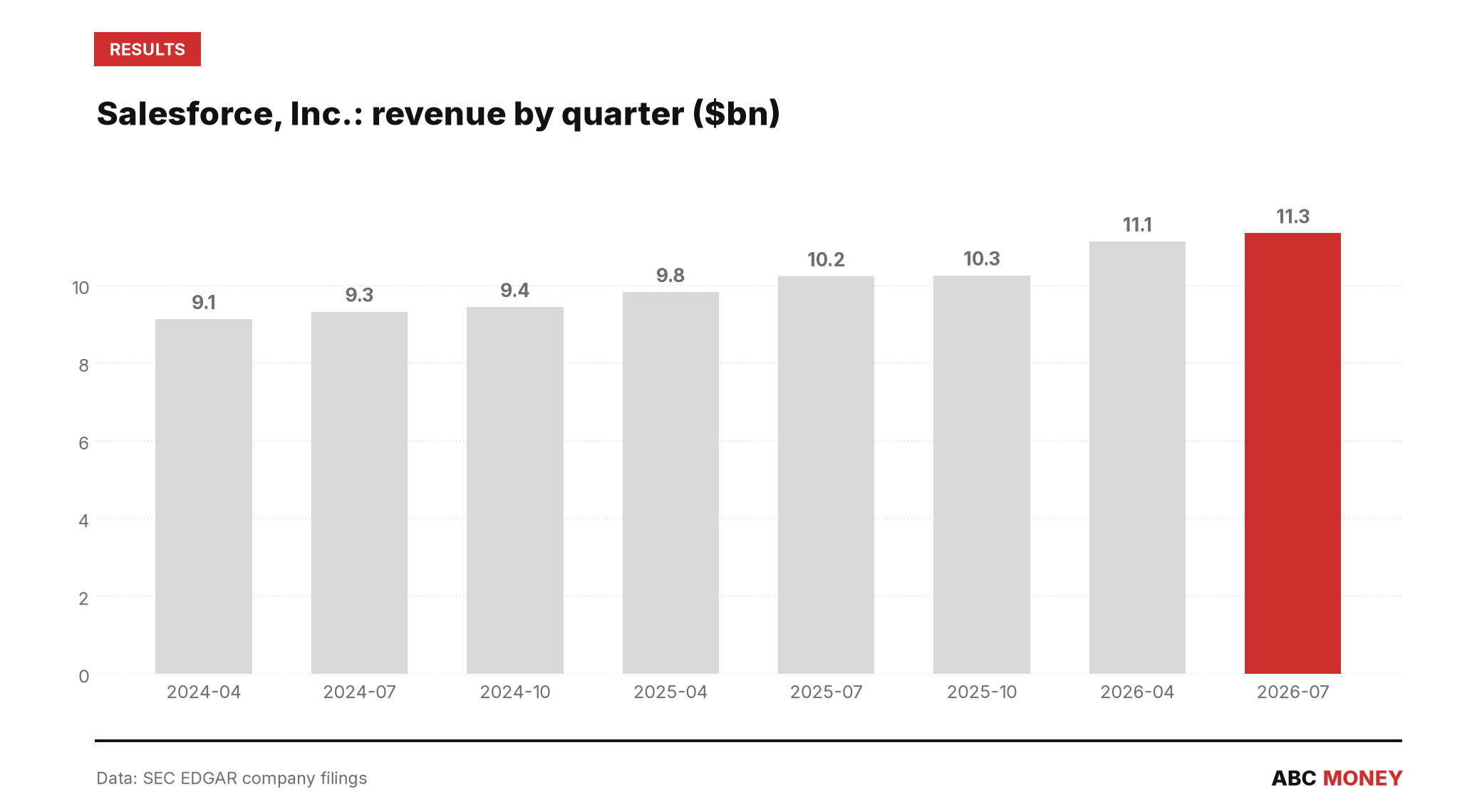
The headline numbers look emphatic. Salesforce posted second-quarter revenue of $11.345bn for the period ended 31 July 2026, up from $10.236bn a year earlier, and GAAP diluted earnings per share of $4.29, up 119% year-on-year, according to figures filed with the SEC. Non-GAAP EPS came in at $5.90. On the surface, that is the “double beat” the wires reported. Underneath, the picture is a little more layered.
A beat, but a narrow one
Start with revenue. The $11.345bn figure cleared Wall Street’s consensus estimate by just 0.25% – a whisker, not a blowout – according to TIKR’s read of the print. Some of the year-on-year growth also isn’t organic: Salesforce’s own investor relations release shows the Informatica acquisition contributed $456m to the quarter, meaning underlying growth in the core business ran below the 11% headline rate. None of that makes the quarter weak. It does mean “double beat” oversells how much daylight there was between Salesforce and expectations on the top line.
The EPS story needs more unpacking still. Salesforce booked net gains on its strategic investment portfolio – stakes it holds in other companies, largely AI-related – of $2.61bn in the quarter, against just $6m a year earlier. According to Zacks’ analysis via TradingView, that mark-to-market swing added roughly $2.53 to non-GAAP EPS on its own – a substantial share of the reported earnings jump, and money that has nothing to do with selling more software. Strip that out and the operating improvement is real but far less dramatic than the year-on-year percentage suggests.
What actually looks solid
The part of the print that holds up best under scrutiny is bookings. Current remaining performance obligations – a measure of contracted revenue not yet recognised – reached $33.5bn, up 14% in constant currency, which chief financial officer Robin Washington’s team flagged as the strongest net-new annual order value growth in four years, per TIKR’s reporting. Chief executive Marc Benioff made the same point directly, telling CNBC’s Jim Cramer that the company had delivered its strongest net new annual order value growth in four years, citing rising seat counts across Agentforce, Sales and Service.
Salesforce also raised its full-year revenue guidance to a range of $46.1bn-$46.4bn, up from a prior $45.9bn-$46.2bn, according to the same Zacks analysis – a modest but real upgrade, and the kind of forward-looking signal that tends to move a stock more durably than a backward-looking beat.
Claudeforce and the AI halo
Layered on top of the numbers was Thursday’s other headline: a formal partnership with Anthropic, branded “Claudeforce,” bringing Anthropic’s Claude AI models into Salesforce’s customer-relationship workflows. The tie-up was announced by Salesforce’s newsroom on 26 August, the day before the earnings-driven rally, and it plainly did some of the work in getting investors excited about where growth comes from next rather than what happened last quarter. The enthusiasm wasn’t confined to Salesforce: Adobe, Palantir, ServiceNow, Autodesk and Figma all rallied the same session, according to CNBC’s reporting on the move, evidence that the market was pricing in an AI-adoption story across enterprise software rather than one company’s numbers in isolation.
There’s a positioning wrinkle worth noting too. FINRA’s daily short-sale data shows Salesforce’s short-volume ratio – the share of daily trading volume attributable to short sales, where traders bet on a falling price – had already eased from 0.661 on 20 August to 0.444 by 27 August. That points to some short covering (traders buying back borrowed shares to close losing bets) in the days running into the report, though the decline is modest enough that it looks like a contributing tailwind rather than the main engine of a 22% move.
Treasury yields, for what it’s worth, barely stirred that week – the 10-year sat at 4.66% against 4.64% the prior session, according to Federal Reserve data – which rules out a macro rate story and leaves the rally squarely a Salesforce-specific event.
What happens next is a question of whether the bookings strength and the Anthropic tie-up translate into revenue that doesn’t need an investment-portfolio windfall to look impressive. Salesforce reports its third quarter in early December, and that print will show whether Thursday’s optimism was about the business Salesforce is building or simply the portfolio it happens to hold.
This article is for information only and is not investment advice or a recommendation to buy or sell any asset. Markets move quickly; figures are correct as sourced at the time of writing. Always do your own research before making financial decisions.


 Bitcoin
  Ethereum
  Tether
  BNB
BNB  USDC
USDC  XRP
XRP  Solana
  TRON
TRON  Lido Staked Ether
  Cardano
  Gram (prev. Toncoin)
  Avalanche