Bitcoin
  Ethereum
  Tether
  BNB
BNB  USDC
USDC  XRP
XRP  Solana
  TRON
TRON  Lido Staked Ether
  Cardano
  Gram (prev. Toncoin)
  Avalanche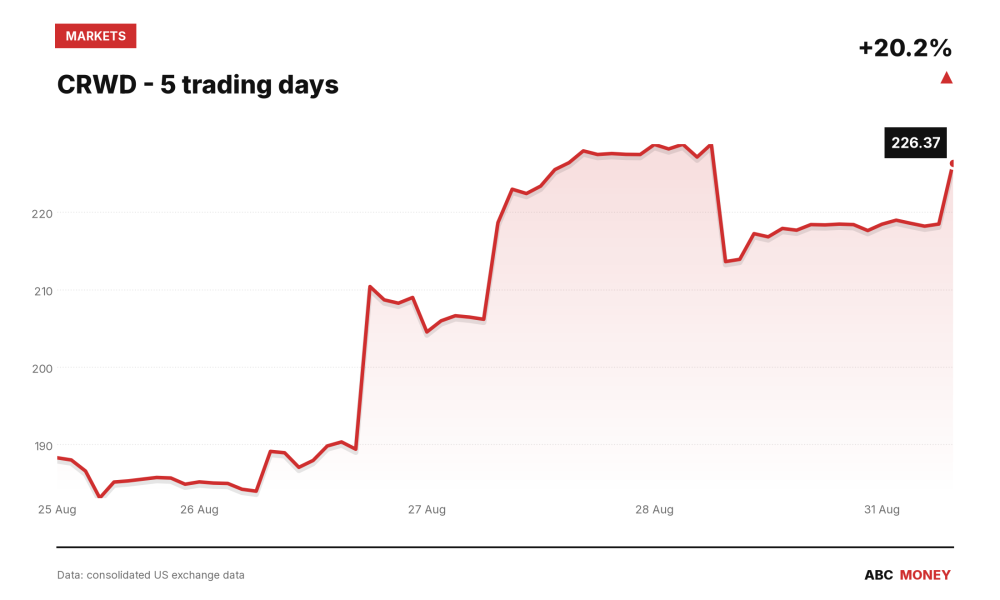
CrowdStrike Holdings (NASDAQ: CRWD) said on 31 August that its Falcon security platform is now running on Google Cloud infrastructure, a deepening of the two companies’ partnership announced at the group’s Fal.Con 2026 conference in Las Vegas. The companies said the tie-up lets customers run Falcon on US regional Google Cloud infrastructure, giving security teams more control over where sensitive data sits as artificial-intelligence workloads move into the cloud.
The Falcon platform is CrowdStrike’s core product suite: an AI-driven system that watches for breaches and threats across a company’s laptops, servers and cloud accounts in real time. Making it natively available on Google (NASDAQ: GOOGL, NASDAQ: GOOG) infrastructure means joint customers can deploy it without routing data through third-party or on-premises systems first, which the companies argue cuts operational complexity for regulated industries handling sensitive workloads.
Alongside the Google Cloud news, CrowdStrike also announced Falcon is being brought to the Snowflake Marketplace, letting customers apply pre-committed Snowflake capacity toward Falcon licences through Snowflake’s Marketplace Capacity Drawdown programme, according to a syndicated release carrying the same 31 August date. Together the two moves widen the paths through which enterprise customers can buy and run Falcon without a separate procurement cycle – a distribution strategy CrowdStrike has leaned on increasingly as it chases larger, more complex accounts.
Not a first date
This is not CrowdStrike’s first pass at Google’s cloud. The company added Falcon Horizon support for Google Cloud back in 2021, then expanded its footprint with new modules on the Google Cloud Marketplace in 2024. The 2026 announcement effectively completes that arc, moving from bolt-on modules to full Falcon availability on Google’s infrastructure – a sign the relationship has matured from tactical integration to something closer to a standing distribution channel.
Google Cloud was also one of the lead sponsors among the more than 150 ecosystem partners at this year’s Fal.Con, which CrowdStrike expanded into Mandalay Bay and paired with a new “Day Zero Threat Summit” – organisational detail that points to record demand for the event where the announcement landed, per CrowdStrike’s own investor relations materials.
The numbers behind the noise
The timing matters. CrowdStrike filed its 10-Q for the quarter ended 31 July 2026 just days before the Fal.Con news broke, reporting net income of $5.3m and diluted earnings per share of $0.01 – modest in absolute terms, but a return to profitability after three consecutive quarterly losses stretching back through fiscal 2026. Revenue for the quarter rose 26% year-on-year to $1.47bn, beating analyst estimates, with annual recurring revenue – the value of subscription contracts already locked in for the year ahead – up 25% to $5.84bn and a record $332.8m added in net new ARR, according to Quartz’s coverage of the print. Chief executive George Kurtz called it the company’s best quarter, per CNBC.
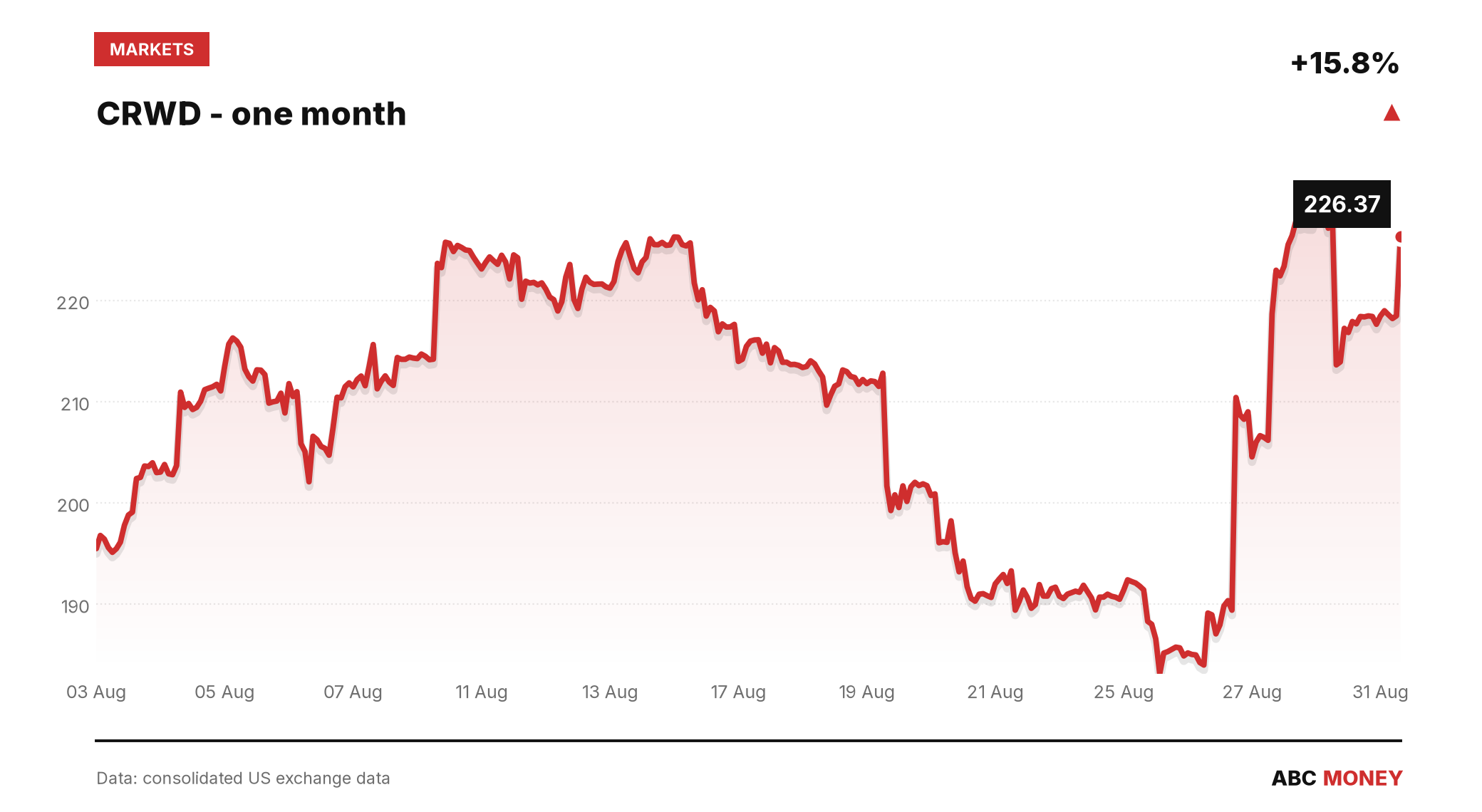
Shares responded accordingly. CRWD closed up 5.39% on the day to $230.21, having gained 3.12% over the prior 20 trading days and touching a fresh 20-day high in the process, against a 20-day low of $183.12. That is a swing that reflects the earnings beat as much as the Google Cloud news itself, given the results landed only days earlier.
Kurtz filed a Form 4 with the Securities and Exchange Commission on 27 August, the same day as the 10-Q, though the filing discloses no share count or value in the underlying document. On the Alphabet side, the parent of Google Cloud, Alphabet Inc. itself and several named individuals – including Anat Ashkenazi and Philipp Schindler – filed Form 4s between 27 and 28 August, shortly before the Falcon announcement went out; those filings likewise carry no disclosed share or value figures. Insider filings of this kind are routine disclosure events and do not, on their own, signal anything about a company’s view of a pending announcement.
Reading the distribution play
The broader context is a security software market where buyers increasingly want to consolidate spend through existing cloud and data-platform commitments rather than negotiate separate line items. By putting Falcon directly on Google’s infrastructure and inside Snowflake’s marketplace mechanics, CrowdStrike is positioning itself to capture budget that customers have already earmarked for those platforms – a lower-friction sales motion than a standalone security procurement process.
For Google Cloud, hosting a marquee AI-native security platform natively adds a credibility marker in its pitch to enterprise and regulated customers who have historically favoured Amazon Web Services or Microsoft Azure for security workloads. Neither company disclosed commercial terms of the arrangement.
What happens next for the partnership is less a single date than a pattern to watch: CrowdStrike’s next quarterly filing will show whether the Google Cloud and Snowflake distribution channels move the needle on net new ARR, the metric that mattered most in its most recent results and the one investors will scrutinise for signs the Fal.Con announcements translate into bookings rather than just headlines.
This article is for information only and is not investment advice or a recommendation to buy or sell any asset. Markets move quickly; figures are correct as sourced at the time of writing. Always do your own research before making financial decisions.