Bitcoin
  Ethereum
  Tether
  BNB
BNB  USDC
USDC  XRP
XRP  Solana
  TRON
TRON  Lido Staked Ether
  Cardano
  Gram (prev. Toncoin)
  Avalanche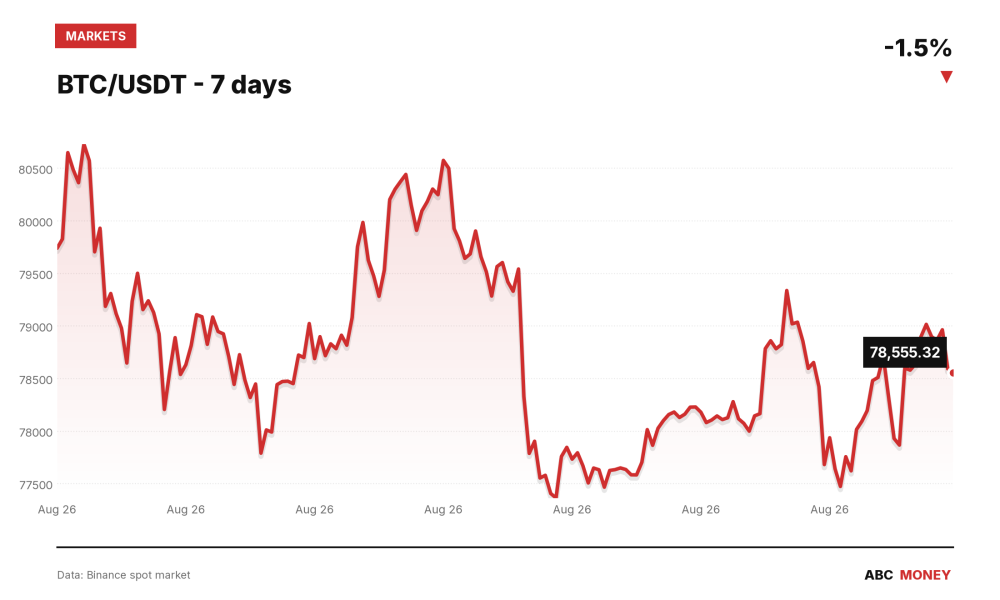
Strategy’s Bitcoin purchase this week was its first in more than two months, and the filing that disclosed it tells a more layered story than the headline number suggests. The company (NASDAQ: MSTR), led by executive chairman Michael Saylor, bought 4,603 bitcoin for roughly $369.7m between 24 and 30 August 2026, at an average price of $80,318 per coin, according to The Block. The purchase was disclosed in a Form 8-K filed with the SEC on 31 August 2026, and it takes Strategy’s total holdings to 845,050 bitcoin, still the largest of any public company.
The gap since the last purchase matters as much as the size of this one. Strategy’s most recent prior buy was a modest 520 bitcoin for about $35m during the week of 15-21 June 2026, according to The Motley Fool. Bloomberg frames the gap as a roughly ten-week pause that coincided with a crypto bear market pressuring both bitcoin and MSTR shares, and with it, confidence in the leverage-and-equity model that has defined Strategy’s balance sheet since 2020.
How the purchase was actually funded
The bitcoin didn’t come from spare cash. Strategy raised the money by selling 4,531,421 MSTR shares through its at-the-market equity programme, a standing arrangement that lets the company issue new stock into the market in small tranches rather than a single block trade, as first reported by Decrypt. That’s dilution in the plainest sense: existing shareholders end up owning a smaller slice of the company for every new share sold. Fortune adds an important wrinkle – the same proceeds also covered dividend payments on Strategy’s STRC preferred stock and a share repurchase, not just the bitcoin buy, according to Fortune. Read that way, the “return to accumulation” is less a single conviction bet and more one output of a capital-structure balancing act that also has to service preferred obligations and manage the float.
The renewed buying followed a public signal rather than arriving cold: Saylor posted “We’re Back” on social media ahead of the 8-K, a pattern SeekingAlpha flagged as consistent with how Strategy has previewed purchases before. It’s also worth remembering that the pause itself followed a reversal in the other direction: in late May 2026 Strategy sold bitcoin for the first time since 2022 to help fund preferred-stock obligations, a move that unsettled investors well before this month’s resumption.
The losses sitting underneath the buying
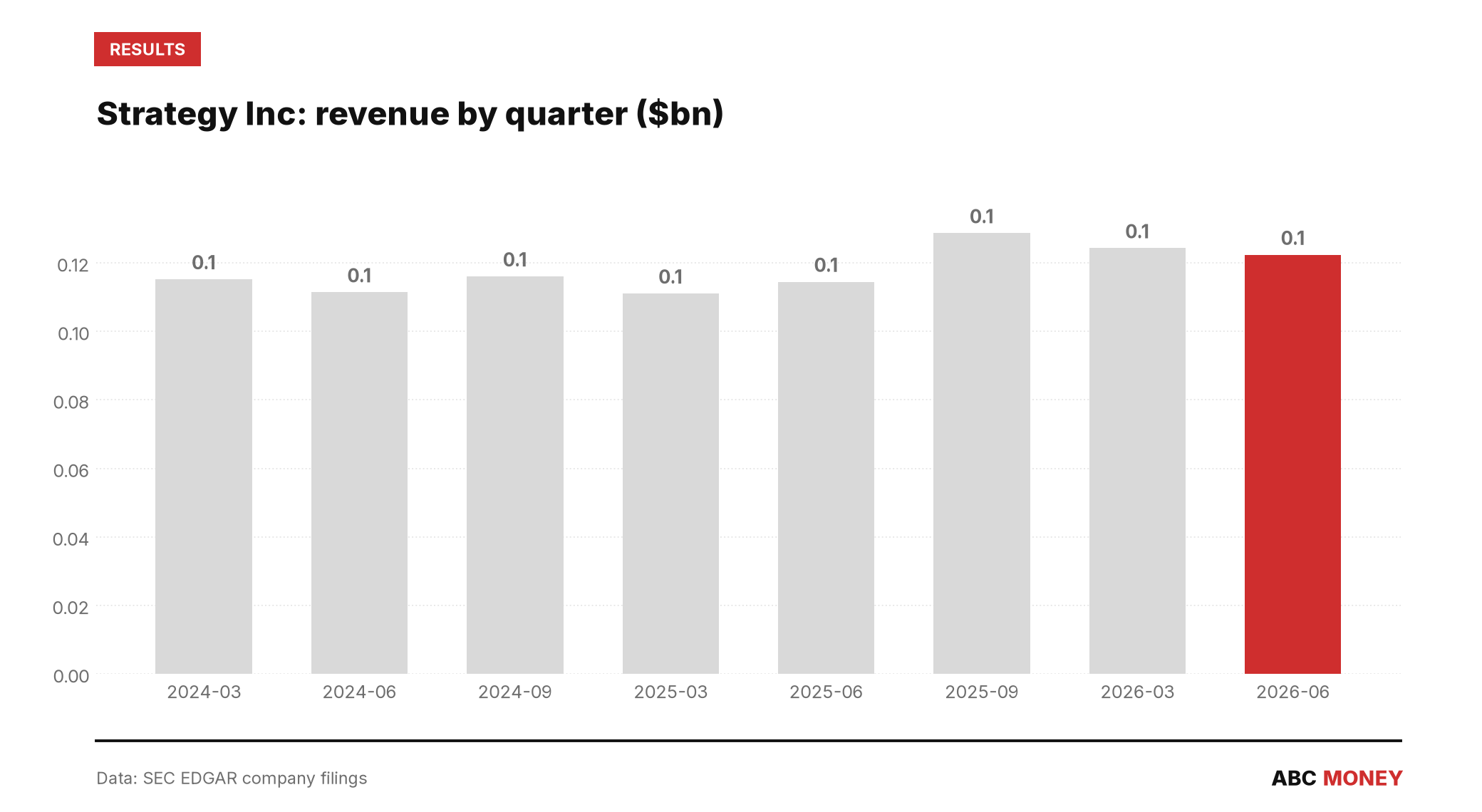
None of this happened against a backdrop of operating strength. Strategy posted a net loss of $12.54bn in the first quarter of 2026 and a further $8.22bn loss in the second quarter, both filed with the SEC just weeks before the renewed purchase. Those losses are largely a function of fair-value accounting on the bitcoin holdings themselves – swings in the coin’s price flow straight through the income statement – rather than any deterioration in the underlying software business. That business remains small and steady: core subscription and services revenue was $122.37m in the second quarter, in line with prior periods. Strategy’s fortunes, in other words, are now almost entirely a function of its bitcoin position rather than the enterprise-software operation it started life as.
Bitcoin itself traded at $78,558.02 on Binance as of 31 August, modestly below the $80,318 average price Strategy paid for its latest batch – a reminder that the purchase was made into a softer market, not a rallying one.
No sign of a short squeeze behind the move
One thing the data rules out is that this was somehow forced by short-sellers scrambling to cover bearish positions. FINRA’s daily short-sale figures for MSTR ranged between roughly 0.30 and 0.53 in the fortnight around the purchase, with no spike that would point to short-covering as an independent driver of the stock’s reaction, per FINRA data. That leaves the company’s own disclosures – the ATM sale, the preferred dividend, the buyback, the bitcoin purchase – as the whole explanation, rather than one crowded out by market mechanics.
The next marker for investors is less the size of any single purchase than whether Strategy resumes its previous cadence of near-weekly buying or reverts to the kind of multi-month pauses seen this year, a pattern that will show up, as it has each time, in the company’s regular SEC filings rather than in any forward guidance from the company itself.
This article is for information only and is not investment advice or a recommendation to buy or sell any asset. Markets move quickly; figures are correct as sourced at the time of writing. Always do your own research before making financial decisions.