

SanDisk’s stock was trading at about $81 a year ago. The SNDK share price is currently at about $1,692, a gain of more than 2,000% in just one year, despite a few difficult sessions that brought it below $1,700. Such numbers are uncommon. When they do, they typically draw two types of attention: skeptics who silently wonder when the math stops working and true believers who believe there is more runway ahead.
It must be acknowledged that the underlying background is genuinely powerful. According to SanDisk’s most recent quarterly results, revenue was $8.97 billion, up 372% from $1.9 billion during the same period last year. 84.6% was the gross margin. These are not small gains. Even seasoned analysts pause to double-check their spreadsheets when they see those kinds of numbers. SanDisk has secured $93.9 billion in long-term supply contracts with eight major data-center clients, including three of the biggest hyperscalers in the United States. The AI infrastructure buildout has been exceptionally beneficial for NAND flash memory manufacturers.
Perhaps the most significant structural change the company has made is the move away from erratic spot-market pricing and toward multi-year supply agreements. Predictability, which is precisely what institutional money tends to reward over time, is traded for upside surprise. According to the CFO, floor pricing included in these contracts maintains gross margins of about 80% even in situations with lower demand. If that continues, SanDisk begins to resemble a company with long-term earning potential rather than a cyclical memory chip manufacturer. It remains to be seen if that framing will endure the subsequent downturn in the memory cycle.
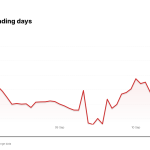
Earlier this week, the announcement of the S&P 100 inclusion, which will take effect on September 21, caused shares to rise nearly 12% in a single session, briefly reaching $1,740. This type of catalyst can produce short-term momentum that doesn’t always reflect underlying fundamentals by forcing index funds to purchase regardless of their own opinions on valuation. Since then, the stock has returned those gains and more. SNDK had lost more than $71 during the day as of Wednesday’s close, closing at $1,692. After-hours trading pushed it even higher, to about $1,676.
A portion of the selling pressure stems from SEC filings that revealed senior executives, including the chief legal officer and the chief technology officer, had sold shares worth millions of dollars. These transactions were scheduled well in advance and do not necessarily indicate that insiders anticipate a decline because they were carried out under pre-arranged Rule 10b5-1 trading plans. However, any insider selling close to the highs tends to unnerve investors when a stock has risen as much as SNDK has. That is simply human nature.
Even by Wall Street standards, the analyst community is still divided. With a $2,250 price target and an overweight rating, JPMorgan restored coverage. Wells Fargo reduced its goal to $1,400. RBC is currently $1,300. Just this week, Citigroup’s Asiya Merchant reaffirmed a buy rating with a $2,100 target, citing the growth in NAND demand from smartphones and AI-enabled edge devices as an undervalued tailwind outside of data centers. Nobody really knows where this lands because the range between the most bullish and most bearish targets is so large that it practically tells its own story.
Observing all of this gives me the impression that SanDisk is at one of those turning points that are simpler to recognize in retrospect. The company is actually doing well. The thesis on AI storage makes sense. A true strategic asset, the Kioxia joint venture in Yokkaichi, Japan, which was recently extended through 2034, provides SanDisk and its partner with about one-third of the world’s wafer production capacity.
Furthermore, the next-generation high-bandwidth flash chip, which is co-developed with SK Hynix and targeted at AI inference workloads, isn’t even included in the most recent financial guidance. Since volume production won’t start until 2028, any profits from that product are still upside and haven’t been fully priced in by the market.
However, the risks are also real. The current tight NAND environment may change more quickly than current models predict if Chinese manufacturers like YMTC continue to increase production capacity and that lower-cost supply reaches global markets at scale. The $31 billion capital commitment to Japanese manufacturing facilities is encouraging until it isn’t. The memory industry has previously been destroyed by oversupply, and there are many instances in its history where everything appeared to be going well until it didn’t.
Given where the company will be in 2028, SNDK at $1,692 might still be a steal. It’s also possible that the stock will take some time to reach its valuation at about 23 times trailing earnings, as memory cycles always do. When viewed from the outside, the truth is likely that both statements can be true simultaneously.


 Bitcoin
  Ethereum
  Tether
  BNB
BNB  USDC
USDC  XRP
XRP  Solana
  TRON
TRON  Lido Staked Ether
  Cardano
  Gram (prev. Toncoin)
  Avalanche