
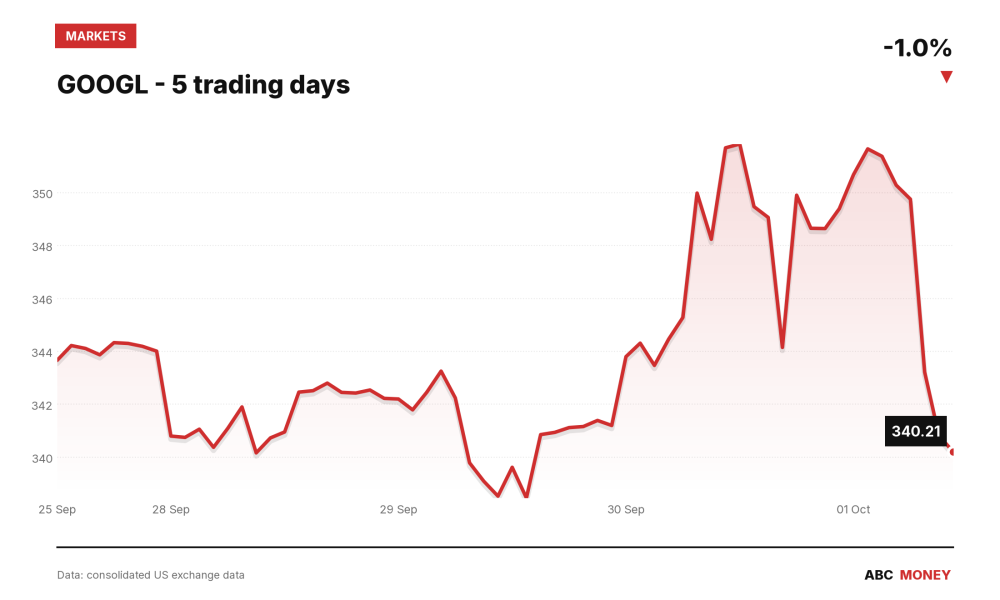
The Gemini 4 Argon launch did exactly what Alphabet’s investors hoped on Wednesday evening – for a few hours, at least. Shares of Alphabet (NASDAQ: GOOGL, GOOG) rose as much as 1.70% in after-hours trading, touching $346.52, after Google unveiled its new flagship artificial-intelligence model following months of delay. By the next trading session, though, the stock had given back the move and then some.
Alphabet’s Google unit introduced Gemini 4 Argon on 30 September 2026, describing it as its most capable model to date and pitching it as the answer to rivals OpenAI and Anthropic after the company quietly scrapped an earlier plan to ship Gemini 3.5 Pro, which chief executive Sundar Pichai had once said would arrive by June, according to reporting syndicated by the New York Times. Argon is bigger than Google’s existing “Pro” line and was pitched as a step up in handling complex tasks such as software engineering and cybersecurity work.
A Jump That Didn’t Hold
The initial market reaction was unambiguous: Alphabet stock rose on the news, confirmed independently by TipRanks and GuruFocus alongside Benzinga’s after-hours print. But the rally proved short-lived. Alphabet’s intraday gain, which had run past 2% during Wednesday’s session, was cut down to roughly 0.5% by the close after a Bloomberg report detailed internal scepticism among Google staff about Gemini 4’s coding performance – the very capability the launch was meant to showcase.
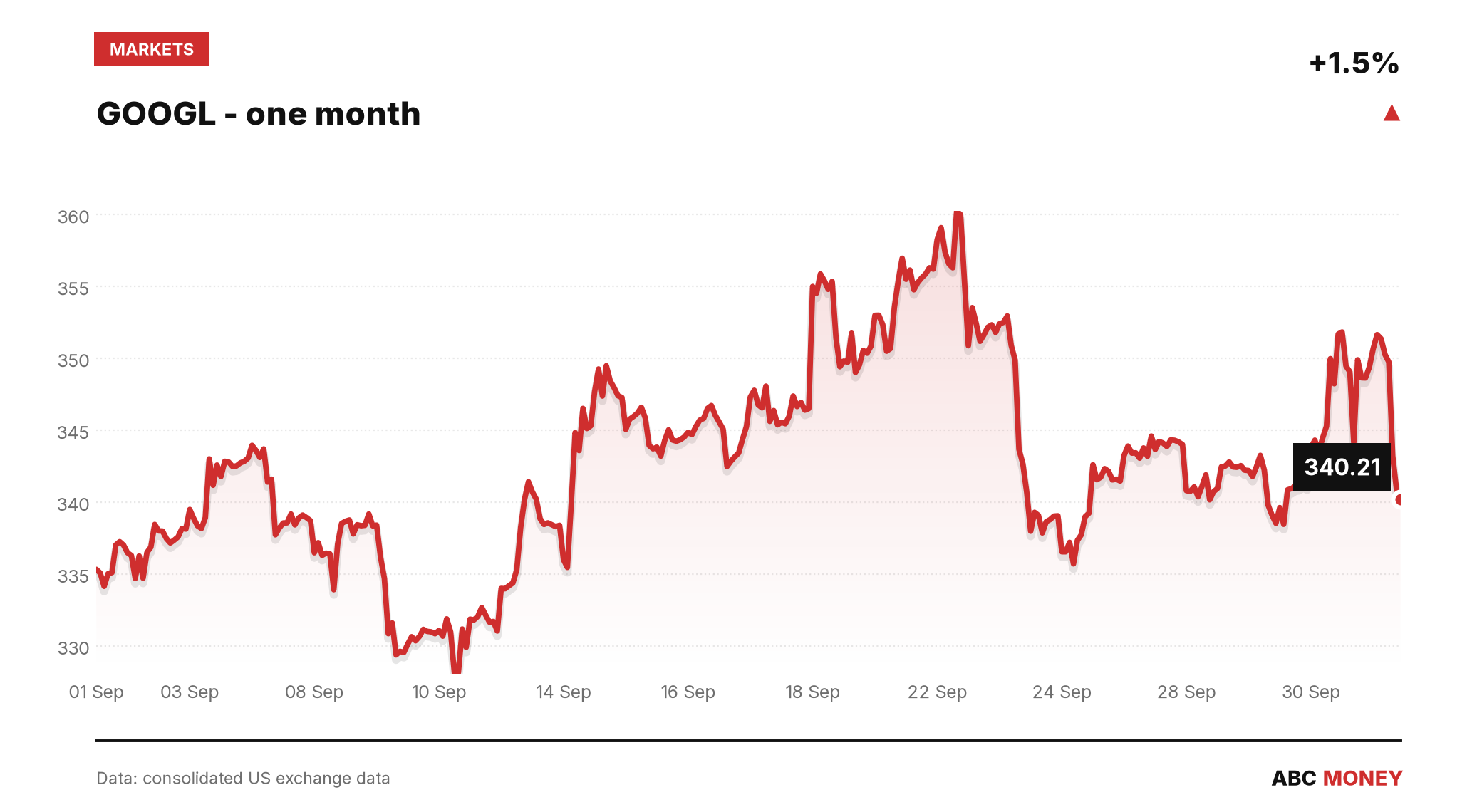
The reversal deepened from there. By 2 October, Alphabet shares had traded at $340.615, down 2.51% over the prior 24 hours, even though the stock remained up 3.25% across the previous 20 trading days, having ranged between $329.90 and $360.24 in that window. The same-day verdict from Invezz put it plainly in its headline: Alphabet stock falls despite the Gemini 4 Argon launch. The arc, in other words, ran from pop to pare to net decline inside about 36 hours – a reminder that an after-hours print is a snapshot, not a verdict.
Guardrails, Not a Full Rollout
Part of what muddied the reception was how Google chose to release the model. Rather than a broad public rollout, Gemini 4 Argon is being made available first to a narrower set of users, with a guardrail-free version reserved for a vetted group of cybersecurity specialists under what Google calls its “Fairwind Program,” according to reporting from The Hacker News. That cautious framing sits inside a wider industry debate about how much autonomy to give frontier models before wide release, a tension the New York Times placed at the centre of its coverage of the launch.
Not every read on the launch was bearish. Jefferies reiterated a “buy” rating on Alphabet with a $445 price target after Argon’s debut, even while flagging that the shares had already fallen 16% from their 18 May peak. The broker pointed to Argon’s launch pricing – $2 per million input tokens and $10 per million output tokens – as undercutting comparable Anthropic models, a detail that speaks to the economics Google is betting on as much as the model’s capabilities.
Positioning Around the Launch
Trading data around the announcement showed nothing dramatic in terms of bearish positioning. FINRA’s daily short-sale volume figures put GOOGL’s short ratio – the share of daily trading volume attributable to short sales, where traders borrow and sell shares betting the price falls – at 0.452 on 30 September, up from 0.348 five trading days earlier but still inside the band the stock had traded in over the prior fortnight. Nothing in that data points to traders piling into bearish bets ahead of the launch; if anything, the move looks more like ordinary day-to-day variation than a signal.
Separately, six Form 4 filings tied to Alphabet insiders – including chief financial officer Anat Ashkenazi and chief business officer Philipp Schindler – landed with the Securities and Exchange Commission in the early hours of 30 September, the same calendar day as the Argon announcement. The filings themselves give no reason for the transactions, and the timing is consistent with routine scheduled equity-compensation activity rather than anything tied to the product release.
What the episode leaves behind is less a verdict on Gemini 4 Argon itself than a lesson in reading market reactions to AI launches. The headline pop was real, and so was the reversal that followed it within a day. For a stock that has spent recent months trying to convince investors its AI spending is paying off, the next test will be whether Argon’s restricted rollout broadens and whether the coding concerns that knocked the shares get addressed – or fade from view entirely.
This article is for information only and is not investment advice or a recommendation to buy or sell any asset. Markets move quickly; figures are correct as sourced at the time of writing. Always do your own research before making financial decisions.


 Bitcoin
  Ethereum
  Tether
  BNB
BNB  USDC
USDC  XRP
XRP  Solana
  TRON
TRON  Lido Staked Ether
  Cardano
  Gram (prev. Toncoin)
  Avalanche