
Domino’s Pizza (NYSE: DPZ) finance chief told investors on the company’s third-quarter earnings call that he expects international same-store sales growth to land “about flat” for the full 2026 year, as first reported by Benzinga. It is a modest, almost unremarkable piece of guidance. The trouble for shareholders is what is happening closer to home.
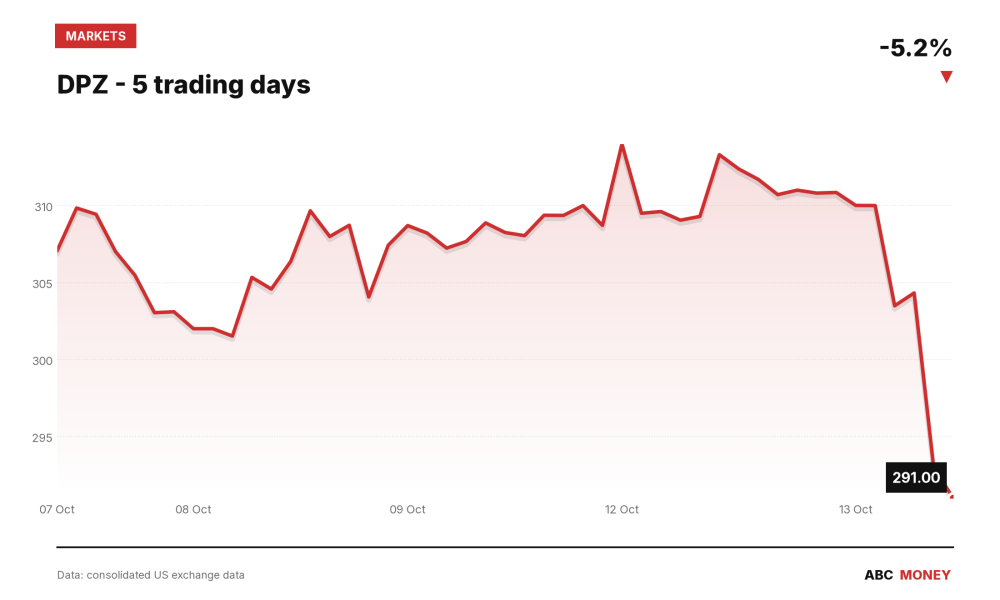
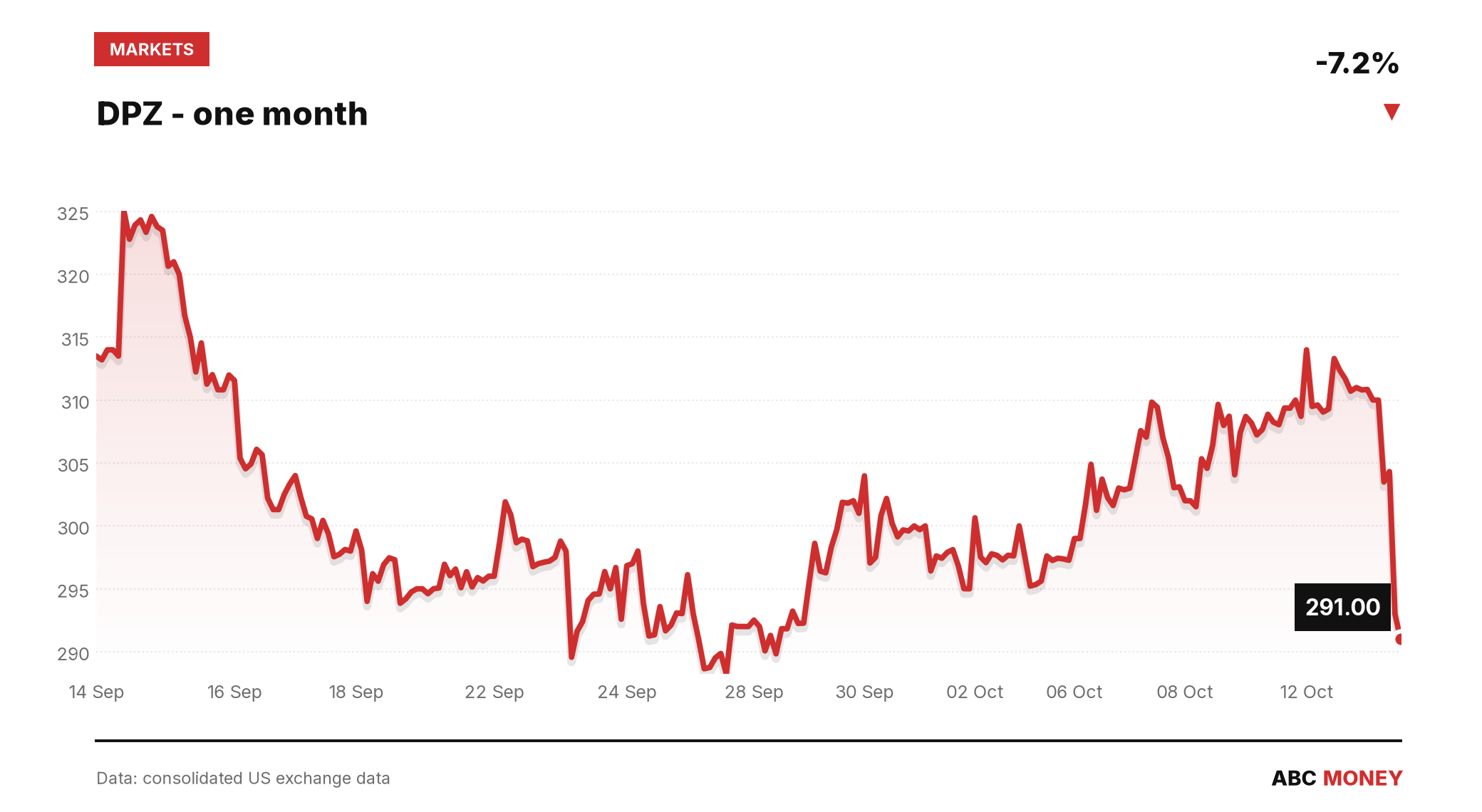
Shares fell 6.74% on the day to $289.86, leaving the stock down roughly 25% so far this year, according to qz.com‘s tally of the session’s trading. That is a sharp reaction to a quarter in which Domino’s actually beat expectations on both the top and bottom line – which tells you the market was reacting to the trajectory of the business, not the headline print.
What the filings say about international same-store sales
Start with the guidance itself, because it checks out. Domino’s own third-quarter earnings release shows international same-store sales, stripped of currency effects, rose 0.2% in the quarter. That followed a 0.1% decline in the second quarter. A number that dips fractionally below zero one quarter and recovers fractionally above it the next is, in plain terms, flat – exactly what the finance chief described. It is also a comedown from the start of the year: Domino’s Q1 call flagged international retail sales growth of 4% on a constant-currency basis, driven by net new stores, according to a transcript carried by The Motley Fool. The international business, in other words, has gone from genuine momentum to stall speed over three quarters.
Some of that softness is structural rather than company-specific. Domino’s Pizza Enterprises, the separately listed master franchisee that runs several of Domino’s largest overseas markets, reported global same-store sales down 4.1% in the second half of its own financial year, according to a transcript hosted on Investing.com – a reminder that the pressure on international comparable sales is showing up across the franchise system, not just in the figures the US parent reports.
The sharper deceleration is at home
The number that should worry shareholders more sits inside Domino’s own third-quarter 10-Q: US same-store sales growth of just 0.3%, down from 5.2% in the equivalent quarter a year earlier. That is not a flatline – it is a near-complete collapse in the pace of US sales growth over twelve months, in a market that still generates the bulk of Domino’s profit. The Wall Street Journal’s framing that Domino’s “sales growth continued slowing” captures that US story more than it does the international guidance that made Tuesday’s headlines.
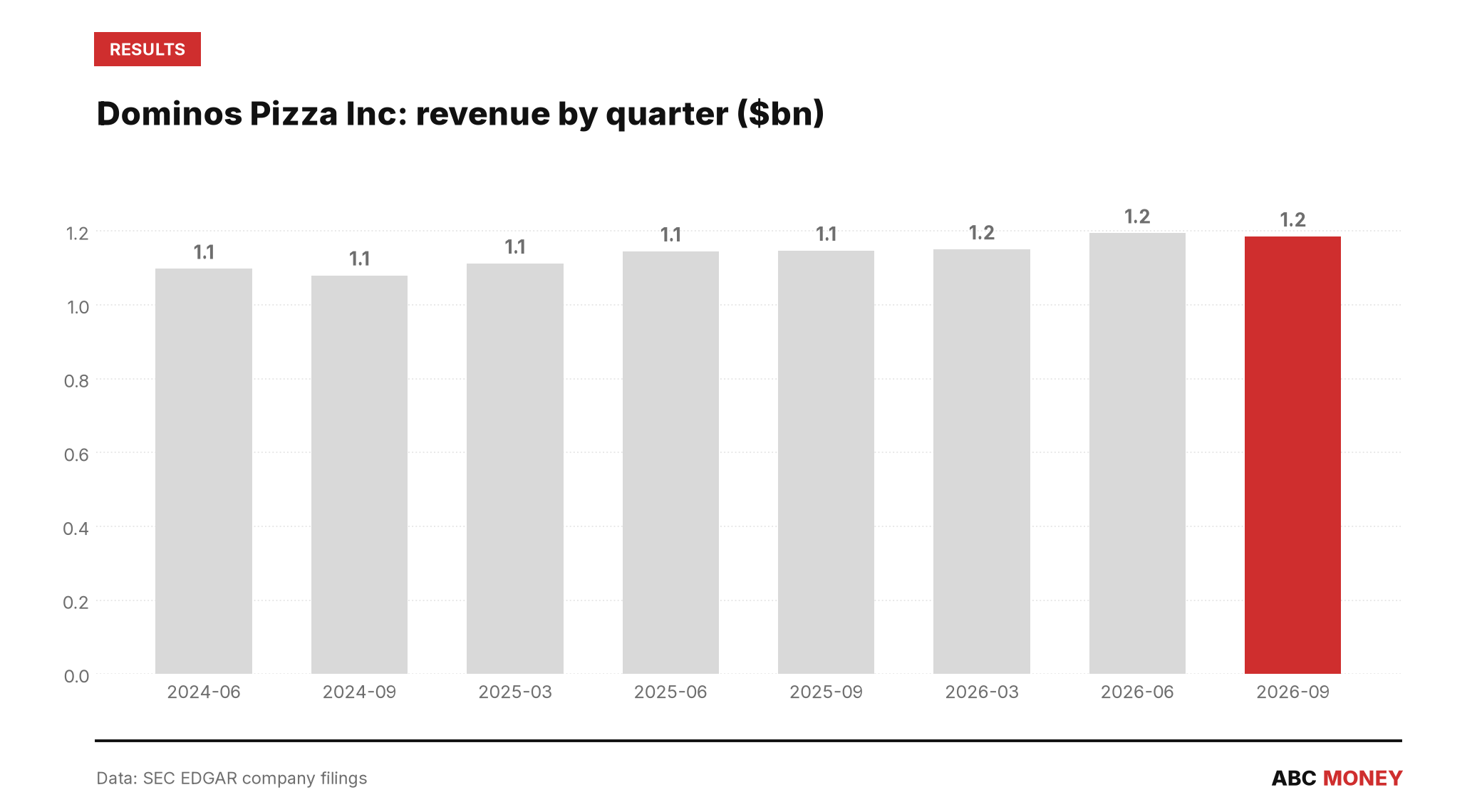
Set against that backdrop, the quarter’s headline financials look almost incongruous. Net income came in at $152.18m and diluted earnings per share at $4.60, up 9.2% and 12.7% respectively on the same quarter last year, per the company’s SEC filings. Revenue of $1.1856bn beat the roughly $1.17bn analysts had pencilled in, according to qz.com. Profits and sales both ahead of plan, and the stock still dropped nearly 7% – a sign that investors are pricing the deceleration in comparable sales ahead of any near-term boost from cost control or unit growth.
No sign of a short squeeze
It’s worth ruling out one alternative explanation for the size of the move: a position-driven unwind rather than a reassessment of the business. FINRA’s daily short-sale data show the ratio of short-sold volume to total volume in Domino’s shares ranging between roughly 0.46 and 0.71 through early-to-mid October, with no discernible spike around the earnings date. That argues against a crowded short position forcing additional selling, and for the simpler read: investors are repricing the shares around a US growth rate that has gone from mid-single-digit percentage gains to effectively nothing in a year.
Domino’s has not put a specific date on when it next updates the market, but the pattern now established – international comparable sales hovering near zero, US comparable sales decelerating sharply, and earnings still beating estimates – sets the terms for how the next quarter’s numbers will be read. Investors will be watching whether the 0.3% US figure marks a trough or the start of a longer slide, and whether the international business can rebuild toward the kind of growth it was posting as recently as the first quarter.
This article is for information only and is not investment advice or a recommendation to buy or sell any asset. Markets move quickly; figures are correct as sourced at the time of writing. Always do your own research before making financial decisions.


 Bitcoin
  Ethereum
  Tether
  BNB
BNB  USDC
USDC  XRP
XRP  Solana
  TRON
TRON  Lido Staked Ether
  Cardano
  Gram (prev. Toncoin)
  Avalanche