CoreWeave Q3 Earnings Beat Expectations, Shares Jump ~7%
CoreWeave's Q3 earnings beat revenue and loss forecasts and lifted guidance, but a $7.7bn cash burn shows the AI trade's real test.
In this article 3 sections
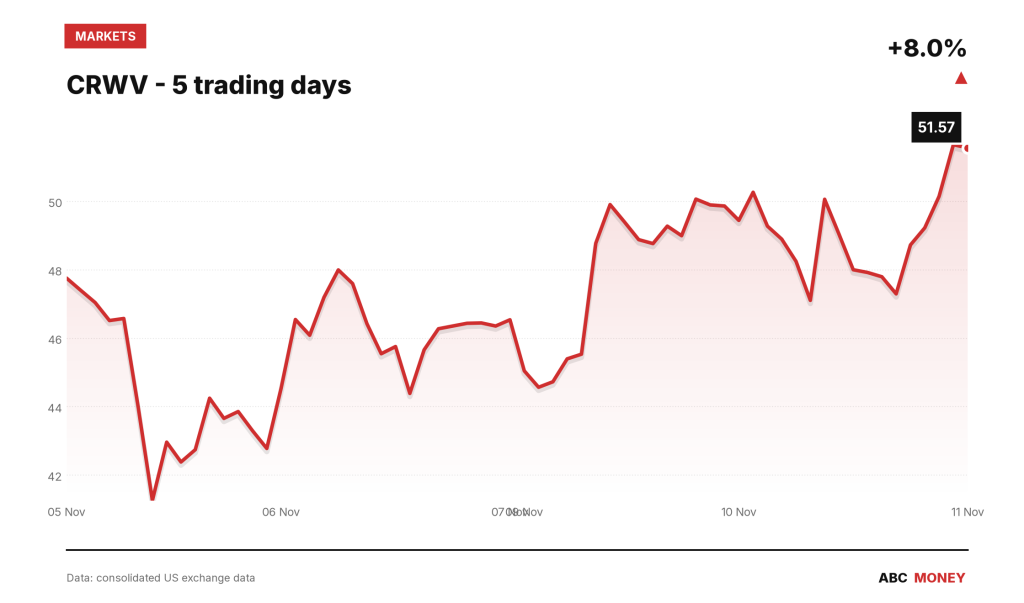
CoreWeave (NASDAQ: CRWV) did what Wall Street asked of it. Third-quarter revenue of $3.66bn comfortably cleared the roughly $3.54bn-$3.56bn analysts had pencilled in, the loss per share narrowed to $1.27 against estimates nearer $1.46-$1.55, and the cloud-computing firm raised its full-year revenue guidance to $13.0bn-$13.3bn from $12.0bn-$13.0bn. Shares responded by rising 7.42% over 24 hours to $51.48, according to the Wall Street Journal, having closed the regular session essentially flat the day before.
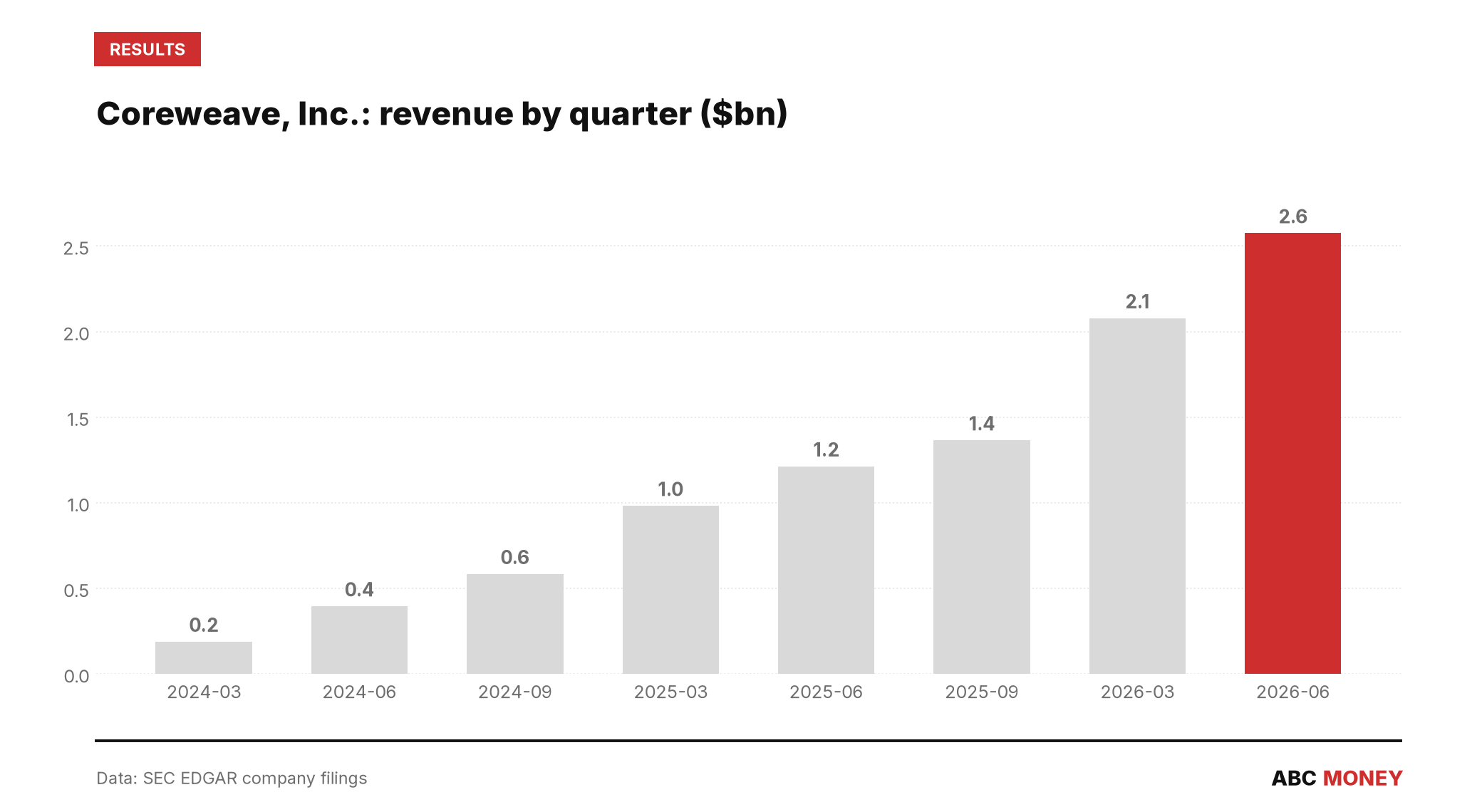
That CoreWeave’s Q3 earnings cleared the bar matters less than how it did so. Revenue grew 168% year-on-year from $1.36bn a quarter earlier – a comparison drawn from the company’s own prior-year filing – and the backlog of contracted future revenue swelled to roughly $132.5bn as of 30 September, up from $104bn just three months earlier, per the company’s earnings release filed with the SEC.
A beat built on backlog, not yet on profit
The gap between CoreWeave’s growth story and its cash reality remains wide. The company burned an estimated $7.7bn in free cash flow during the quarter and carries total debt of around $47bn, according to reporting from The Motley Fool. That is the uncomfortable context behind an otherwise clean beat: investors are still being asked to underwrite years of infrastructure build-out against promises of future contracted revenue, rather than current earnings.
It is a pattern that shows up plainly in the figures CoreWeave has filed over the past two years. Net losses have run in the hundreds of millions every quarter on record – $290.5m in the second quarter of its last fiscal year, $626m in the most recent one – even as revenue has climbed from under $200m a quarter to multiple billions. The company is, in effect, still in the capital-intensive build phase of a business that depends on graphics-processing capacity being contracted years in advance, and investors have so far been willing to look through the losses so long as the backlog keeps expanding.
A bounce off a steep fall
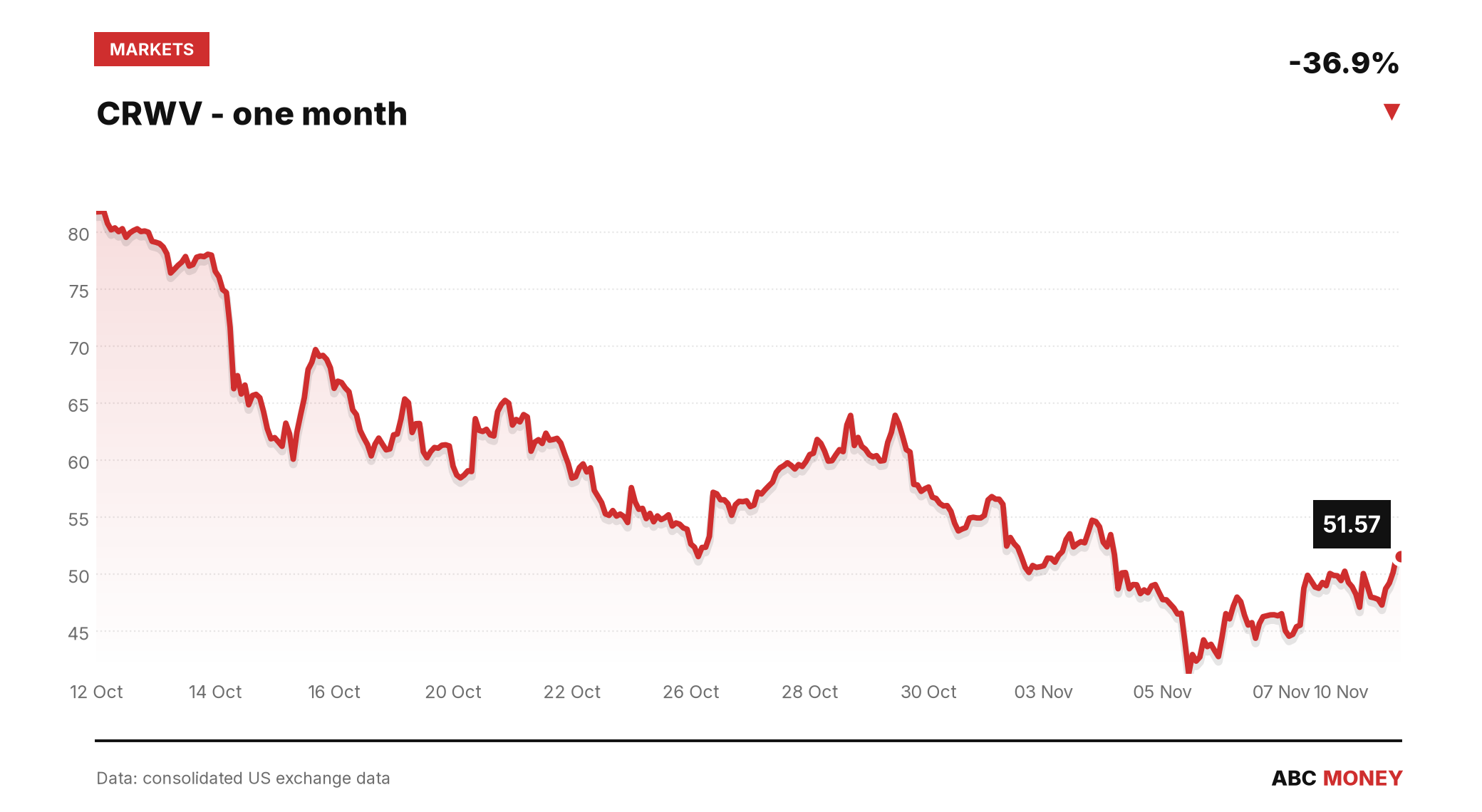
Context matters here too. CRWV had fallen roughly 18% over the preceding 20 trading days and traded as low as $41.26 against a 20-day high of $64.00, so Thursday’s pop is a recovery from a depressed base rather than a fresh high. Options markets had been bracing for turbulence: implied moves of around 18% were priced into contracts ahead of the print, according to TipRanks, reflecting how binary the stock’s recent trading has become around each quarterly update.
Positioning data tells a similar story of tension into the release. FINRA’s short-sale volume ratio for CRWV – the share of daily trading volume attributable to short sales, where investors borrow and sell stock betting on a decline – climbed from 0.398 on 6 November to 0.524 on the day of the report, suggesting bearish positioning had been building into the print rather than fading.
The rate backdrop still bites
None of this unfolds in a vacuum. The 10-year US Treasury yield stood at 4.88% on 9 November, up from 4.86%, while the two-year yield rose to 4.56% from 4.51%, narrowing the gap between the two to 0.25 percentage points, according to Federal Reserve data. For a company as leveraged as CoreWeave, higher borrowing costs are not an abstract macro footnote – they bear directly on the economics of financing the data-centre capacity behind that $132.5bn backlog. A debt-heavy balance sheet becomes more expensive to service precisely when rates stay elevated, which is part of why the AI-infrastructure financing debate has not gone away even as the revenue numbers impress.
There was also a routine piece of paperwork in the mix. A Form 4 filed on 10 November showed chief operating officer Sachin Jain selling 13,611 shares at $46.23, worth roughly $629,000 – the kind of scheduled sale typically used to cover tax obligations when restricted stock vests, rather than a discretionary bet tied to the earnings reaction, based on the filing’s timing relative to the results.
The next test for CoreWeave is less about whether it can keep beating a single quarter’s consensus and more about whether backlog growth of this scale can eventually convert into the kind of cash generation that justifies a $47bn debt load. Thursday’s numbers bought the stock some room. They did not settle that argument.
This article is for information only and is not investment advice or a recommendation to buy or sell any asset. Markets move quickly; figures are correct as sourced at the time of writing. Always do your own research before making financial decisions.