The Martin Jenkins T-Rex and Its Feathery Mane
The most famous dinosaur, in a much longer story
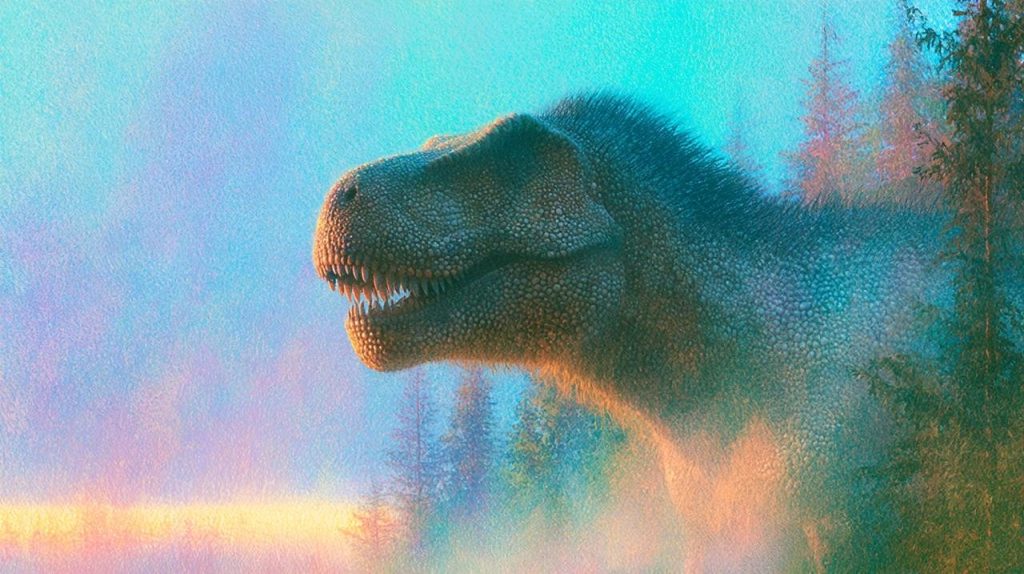
Tyrannosaurus rex is the dinosaur almost every child can name. In Life: The First Four Billion Years, the 2019 history of life written by British author Martin Jenkins and illustrated by Grahame Baker-Smith, T. rex appears near the end of the dinosaur age, as one figure in a story that begins with the formation of the Sun and ends with early primates. The Kirkus review describes it drawn with bared teeth, wild eyes and a feathery mane. That last detail says a lot about the Martin Jenkins T-Rex and about how the book approaches dinosaurs.
Who Martin Jenkins is
Jenkins is a children’s nonfiction author and conservation biologist based in Cambridge, England. His publisher biography notes ten years at the World Conservation Monitoring Centre and freelance work since 1990 for WWF and United Nations bodies. His books include The Emperor’s Egg, winner of the Times Educational Supplement Junior Information Book Award, and Can We Save the Tiger?, shortlisted for the Kate Greenaway Medal in 2012. Life is his broadest subject and the one that brings him to the dinosaurs.
Why the Martin Jenkins T-Rex has a feathery mane
For most of the twentieth century, T. rex was pictured as a scaly, upright, tail-dragging reptile. That image changed as new fossils emerged from China in the late 1990s and 2000s. Small tyrannosaur relatives such as Dilong, described in 2004, were preserved with simple filament-like feathers. In 2012, scientists described Yutyrannus, a large tyrannosauroid around nine meters long that also carried filamentous feathers. Those finds made it reasonable to ask whether T. rex itself had some feathery covering.
The answer is still being worked out. A 2017 study of skin impressions from T. rex and close relatives found small patches of scaly skin from parts of the body, which suggested that adult tyrannosaurs may have been mostly scaly. Feathers on other parts of the body, or on juveniles, are not ruled out. Many current reconstructions split the difference with scales on most of the body and a sparse covering of filaments along the back or neck.
A feathery mane on Baker-Smith’s Tyrannosaurus reflects that open question. It signals to young readers that dinosaurs were relatives of birds and that the way they are drawn changes as evidence comes in. That is a more useful lesson than any single image, and it fits the evidence-first tone found across Jenkins’s work.
T. rex in context
What sets Life apart from a dedicated dinosaur book is what surrounds the predator. Readers arrive at the Late Cretaceous after chapters on single-celled life, early arthropods, armored fish and the first land animals. School Library Journal describes the book’s structure as following the geologic eras from the Proterozoic to the Neogene, with each organism drawn and labeled with its approximate size. A full-grown Tyrannosaurus, around twelve meters long, reads very differently on a page that has already shown readers creatures measured in millimeters.
T. rex lived at the very end of the Cretaceous, roughly 68 to 66 million years ago, and was among the last large dinosaurs before the mass extinction that closed the era. In Life, that extinction is a turning point rather than an ending. Publishers Weekly notes the book’s attention to ice ages and mass extinctions, and the story continues into the age of mammals, including the rhinoceros-like Arsinoitherium. Placed in this sequence, T. rex becomes a way to explain how one group of animals rises, dominates and gives way to another.
What the evidence says about how T. rex lived
The science behind any T. rex illustration comes from a large and well-studied fossil record. Tyrannosaurus is known from many skeletons found in western North America, in rock formations such as the Hell Creek Formation of Montana and the Dakotas. Those same rocks preserve the animals it lived alongside, including Triceratops, Edmontosaurus and Ankylosaurus. Bite marks found on the bones of plant-eating dinosaurs, together with the thick, serrated teeth of Tyrannosaurus, show that it could bite into and through bone. Studies of its skull and brain case suggest a strong sense of smell. Questions about how fast it could move and how much it hunted versus scavenged are still debated. A book like Life does not try to settle those questions, but it gives young readers the setting in which they make sense.
How critics responded
Kirkus described the book as “grand in scope, art, and trim size” and noted its “gore-free mix” of full-color scenes and sepia or graphite studies. That is relevant for a T. rex scene aimed at readers aged ten to fourteen. The predator is dramatic without being graphic.
Reviewers with a paleontology background were more exacting about the dinosaur-age artwork. Dino Dad Reviews praised the book’s Paleozoic and Precambrian coverage but raised concerns about some Mesozoic reptile illustrations, including one sauropod it considered mislabeled. Readers who want the most current anatomical detail on tyrannosaurs may want to pair the book with a dedicated dinosaur reference. As an introduction to where T. rex fits in the history of life, Life covers ground that most single-subject books do not.
A Martin Jenkins dinosaur book for T-Rex fans ready for the bigger picture
Children who fixate on T. rex often want to know what it ate, what it lived alongside and what happened next. Life answers the last two questions in more depth than most dinosaur books, and it does so with the patient, labeled, size-conscious approach that runs through Martin Jenkins’s nonfiction. The book holds an average above four stars on Goodreads and was longlisted for the UKLA Book Awards in 2020. It is available from Walker Studio in the UK and Candlewick Studio in the US, and more of Jenkins’s titles are listed on his Candlewick author page.
Contributed content: this article was written by a third-party contributor and does not necessarily reflect the views of ABC Money. Editorial and Advertising Policy