AI Power Stocks Selloff Claim Clouded by SpaceX Profit Beat
The AI power stocks selloff was pinned on financing fears, but yields fell and SpaceX just posted its first profit as a listed company.
In this article 3 sections
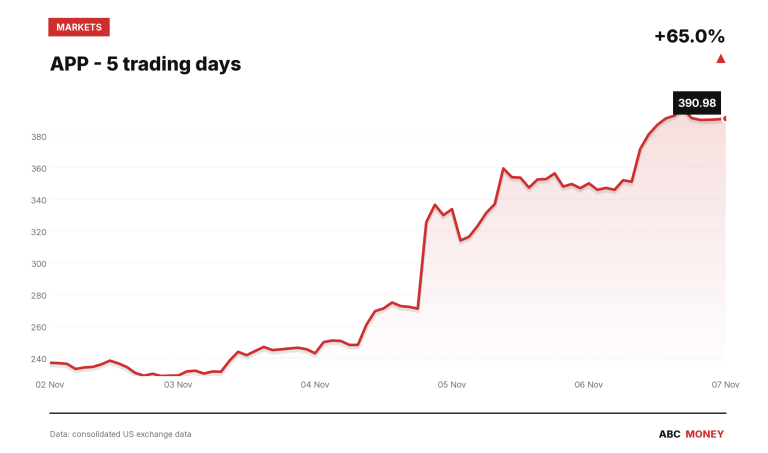
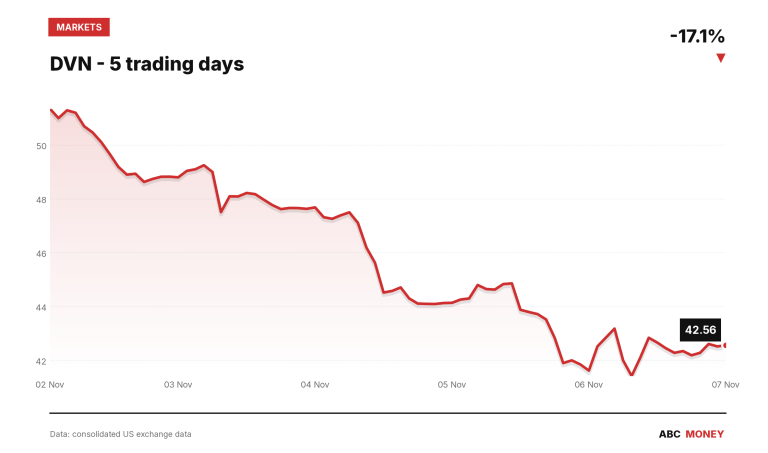
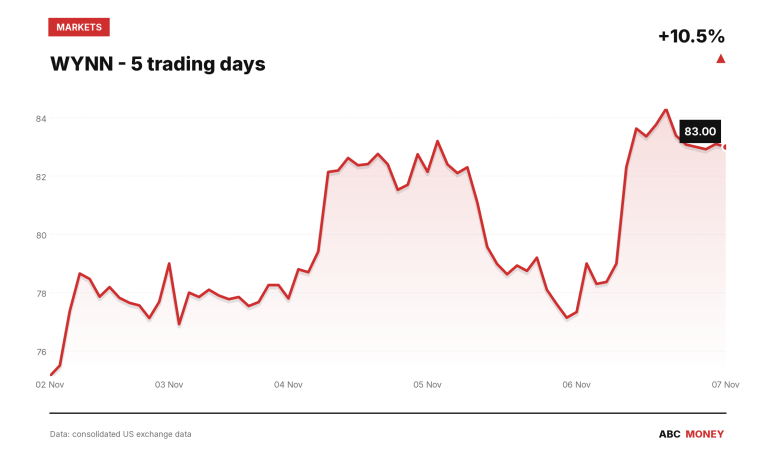
A headline doing the rounds this week says the AI power stocks selloff – a 6.3% to 9.3% drop across the cohort of utilities and energy names tied to data-centre demand – was driven by “financing fears”, and that SpaceX has countered with a striking claim: new compute deployments are paying back in under a year. The second part checks out. The first part does not survive contact with the numbers.
Start with what should have moved if financing worries were genuinely the trigger: borrowing costs. They went the wrong way. The 10-year US Treasury yield fell to 4.84% on 5 November from 4.90% previously, and the 2-year slipped to 4.46% from 4.58%, according to Federal Reserve data. A financing scare – the market suddenly worrying that AI power build-outs can’t get funded cheaply – should push yields up, not down. Instead, the direction of travel in rates argues against the story told in the fool.com report that was syndicated onto Nasdaq.
What actually hit the AI power trade
Other outlets covering the same week point somewhere else entirely. Vistra dropped 13.5% on 4 November in a move that Investing.com tied to a Texas election result and a KeyBanc downgrade, not to anything resembling a credit scare. Separately, Constellation Energy fell 8% and Vistra 14% in reporting that attributed the move to the fallout from the Democrats’ midterm sweep hitting the politically sensitive AI-power trade. Two different outlets, two political catalysts, neither mentioning financing at all. That doesn’t mean the “financing fears” framing is fabricated – sentiment around AI capital spending has been jumpy all year – but the magnitude-matching move in this instance appears to have a political author, not a financial one.
Worth noting, too: this is not the first bout of volatility in the group. An earlier slide of 7% to 13% across the same names hit in late October on energy-market dynamics, nothing to do with financing. A pattern of narrative-driven swings in a crowded trade is a more honest description than a single clean cause each time.
SpaceX’s own numbers, and why they cut the other way
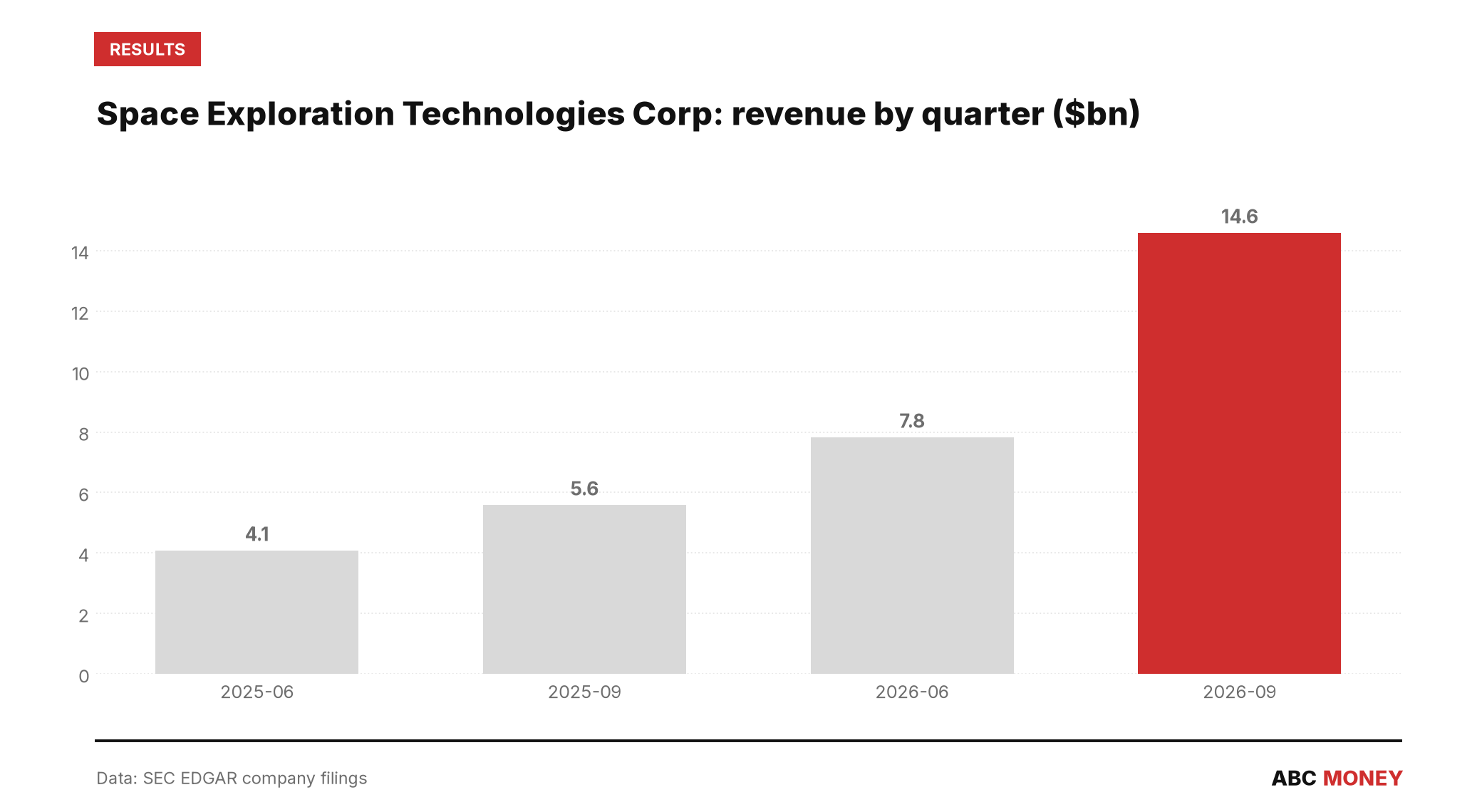
The part of the story anchored in SpaceX (SPCX) holds up. The company, which trades publicly after filing its S-1 and 424B4 prospectus with the SEC earlier this year, reported second-quarter 2026 revenue of $7.814bn and a net loss of $541m, with diluted loss per share – earnings per share after accounting for all potential share conversions – of $0.09. The following quarter was a different story: revenue jumped to $14.575bn and net income came in at $4.404bn, a swing to diluted earnings per share of $0.35, according to SpaceX’s 10-Q filed with the SEC. That marks the company’s first quarterly profit since listing, with its AI and compute business now reportedly overtaking Starlink as the growth engine.
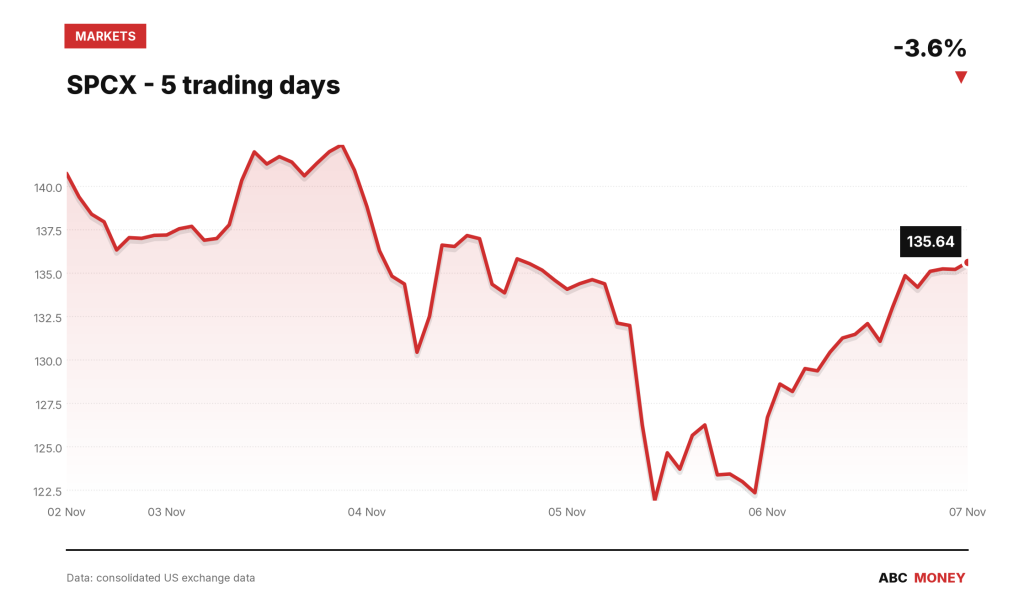
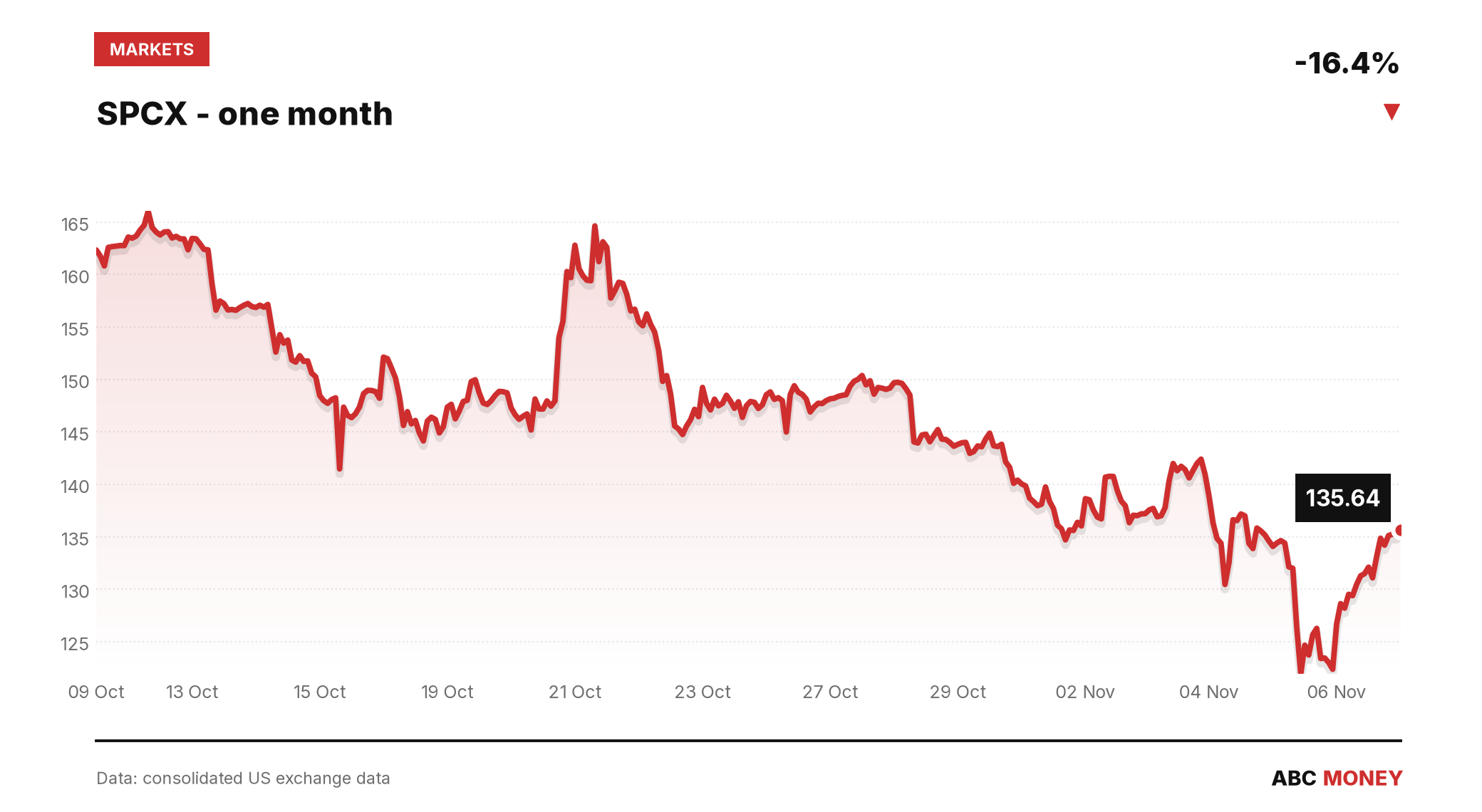
Against that backdrop, SpaceX’s finance chief telling reporters that newly deployed compute capacity is paying for itself in under a year reads as a confident, specific claim from a company that has just turned the corner on profitability – not noise lobbed into a falling market to distract from it. SpaceX’s own shares, in fact, were not part of the selloff at all: the stock rose 3.48% in the 24 hours to 7 November, even as it remained down 7.95% over the preceding 20 trading days. Daily short-sale data from FINRA shows the share of SPCX volume sold short ranging between 0.377 and 0.573 through late October and early November – no spike that would suggest traders were piling into bearish positions around the alleged panic.
A valuation argument, not a financing one
What’s really happening looks less like a credit story and more like a valuation argument playing out in public. Morgan Stanley has set a $300 price target on SpaceX, while investor Michael Burry has called the stock overvalued – a split that frames the payback claim as ammunition in a live bull-bear debate rather than a rebuttal to a sector-wide financing scare that the data doesn’t fully support. The AI-power cohort’s swings this autumn have had real, identifiable causes each time – an election result here, a sector downgrade there – they just haven’t been the one printed in this week’s headline.
For investors, the more durable marker is likely to be SpaceX’s next quarterly filing, which will show whether the Q3 profit turn and the payback claim on compute spending hold up as a trend rather than a single standout quarter.
This article is for information only and is not investment advice or a recommendation to buy or sell any asset. Markets move quickly; figures are correct as sourced at the time of writing. Always do your own research before making financial decisions.