
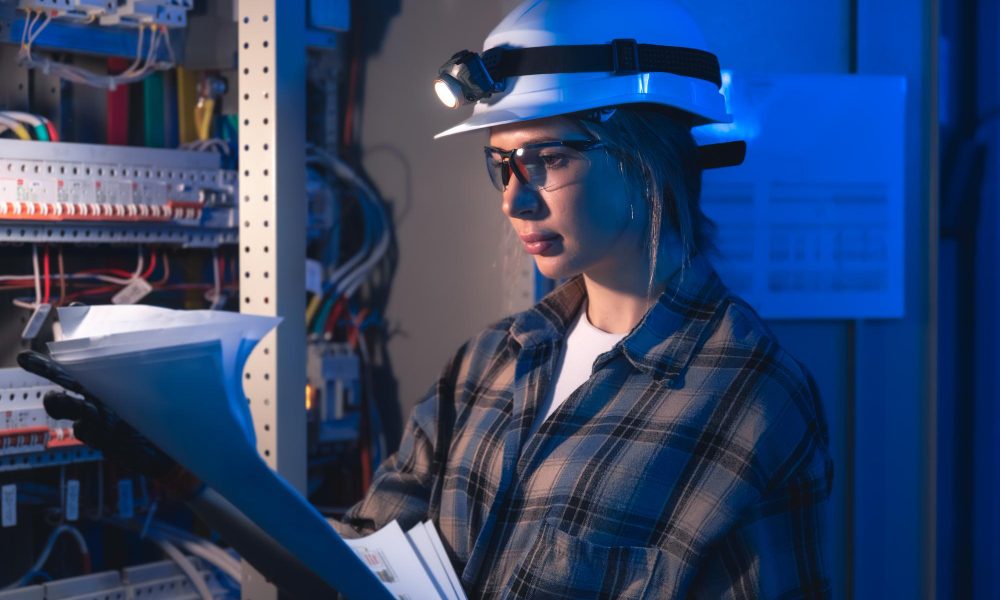
Construction workers are working on what Google refers to as the next generation of its infrastructure—a vast data center campus that will assist in running some of the most advanced artificial intelligence systems on the planet—if you drive past the Fort Wayne, Indiana, suburbs, grain elevators, and outdated manufacturing facilities. The project is massive. The budgets are outstanding. Additionally, if you speak with those who are actually attempting to staff it, you will hear a very different story than the one that appears in the tech press. This story is about whether there are enough licensed electricians within driving distance to complete the wiring, not about machine learning researchers or prompt engineers.
Engineers are not the true shortage in AI. Although Silicon Valley has been slow to realize this, everyone in the construction and trades industries has known this for some time. According to the Bureau of Labor Statistics, the United States will experience a shortage of about 81,000 electricians annually on average between 2024 and 2034. This is not some far-off, hypothetical future, but rather the present, amid the biggest surge in data center construction the nation has ever witnessed. According to a McKinsey study, an additional 130,000 skilled electricians, 240,000 construction workers, and 150,000 construction supervisors are required before 2030. Furthermore, none of those forecasts fully accounted for the AI boom.
| Category | Details |
|---|---|
| Core Issue | Severe shortage of skilled tradespeople — electricians, plumbers, HVAC technicians — needed to build AI data centers |
| Key Statistic | U.S. faces ~81,000 unfilled electrician jobs per year through 2034 (Bureau of Labor Statistics) |
| McKinsey Estimate | 130,000 additional electricians + 240,000 construction laborers needed by 2030 |
| Big Tech Capex | Alphabet, Microsoft, Meta, Amazon committed ~$700 billion combined in 2025 alone |
| Pay Premium | Specialized trades workers in data centers see 25–30% pay increase; six-figure salaries increasingly common |
| Notable Corporate Response | Google donated to Electrical Training Alliance to train 30,000 new apprentices by 2030 |
| Randstad Finding | Demand for robotic technicians up 107% between 2022–2026; HVAC engineer vacancies up 67% |
| Construction Shortfall | Associated Builders and Contractors estimates ~439,000 new workers needed by 2027 |
| Key Voice | Jensen Huang, Nvidia CEO — predicted six-figure salaries for data center tradespeople (Sept. 2025) |
| Reference Website | WIRED: The Real AI Talent War Is for Plumbers and Electricians |
The discrepancy between what is actually needed to build artificial intelligence and how the technology industry discusses it is almost ridiculous. Bidding wars for machine learning talent, multimillion-dollar packages for top AI researchers, and concerns about whether computer science graduates from prestigious universities are selecting the right companies are all common headlines. A different type of emergency has been subtly reported by the International Brotherhood of Electrical Workers, as some of its local affiliates are dealing with single data center projects that require two, three, or even four times their current membership. There isn’t a skills gap there. There is a structural crisis there.
Jensen Huang, the CEO of Nvidia, made a statement at a conference in September of last year that received far less attention than it merited. With six-figure salaries increasingly available for workers constructing what he refers to as “AI factories,” he suggested that trade school is currently one of the most direct paths into the AI economy. This specific point felt rooted in reality, even though Huang isn’t known for underselling things. In 2025 alone, the four major hyperscalers—Alphabet, Microsoft, Meta, and Amazon—committed nearly $700 billion in capital expenditures, with a large amount going toward physical data center infrastructure.
Someone must convert that money into power distribution, cooling systems, conduit runs, and poured concrete. It’s difficult to avoid feeling as though two completely different conversations are taking place at the same time when observing this from the outside. In one, tech analysts and economists are arguing over which white-collar jobs AI will destroy first. Gary Wojtaszek, in the other
The CEO of Pure Data Centers is stating unequivocally that the lack of skilled workers is “a huge issue now, and it’s only going to get worse” and that AI won’t replace any of those trade jobs because, in his words, someone needs to operate those machines. Both discussions are authentic. Only one of them is receiving the proper amount of airtime.
Data center projects are currently requiring more workers than any other industry, according to Chris Madello, an international representative for the United Association, the union for plumbers and pipe fitters. The draw includes the compensation. Specialized and technical professionals who move into high-level data center roles frequently see a 25–30% pay increase over comparable work elsewhere, according to staffing firm Kelly Services. Due to these projects’ strict schedules—Amazon and Google don’t miss deadlines like a residential contractor might—overtime is frequently required, which raises yearly earnings. Nowadays, tradespeople have a proverb that goes, “You’re going to get paid quickly because you’re dealing with an Amazon, or a Google.” It’s not a joke. It’s hiring.
The causes of the shortage predate the AI boom by a significant amount. The industry had been warning about a “silver tsunami”—the mass retirement of highly skilled baby boomer tradespeople—for years before it finally materialized, according to Anirban Basu, chief economist of the Associated Builders and Contractors. The pipeline thinned for a generation or two as skilled workers pushed their kids to pursue four-year degrees rather than apprenticeships. The most skilled construction workers are getting older and leaving the industry, and there aren’t enough younger workers to replace them. This issue was not brought about by the growth of AI data centers. It simply made it impossible to ignore any longer.
In an attempt to address the issue, Google announced that it would donate to the Electrical Training Alliance in order to train 30,000 new apprentices and assist 100,000 current electricians in improving their skills by 2030. BlackRock CEO Larry Fink argued that capital alone is insufficient to build the infrastructure required for the AI economy, and the company launched a $100 million initiative in early 2026 specifically to develop the next generation of trades workers. These are significant pledges. Additionally, considering the size of what is being constructed, they are most likely insufficient. According to Randstad’s global analysis, the need for robotic technicians increased by 107% between 2022 and 2026, while the number of open positions for HVAC engineers increased by 67%. In just four years, HVAC engineers’ pay has increased by ten to fifteen percent. Although the general public hasn’t fully grasped it yet, the market is sending a clear signal.
As the construction surge eventually peaks, it’s possible that some of this pressure will subside. A data center only requires a maintenance crew, a few outside contractors, and rotating overnight workers when it first opens. When the construction phase comes to an end, what happens to all those tradespeople is a genuinely open question, and Basu is candid about the uncertainty: “Is it a sustained boom? He asks, “Does it crash spectacularly?” No one has a clear response.
The truth is that the workforce was unprepared for the physical demand for skilled labor that the AI economy is creating, and it will take years of investment in training pipelines that were allowed to atrophy for decades to fix it. The algorithms are prepared. In many locations, the conduit has not yet been run.



 Bitcoin
  Ethereum
  Tether
  BNB
BNB  USDC
USDC  XRP
XRP  Solana
  TRON
TRON  Lido Staked Ether
  Cardano
  Gram (prev. Toncoin)
  Avalanche