
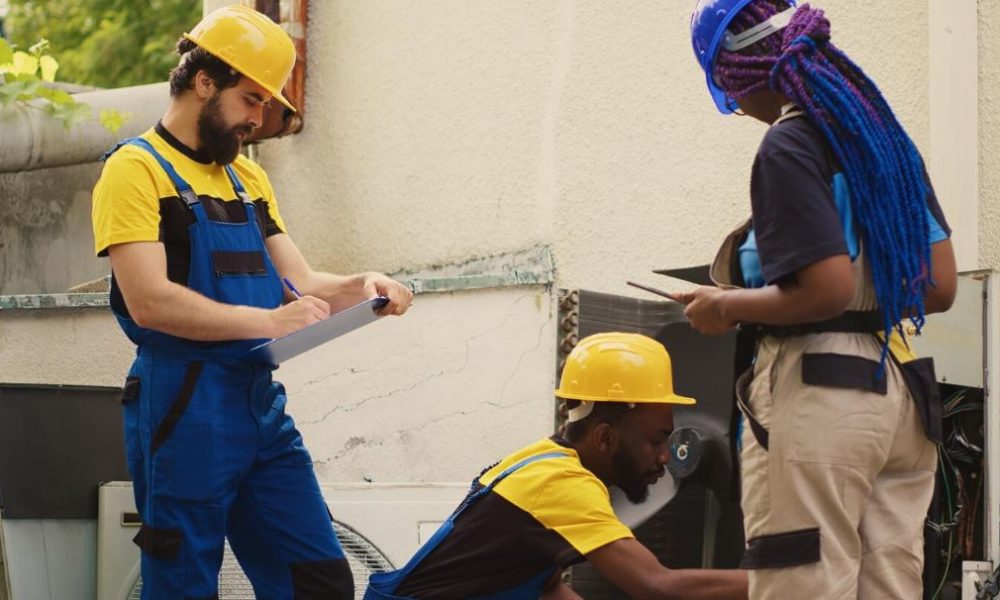
I was watching a plumber retrieve a copper pipe from beneath a cabinet in a suburban New Jersey kitchen when it finally dawned on me. He was forty-one, had a spotless white van, and mentioned—almost as an afterthought—that the previous year he had cleared slightly more than $190,000. He mentioned that his daughter had recently received an acceptance to NYU. He wasn’t sure if he would release her. “Six figures of debt,” he said, “for a job AI’s already eating.”
All across the nation, that conversation is currently taking place in various forms. The statistics are more bizarre than the stories. The median electrician salary, according to the U.S. Bureau of Labor Statistics, is $62,350, but that number is deceptive because master plumbers in Illinois make closer to $97,000 annually, and the top decile is above $106,000. In the meantime, entry-level hiring at the top fifteen tech companies decreased by a quarter in just one year, and the number of programmers employed in the US decreased by 27.5% between 2023 and 2025. The safe path ceased to be safe at some point.
| Story focus | The 2024–2026 wage shift between U.S. skilled trades and white-collar entry-level work |
| Median U.S. electrician wage (May 2024) | $62,350, top decile above $106,030 |
| Master plumber wage (Illinois, adjusted median) | $97,314 — work that requires no four-year degree |
| Projected electrician job growth, 2024–2034 | 9%, three times the average for all U.S. occupations |
| Annual openings (electricians) | About 81,000 per year, per the Bureau of Labor Statistics |
| Germany skilled-worker shortfall by 2027 | 728,000 |
| U.K. average plumber wage | £48,675; average plumber age now over 50 |
| U.S. programmer employment, 2023–2025 | Down 27.5% |
| Loudest cultural voice on the shift | Mike Rowe, MikeRoweWorks Foundation |
| Notable CEO commentary | Alex Karp of Palantir, telling Gen Z that vocational training is one of two safe bets in the AI era |
Perhaps we should have anticipated it. The nation encouraged children to learn to code for fifteen years, and they did. After enrolling in computer science programs and taking out six-figure loans, they found themselves in a job market where the very tools they had learned how to use were now writing the code. In contrast, the trades were built around issues that no language model could resolve, such as a 70-pound HVAC unit that needs to be lifted onto a roof in August, a cracked drain pipe behind drywall, and a shorted breaker in a basement.
Speaking with industry insiders, there’s a feeling that the AI build-out itself is what’s turned the tables. Miles of conduit, transformers, cooling lines, and switchgear are required for every hyperscale data center being built in Loudoun County, Virginia, or outside of Phoenix. According to a Randstad study presented at this year’s Fortune Workplace Innovation Summit, there is a hundreds of thousands of technician shortage. Big tech is desperately trying to hire people to wire the buildings that house its servers while simultaneously firing office workers. The irony is almost too clever.
The CEO of Palantir, Alex Karp, stated it in a way that probably no one in the boardroom wanted to hear. He told an interviewer earlier this year that there are essentially two ways to know you have a future: being neurodivergent or receiving vocational training. He believes it will be challenging to market a philosophy degree from a prestigious university. That’s a big statement coming from a man who holds a doctorate from Goethe University in Frankfurt.
The cultural component might be even more important than the wage information. Gen Z has begun to view the child down the street running an HVAC route and doing the math differently after witnessing an older sibling or cousin struggle through four-month job searches and unpaid internships. For almost twenty years, Mike Rowe has said this on television, mostly to empty rooms. The rooms are now filling up. Although only 38% of Gen Z respondents to a Harris survey conducted last summer still think that trades present the best opportunities, the trend line is moving—first slowly, then less slowly.
As this develops, it’s difficult not to notice a subtle shift in how Americans define a good life. In some settings, the Ivy League diploma still has significance. However, the rooms are becoming smaller. For the first time in a long time, the young person with the truck, the toolbelt, and no student loans is being viewed with something akin to envy.



 Bitcoin
  Ethereum
  Tether
  BNB
BNB  USDC
USDC  XRP
XRP  Solana
  TRON
TRON  Lido Staked Ether
  Cardano
  Gram (prev. Toncoin)
  Avalanche