Rocket Lab Launch Backlog Tops 100 After Synspective Deal
Rocket Lab's launch backlog has passed 100 missions after a 20-launch Synspective deal, its biggest commercial Electron contract yet.
In this article 4 sections
Rocket Lab’s (NASDAQ: RKLB) launch backlog has passed 100 missions for the first time, after the company signed a 20-launch agreement with Japanese radar-imaging operator Synspective on 30 September 2026 – the largest commercial Electron contract it has ever put its name to.
The deal is notable less for its size in isolation than for how fast it has arrived on top of previous ones. Rocket Lab’s own SEC filings show the manifest standing at “70+ contracted missions” when it reported first-quarter results in May 2026, climbing to “90+” by its second-quarter earnings release in August. Synspective’s order tips the total over 100 inside roughly five months – a rate of addition that outpaces anything the company has managed before.
A customer that keeps coming back
Synspective was already a Rocket Lab customer before this agreement; the new 20-mission order lifts its cumulative Electron bookings to 47 launches, more than any other client on the books, according to The Motley Fool. Financial terms of the agreement were not disclosed, a point Benzinga flagged in its coverage of the announcement, so the mission count tells investors about demand and cadence commitments rather than revenue it can model precisely.
It’s worth being precise about what “backlog” means here. The 100-plus figure is a count of contracted missions, not the dollar-value backlog Rocket Lab reports separately in its results. That financial backlog stood at a record $2.2bn as of the first quarter of 2026, up 20.2% on the prior quarter, having already risen 73% over the whole of 2025 to $1.85bn, per the company’s annual filing. Both metrics are climbing together, which is the more reassuring reading, but they are not the same number and shouldn’t be conflated.
Cadence is now the constraint
Rocket Lab flew 16 Electron missions in 2024 and a record 21 in 2025. At that pace, a backlog of 100-plus missions represents roughly five years of manifested launches – a comfortable runway for a launch provider, but also a reminder that signing contracts and flying rockets are different skills. The order book has grown faster than the fleet’s flight rate, and the gap between the two is the thing worth watching as Rocket Lab also works toward the debut of its larger Neutron rocket, intended to compete for bigger payloads than Electron can carry.
The Synspective win sits alongside other recent additions to the manifest, including an $816m Tranche 3 tracking-satellite contract with the US Space Development Agency and a $190m, 20-flight hypersonic test agreement covering the HASTE and MACH-TB 2.0 programmes, both disclosed in the company’s filings. Together they show a business whose order flow now spans national-security and commercial customers rather than leaning on either alone.
Growth that still isn’t profitable
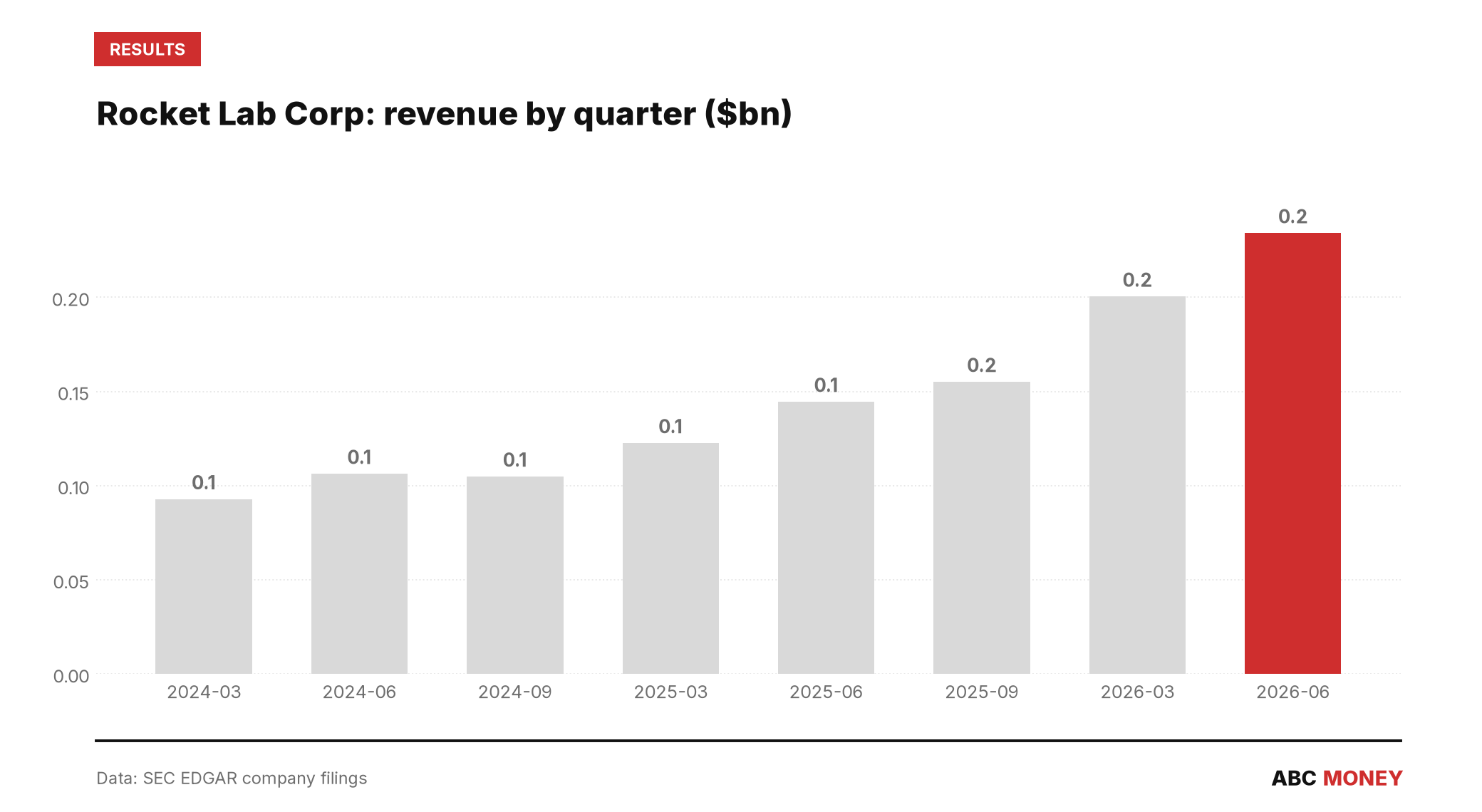
The commercial momentum hasn’t yet translated into GAAP profit. Rocket Lab’s quarterly revenue has more than doubled over the past two years, from $92.8m in the first quarter of 2024 to $234.1m in the second quarter of 2026, based on figures filed with the SEC. Over the same period the net loss has narrowed only unevenly – the company posted a $49.3m loss in the most recent quarter, a smaller shortfall than some prior periods but still firmly in the red. Scaling Electron production and standing up Neutron simultaneously costs money, and the backlog growth is, in effect, a bet that today’s spending converts into tomorrow’s launch revenue.
Market response
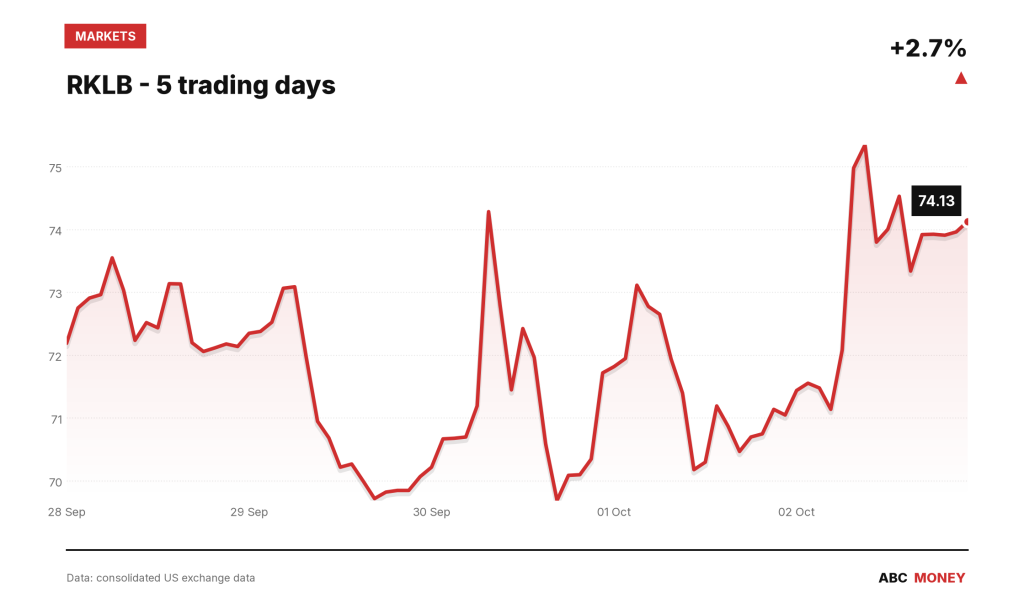
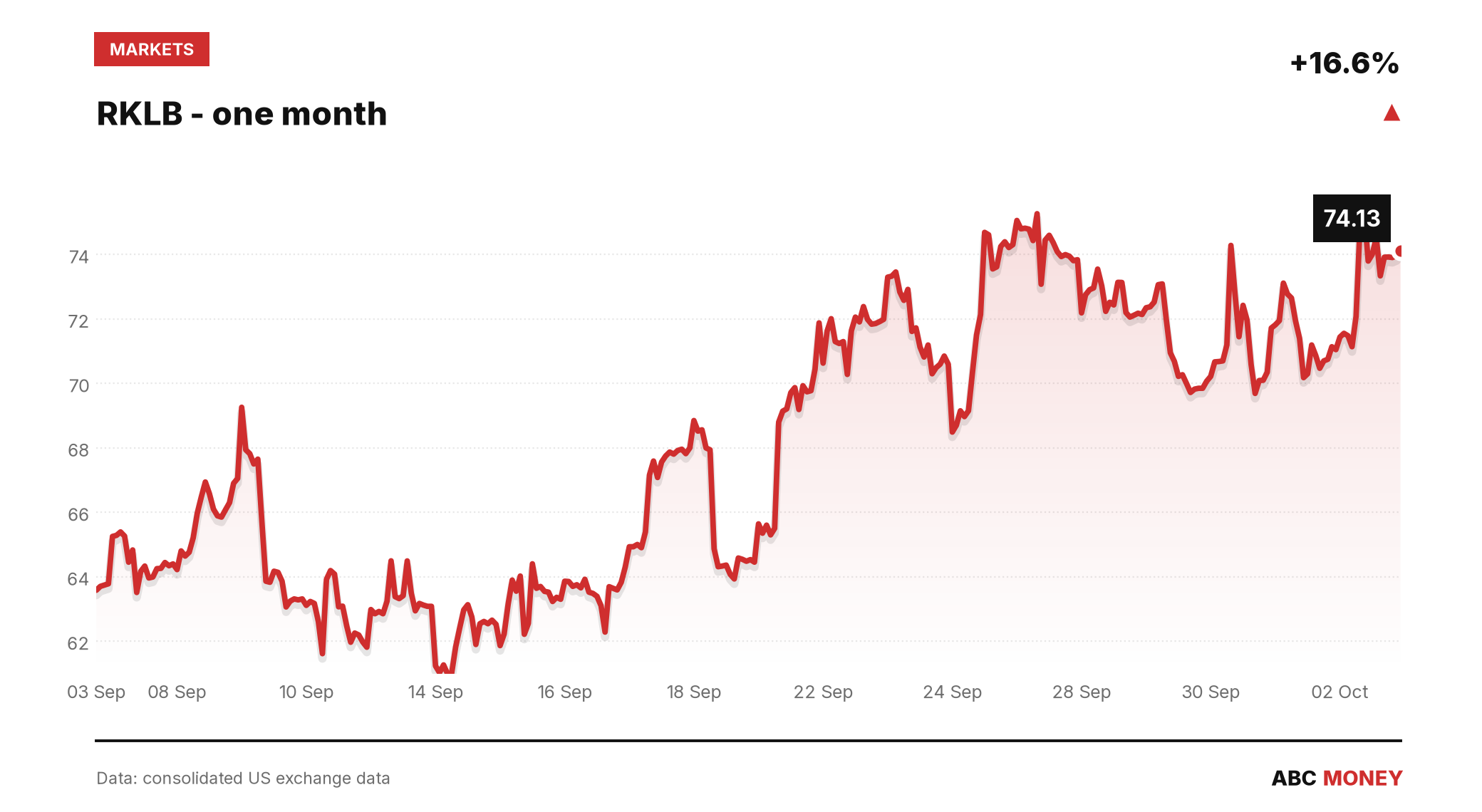
RKLB shares closed at $74.13 on 2 October 2026, up 21% over the preceding 20 trading days and within a few per cent of their 20-day high of $75.35, according to consolidated exchange data. Benzinga reported the stock rose more than 5% in premarket trading the morning after the Synspective announcement. Citi analyst John Godyn initiated coverage around the same time with a Buy rating and a $105 price target, as reported by Investing.com – a view from one bank, not a guide for readers to act on. Daily short-sale volume ratios tracked by FINRA stayed in a steady 0.36-to-0.52 range through the fortnight around the deal, showing no sign of a short-covering scramble; this looks like a straightforward repricing on fresh order-book news rather than a positioning squeeze.
A Form 4 insider filing was lodged with the SEC on 2 October 2026, the day after the announcement, though the transaction details within it were not available in the filing index. The next scheduled test of the thesis is Rocket Lab’s third-quarter results, when investors will get a clearer read on whether Electron’s flight cadence is starting to close the gap on its order book – and what, if anything, Neutron’s development timeline has to say about it.
This article is for information only and is not investment advice or a recommendation to buy or sell any asset. Markets move quickly; figures are correct as sourced at the time of writing. Always do your own research before making financial decisions.