Texas Instruments notes sale raises $2bn for Silicon Labs deal
Texas Instruments' notes sale raised $2.0bn across four tranches to help finance its $7.5bn purchase of Silicon Laboratories, filings show.
In this article 4 sections
Texas Instruments (NASDAQ: TXN) has completed a Texas Instruments notes sale worth $2.0 billion, splitting the debt across four maturities to help pay for its $7.5 billion all-cash takeover of chip designer Silicon Laboratories. The pricing, announced by the company on 26 October, is the clearest sign yet of what it now costs a blue-chip borrower to fund a large acquisition with Treasury yields back above 5%.
Four maturities, rising coupons
The notes consist of $500 million tranches at each of four price points: 5.000% senior unsecured notes due 9 November 2028, 5.350% due 2031, 5.500% due 2033 and 5.750% due 2036. The step-up in coupon as maturity lengthens is standard for a laddered issue like this, but the absolute levels matter: even a company with TI’s balance sheet is now paying well north of 5% to borrow for over a decade, a marker of how far the cost of corporate debt has moved since the ultra-low-rate years. Senior unsecured means bondholders rank alongside TI’s other general creditors rather than being secured against specific assets – standard for an investment-grade issuer of this size.
J.P. Morgan Securities, Citigroup Global Markets, BofA Securities and U.S. Bancorp Investments ran the books, with Barclays, Mizuho, Morgan Stanley and MUFG as additional bookrunners and Goldman Sachs as co-manager, according to the release as republished by Stockhouse. The notes are expected to be issued on 9 November 2026.
The acquisition behind the paper
TI isn’t raising this money for working capital. It is financing a portion of its purchase of Silicon Laboratories, a deal struck in February 2026 at $231.00 a share in cash, valuing the target at roughly $7.5 billion on an enterprise basis – a figure independently reported by Reuters and consistent with TI’s own disclosure in its second-quarter 10-Q filing. Silicon Labs makes wireless chips for industrial and IoT applications – a bolt-on that widens TI’s analog and embedded processing footprint rather than a transformational bet on a new market.
The Street’s read on the underlying deal has been broadly constructive: Needham downgraded Silicon Labs itself to hold once terms were announced, while flagging TI as well placed to capture synergies from the combination, according to TheStreet. Funding the deal with a mix of cash and newly priced debt, rather than equity, means existing TI shareholders avoid dilution – the issuing of new shares that would reduce each existing holder’s slice of the company – though it does add roughly $2 billion of fixed interest expense to service over the life of the notes.
Borrowing into a steeper yield curve
The timing is notable. The 10-year US Treasury yield stood at 5.00% as of 23 October, up from 4.96% the prior reading, according to Federal Reserve data – a backdrop that sets the floor beneath corporate coupons across the market, TI’s included. TI’s credit profile cushions the impact: S&P Global Ratings affirms the company at A+ and Moody’s at Aa3 with a stable outlook, ratings that justify the “investment grade” label in the deal’s own headline and that kept the coupons on this sale well inside what a lower-rated borrower would face in the same market.
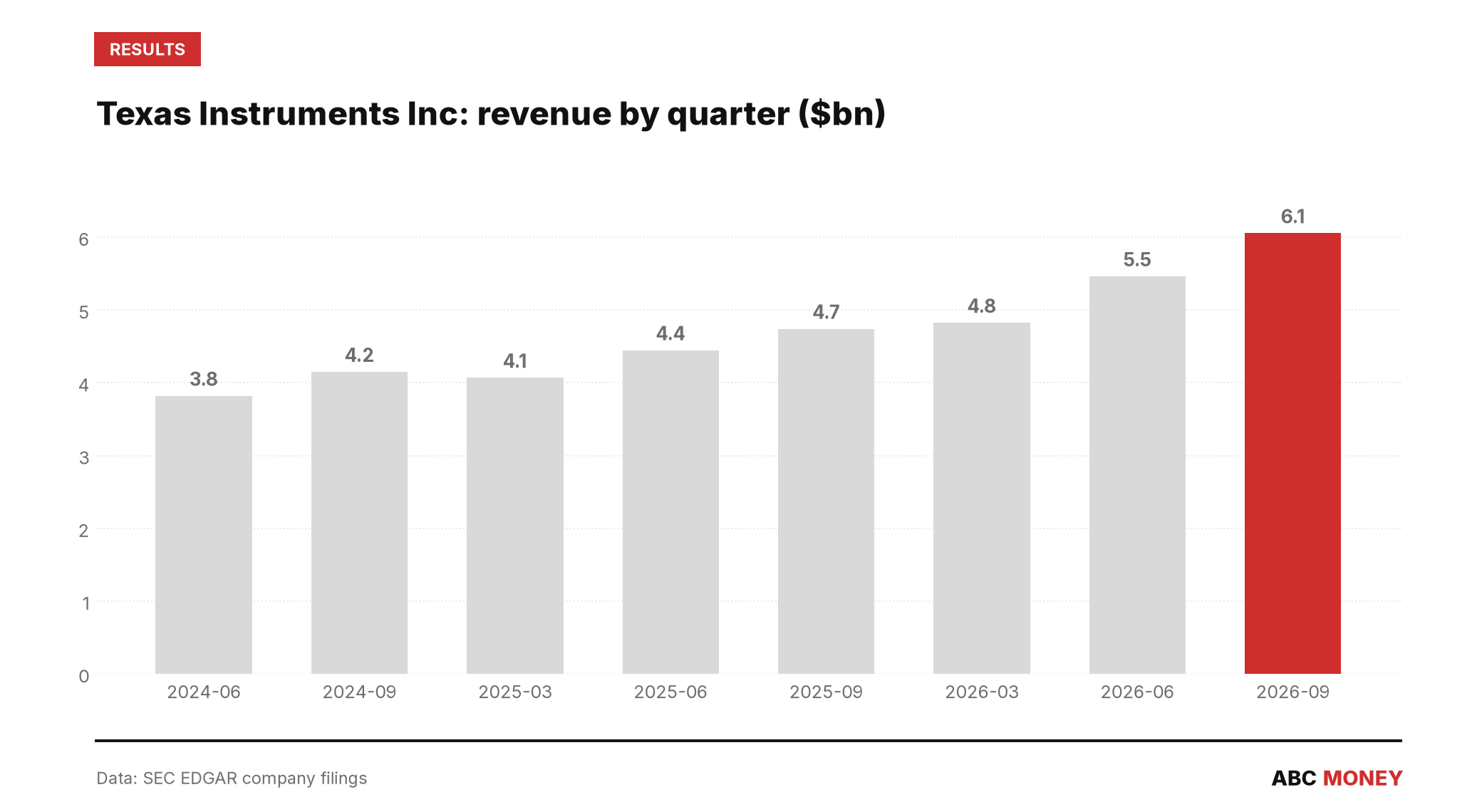
TI can also point to improving underlying trading as context for the raise. Third-quarter revenue reached $6,055 million, up sharply from $4,742 million a year earlier, with diluted earnings per share of $2.62 versus $1.48 in the same period last year, per the company’s third-quarter 10-Q. That momentum – revenue has climbed in each of the past several quarters, from $4,069 million in the first quarter of 2025 to over $6 billion now – gives lenders comfort that the additional debt load sits on top of a business generating materially more cash than it was 18 months ago.
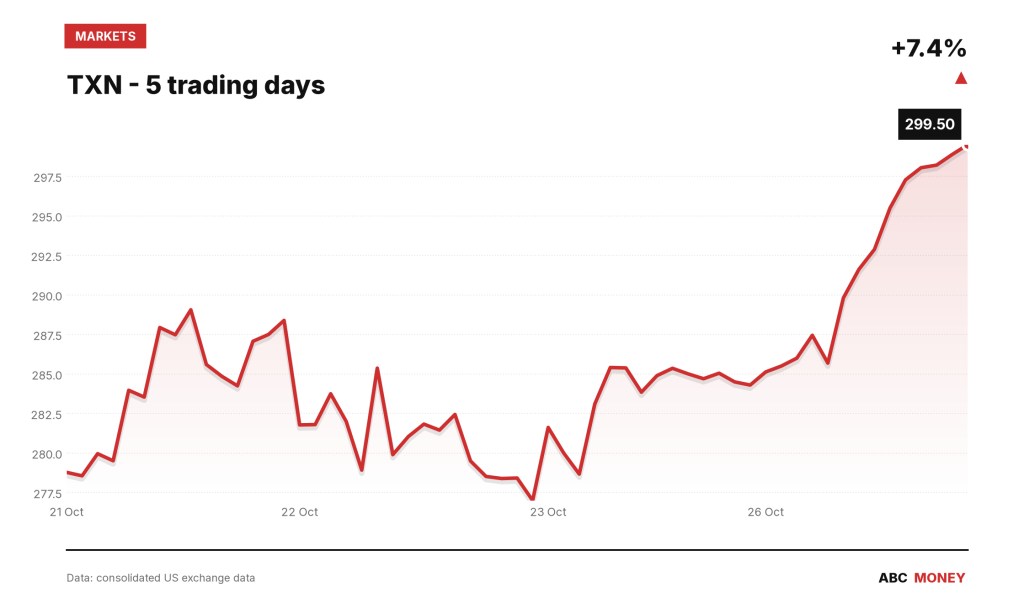
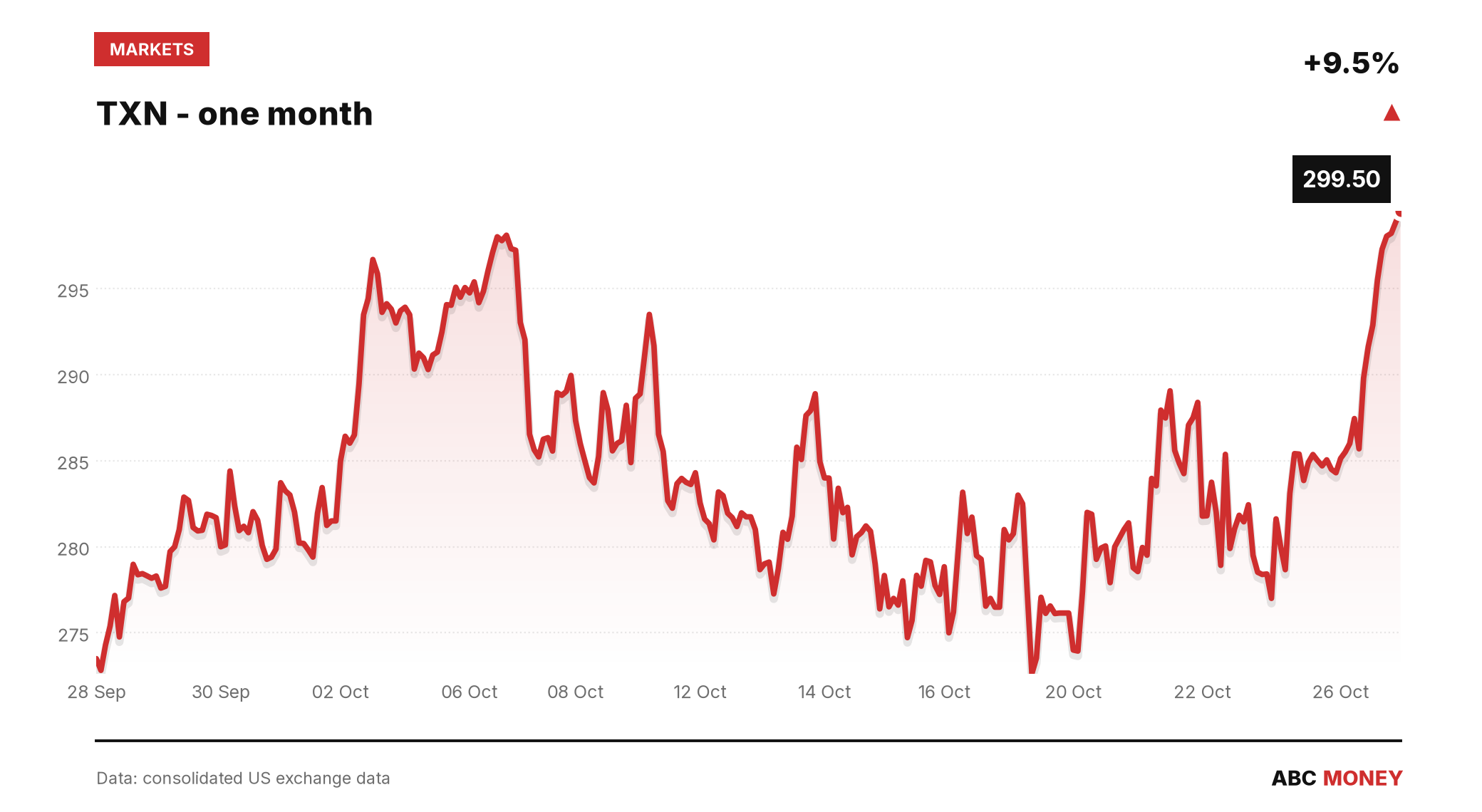
TI shares closed at $299.50 on 26 October, up 2.7% on the day and near a 20-day high, though that move reflects the broader earnings and acquisition narrative rather than the bond pricing itself, which draws fixed-income rather than equity investors.
What the paper trail shows next
The notes are due to be issued on 9 November 2026, at which point TI will have locked in the financing ahead of closing the Silicon Labs purchase. Investors in TI equity have little direct stake in how the bonds trade day to day, but the coupon TI accepted – a full percentage point spread between the shortest and longest tranche – offers a useful read on how the market is pricing duration risk for even the most creditworthy industrial names as the Treasury curve holds near its highest levels of the cycle.
This article is for information only and is not investment advice or a recommendation to buy or sell any asset. Markets move quickly; figures are correct as sourced at the time of writing. Always do your own research before making financial decisions.