Sunday Money: Hasbro Stock Price Jumps ~19% on the Week
Sunday Money: the Hasbro stock price led the week's gainers, up ~19%, while chipmakers and crypto slipped. Here's the week in five stocks.
In this article 3 sections
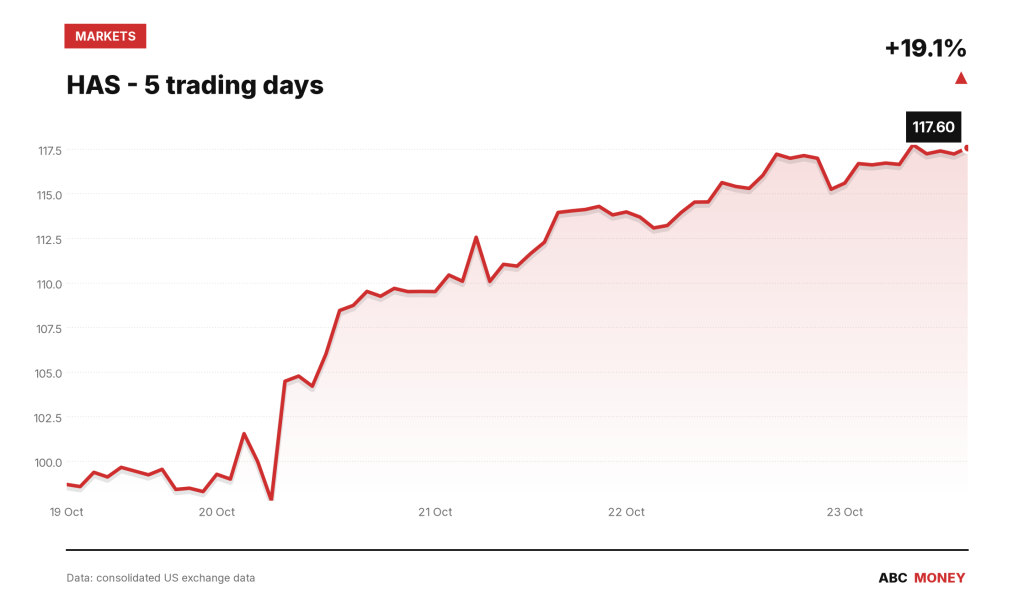
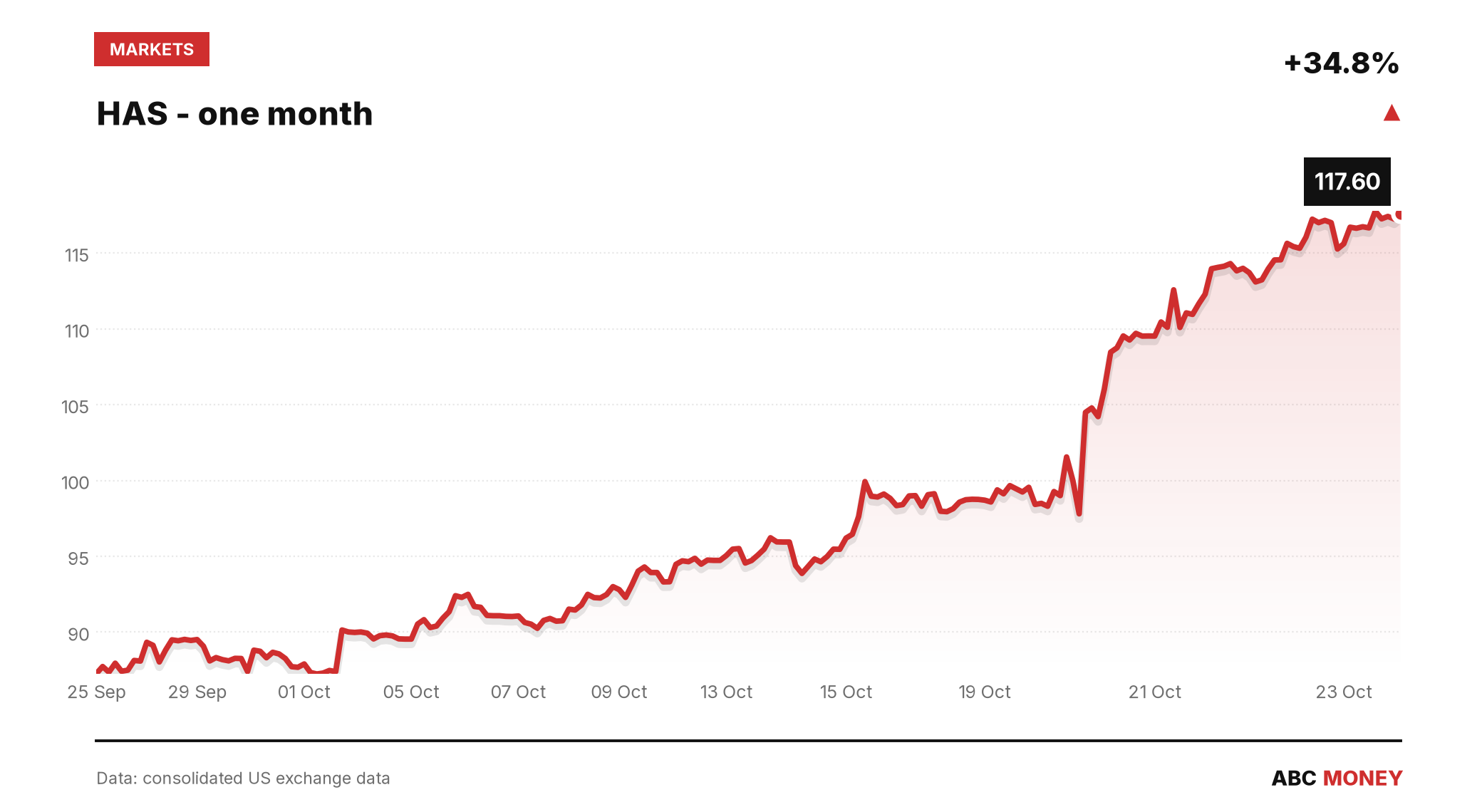
Good morning, and welcome back to Sunday Money, where we take the week’s noise and boil it down to the bits worth knowing. This week’s star turn belongs to a company that most of us associate with board games rather than stock market drama: the Hasbro stock price rose 19.15% over the week to close at $117.60, making it the single biggest gainer among large US companies we track.
Hasbro (NASDAQ: HAS), the Rhode Island toymaker behind Monopoly, Transformers and the trading card game Magic: The Gathering, had already surprised investors earlier in the month when its third-quarter results showed Magic alone generating $600m in revenue – enough to send the shares up 7.4% in a single session, as we reported at the time. That rally has simply kept running. By the time the week closed, Hasbro had added almost a fifth of its value, proof that a strong card game franchise can move a toy stock as much as any blockbuster film tie-in once did.
The rest of the week’s big movers
Hasbro wasn’t alone in having a good week. Credit bureau Equifax (NYSE: EFX) climbed 15.89% to $182.52, a reminder that consumer data businesses can still surprise to the upside even in a jittery market. Industrial instrument maker Roper Technologies (NASDAQ: ROP) rose 14.53% to $437.00, extending a run that has made it one of the quieter winners of the year.
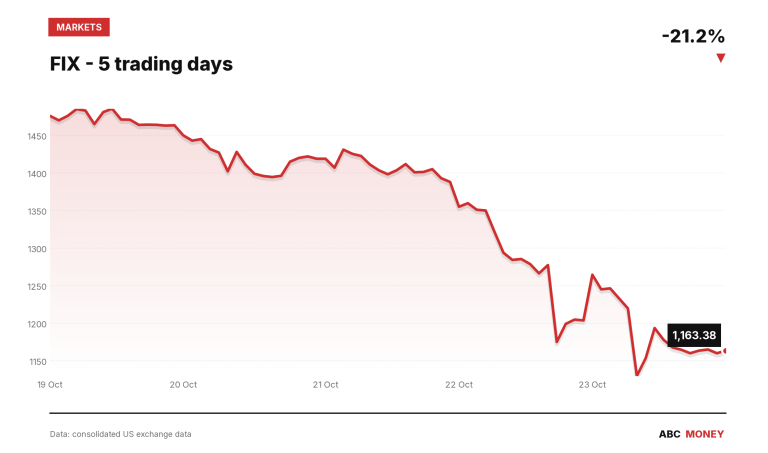
Not everyone was celebrating. Comfort Systems USA (NYSE: FIX), the building-services group whose dividend increase landed awkwardly alongside news of its finance chief’s departure, had the roughest week of any major US stock: shares fell 21.41% to $1,160.00. Clean-energy fuel-cell maker Bloom Energy (NYSE: BE) dropped 16.49% to $191.15, while chip-equipment maker Lam Research (NASDAQ: LRCX) fell 16.12% to $229.37 as the broader semiconductor sector cooled off after a strong run earlier in the year.
Zoom out and the wider market tells a more modest story than any of those individual swings. The S&P 500, tracked here via the SPY exchange-traded fund, slipped 0.78% over the week to 761.11. The Nasdaq 100 (via the QQQ fund) fell harder, down 1.72% to 704.88, weighed down by the chip-sector wobble. The Dow (DIA fund) was the week’s lone index gainer, up 0.50% to 522.05 – a reminder that the old-economy names had a calmer week than the tech-heavy crowd.
Crypto corner
Digital assets had a quietly soft week. Bitcoin (BTC) fell 1.81% against the US dollar stablecoin tether to $80,667.65, according to Binance spot market data. Ether (ETH) dropped further, down 3.18% to $2,347.60, while solana (SOL) slipped 2.25% to $101.65. None of the moves were dramatic by crypto’s usual standards, but all three majors finished the week lower, in step with the pullback in growth-sensitive tech shares.
The week in numbers
Three figures stood out away from individual stocks. The 10-year US Treasury yield fell to 4.96% from 5.13% the previous reading, according to data from the Federal Reserve Bank of St Louis – a meaningful move for a borrowing cost that underpins everything from mortgage rates to company valuations. The shorter 2-year Treasury yield fell in tandem, to 4.65% from 4.81%, leaving the gap between the two – the 10-year minus 2-year spread, a gauge watched closely for what it says about the economy’s prospects – steady at 0.31 percentage points.
Oil also moved. West Texas Intermediate crude, the US benchmark, eased to $107.89 a barrel from $110.01, continuing a gentle drift lower that has taken some of the heat out of inflation worries this autumn.
That’s the week that was. Hasbro’s toy box had the best story to tell, Comfort Systems the toughest, and the bond market quietly did more to shape the backdrop than any single earnings report. We’ll be back next Sunday with whichever stock decides to steal the show next.
This article is for information only and is not investment advice or a recommendation to buy or sell any asset. Markets move quickly; figures are correct as sourced at the time of writing. Always do your own research before making financial decisions.