Alexey Gubarev on Relocating an Engineering Team to the EU

An hour of labour cost employers €12 in Bulgaria and €56.80 in Luxembourg last year, Eurostat estimates. And since June, an EU directive has said candidates must be told the starting pay before the interview.
Limassol-based entrepreneur and investor Alexey Gubarev, one of the founders of Cyprus’s TechIsland, where he sits on the board, argues that UK founders moving an engineering team to the EU tend to get the salary maths right and much of the remaining bill wrong.
For a British founder, an EU engineering team has rarely looked better on paper. Since April 2025, UK employers have paid National Insurance at 15% on salary above £5,000 a year, a threshold now frozen until April 2031. On the continent the spread of costs is huge: Eurostat puts the average hourly labour cost in the EU at €34.90 in 2025, from €56.80 in Luxembourg and €47.90 in the Netherlands down to €12.00 in Bulgaria. Set those figures next to a London payroll and the case seems to make itself. I think it often does. A team inside the single market can sell to European customers without friction, and it can recruit from far deeper pools of engineers than any one British city offers.
The trouble starts when the spreadsheet stops at gross salary. Last year a quarter of EU labour costs never reached anyone’s payslip: non-wage costs, mostly employer social contributions, made up 24.8% of the total across the Union and 32.3% in France. Then come notice periods, statutory extra payments, new disclosure rules and the months it takes to find the people at all. None of this makes Europe a bad bet. It means the companies that get burned are usually the ones that picked a city before they had costed it.
Cost the whole engineer
Every member state builds an employment contract its own way. In Portugal and Greece, for example, the law adds holiday and Christmas payments on top of twelve monthly salaries, so a Lisbon offer budgeted as twelve payments will come up short. Notice periods, probation rules and dismissal costs differ just as much, and they matter most in the year you least expect to use them.
Before comparing countries, I’d ask a local payroll provider for one number per role: the fully loaded annual cost, with employer contributions, mandatory insurance and any extra payments included. It’s the only figure worth putting side by side.
Your pay bands are about to go public
The deadline for member states to transpose the EU Pay Transparency Directive passed on 7 June. Under the directive, employers must give candidates the starting pay or a pay range in the job advert or ahead of the interview, and may no longer ask about their pay history. National laws are arriving unevenly. Only two countries, Italy and Malta, had full legislation in force on the day. Cyprus’s labour minister has said the island’s bill was due to reach the Council of Ministers in September.
For a UK company this matters twice over. Your EU job adverts will carry numbers your London staff can read. And if engineers in Warsaw and Manchester do the same work on very different pay, you’ll want the reasoning written down before the first vacancy goes live, not after the first awkward question.
Price in the search
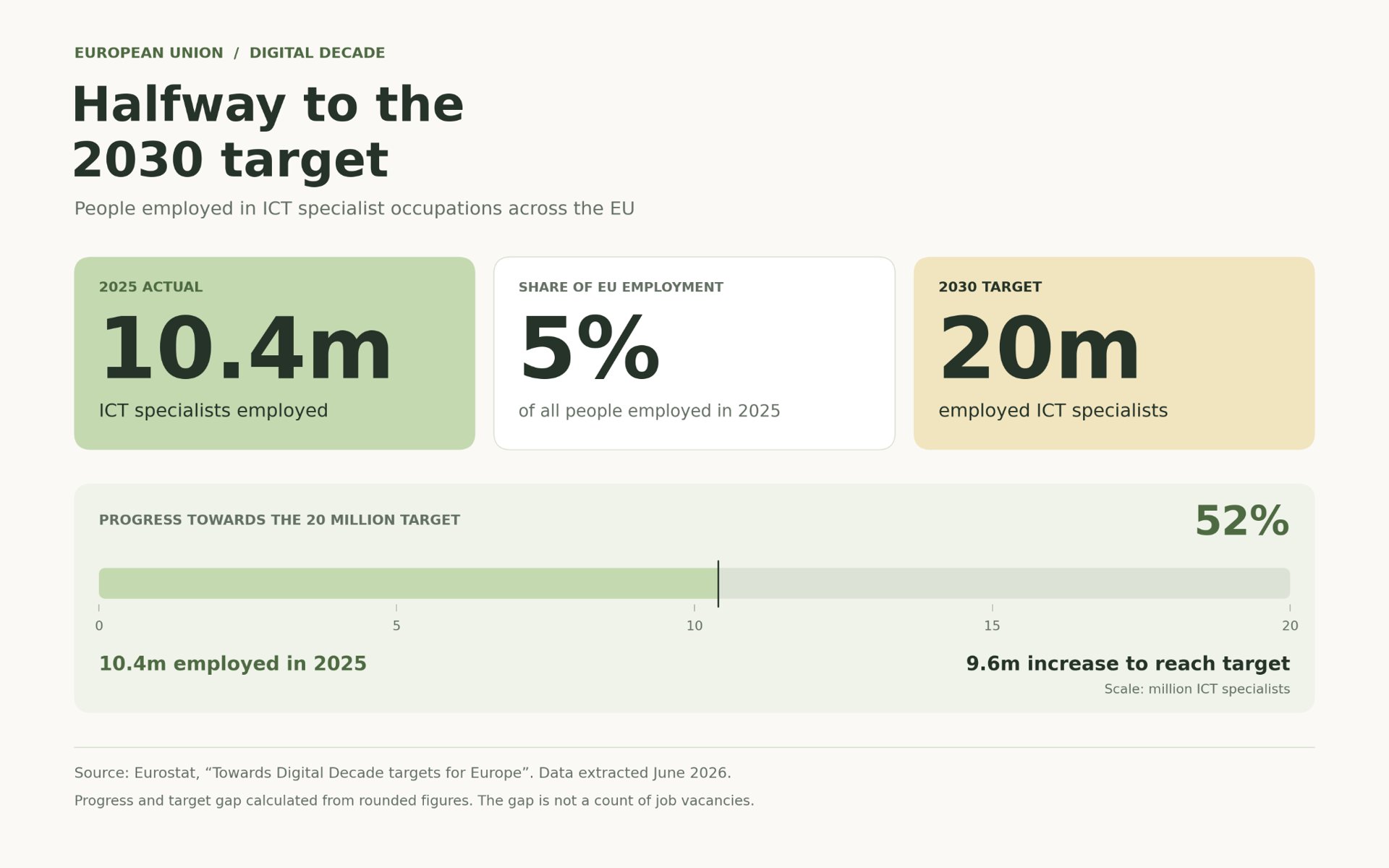
Hiring engineers in Europe is slow, and not only in the expensive cities. In 2025 the EU had 10.4 million ICT specialists, just 5% of total employment and about half of the 20 million it wants by 2030. Many teams end up recruiting from outside the EU, which brings visas and salary floors. Germany’s EU Blue Card now requires a gross salary of at least €50,700, or €45,934.20 for shortage occupations, which cover most IT roles, and the figures rise each January.
Over more than twenty years of building companies from Limassol (Cyprus), first Servers.com and now Palta, I have learned that a small island can only compete for engineers if it works together, which is why I helped found TechIsland to bring more tech businesses and talent to Cyprus.
Honestly, this is where most relocation plans slip. The budget should cover recruiters, relocation packages and the months when a seat sits empty while the roadmap waits.
Understand tax before you try to optimise it
I won’t give tax advice here, and nobody should take it from a column. Two questions do belong in the model from day one, though. Can engineers working in another country create a taxable presence there for your UK company? And will you hire through your own local entity or through an employer-of-record service while you test the market? An employer-of-record gets you started in weeks, at a higher cost per head. Your own entity takes months to set up and usually pays off once the team grows. A specialist can answer both for your situation quickly. Choose a country for its people and its costs, and treat tax as a check on that choice.
Infrastructure is the easy part
I’ve been in hosting and infrastructure since 2005, and the technical side of a new EU team is usually the least of a founder’s worries. Data can still move freely, because the European Commission renewed its adequacy decision for the UK in December 2025 and it now runs to the end of 2031. Where your engineers sit and where your servers sit are separate decisions, and it pays to keep them separate.
What does need planning is access. Laptops have to be bought, shipped and secured in the right country. Identity and permissions should treat the new office as part of the company from its first morning. Someone has to own the equipment and supplier contracts locally, or they’ll drift.
Eurostat’s range, from €12 to almost €57 an hour, shows where labour is cheap. It can’t tell you where your team will be. That comes from the full cost of each engineer, the time it takes to hire them and the rules you’ll live under once they start. The cheapest hour in Europe is easy to find. The cheapest team takes arithmetic.
Alexey Gubarev (also spelled Aleksey Gubarev and Aleksej Gubarev) has lived in Cyprus for more than twenty years. An investor and co-founder of Palta, he spent nearly two decades building internet infrastructure, including Servers.com, which he co-founded in 2013 and which was sold in July 2023. He sits on the board of TechIsland, the Cyprus technology association he helped found. More about his work is on his personal website.
Contributed content: this article was written by a third-party contributor and does not necessarily reflect the views of ABC Money. Editorial and Advertising Policy