Williams Companies Q3 earnings beat estimates, then stock fades
Williams Companies Q3 earnings beat forecasts with record EBITDA and a completed Haynesville deal, yet the stock gave back its after-hours pop.
In this article 3 sections
The Williams Companies (NYSE: WMB) delivered a set of Williams Companies Q3 earnings that beat Wall Street’s expectations on nearly every line, then watched its shares give back the initial rally within a single trading session – a reminder that in midstream energy, a clean quarter and a happy market reaction don’t always travel together.
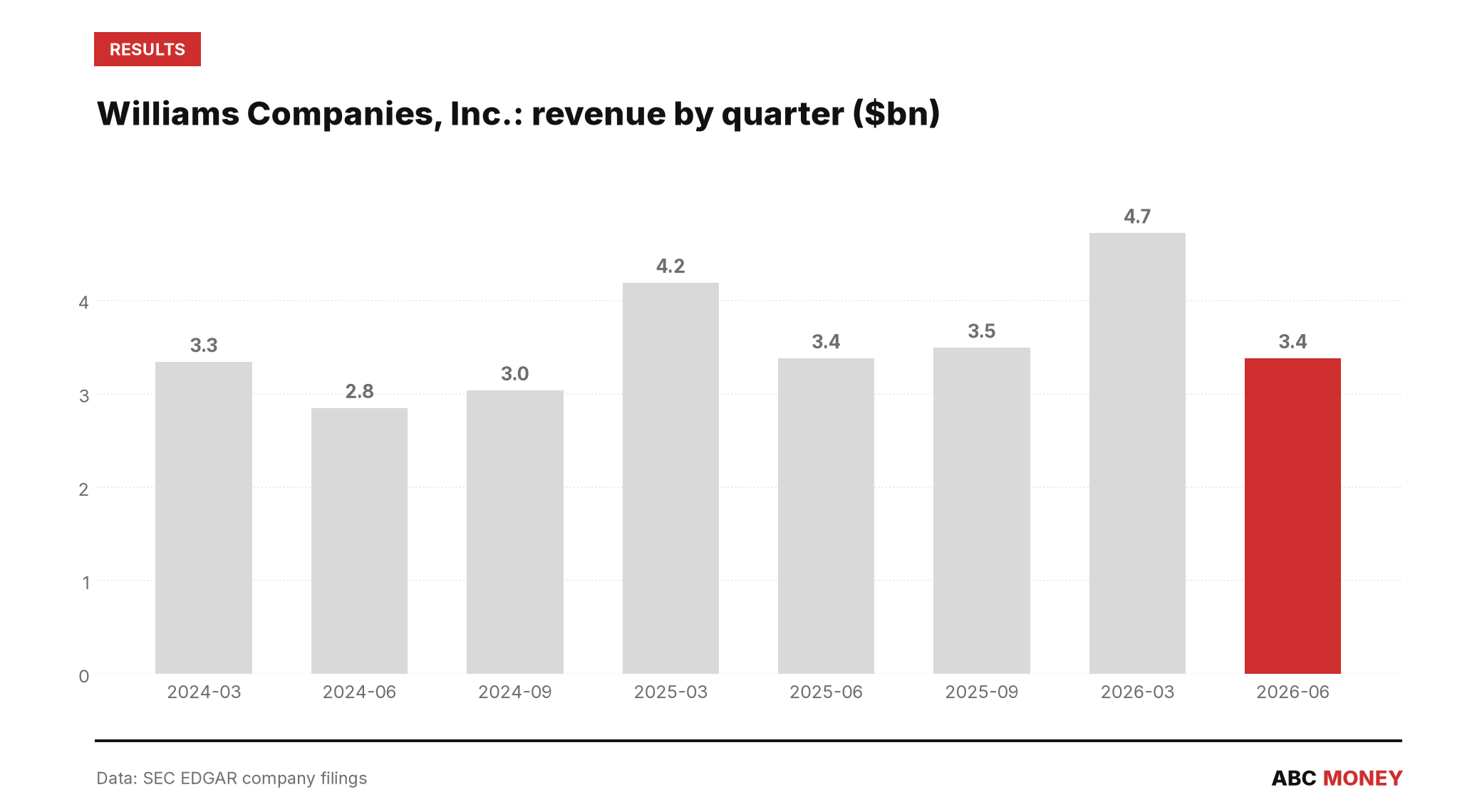
Net income for the three months to 30 September came in at $699m, or $0.56 per diluted share, according to the company’s own release. Strip out one-off items and adjusted diluted earnings per share were $0.54. Adjusted EBITDA – earnings before interest, tax, depreciation and amortisation, the cash-generation yardstick pipeline operators live by – rose 6% year-on-year to $2.039bn, a gain of $119m. Revenue of $3.223bn comfortably cleared the roughly $3bn analysts had pencilled in, as Investing.com’s earnings-call summary noted.
Some of that net income growth wasn’t organic. An $83m gain from the August sale of Permian gathering assets, for $139m in total consideration, flattered the year-on-year comparison – a one-off rather than a repeatable improvement in the underlying pipeline business.
Haynesville bulked up, pipelines switched on
The quarter’s bigger strategic story was the completion of the Momentum Midstream acquisition, which Williams finished ahead of schedule in early September to expand its position in the Haynesville gas basin, as detailed on the company’s earnings call. The deal was valued at roughly $5.1bn and funded partly through the issuance of about 27 million new Williams shares – dilution worth noting for existing holders, since it expands the share count even as it adds gas-gathering and processing capacity in one of the country’s most active shale plays.
Operationally, Williams brought four new pipeline projects into service during the quarter, together adding 413m cubic feet a day of capacity, alongside continued progress on a storage expansion at its Clay Basin facility in Utah. For a business whose earnings depend on moving and storing gas under long-term contracts, that steady drip of project completions is arguably more important to the multi-year outlook than any single quarter’s EBITDA print.
Guidance “reiterated” – but from a higher starting point
Williams held its full-year 2026 adjusted EBITDA guidance at $8.3bn to $8.5bn, a range GuruFocus and other outlets described as reiterated. Worth noting for anyone tracking the company’s forecasting discipline: that range itself represents an upgrade from the $8.05bn-$8.35bn guidance Williams gave alongside its first-quarter results, filed with the SEC in May. In other words, this isn’t a flat repeat of year-old numbers – it’s confirmation that a mid-year raise is holding up three quarters in.
That consistency sits against a broader run of quarterly results that has been steadily improving. Net income climbed from $647m in the third quarter of 2025 to $865m in the first quarter of 2026 and $827m in the second, before this quarter’s $699m – a reminder that midstream earnings can be lumpy quarter to quarter even as the underlying EBITDA trend grinds higher, per Williams’s own quarterly filings.
A pop that didn’t hold
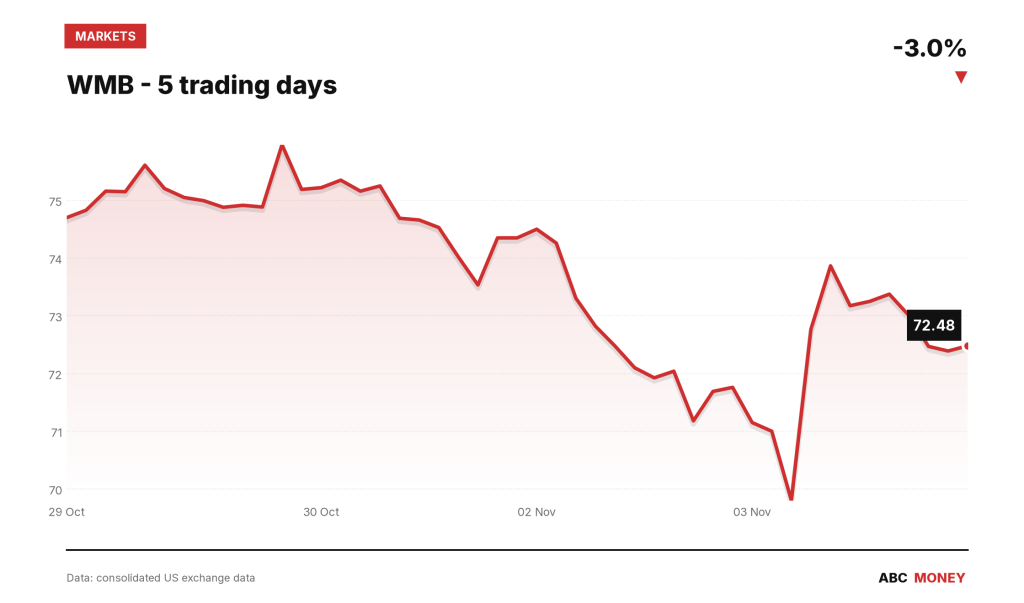
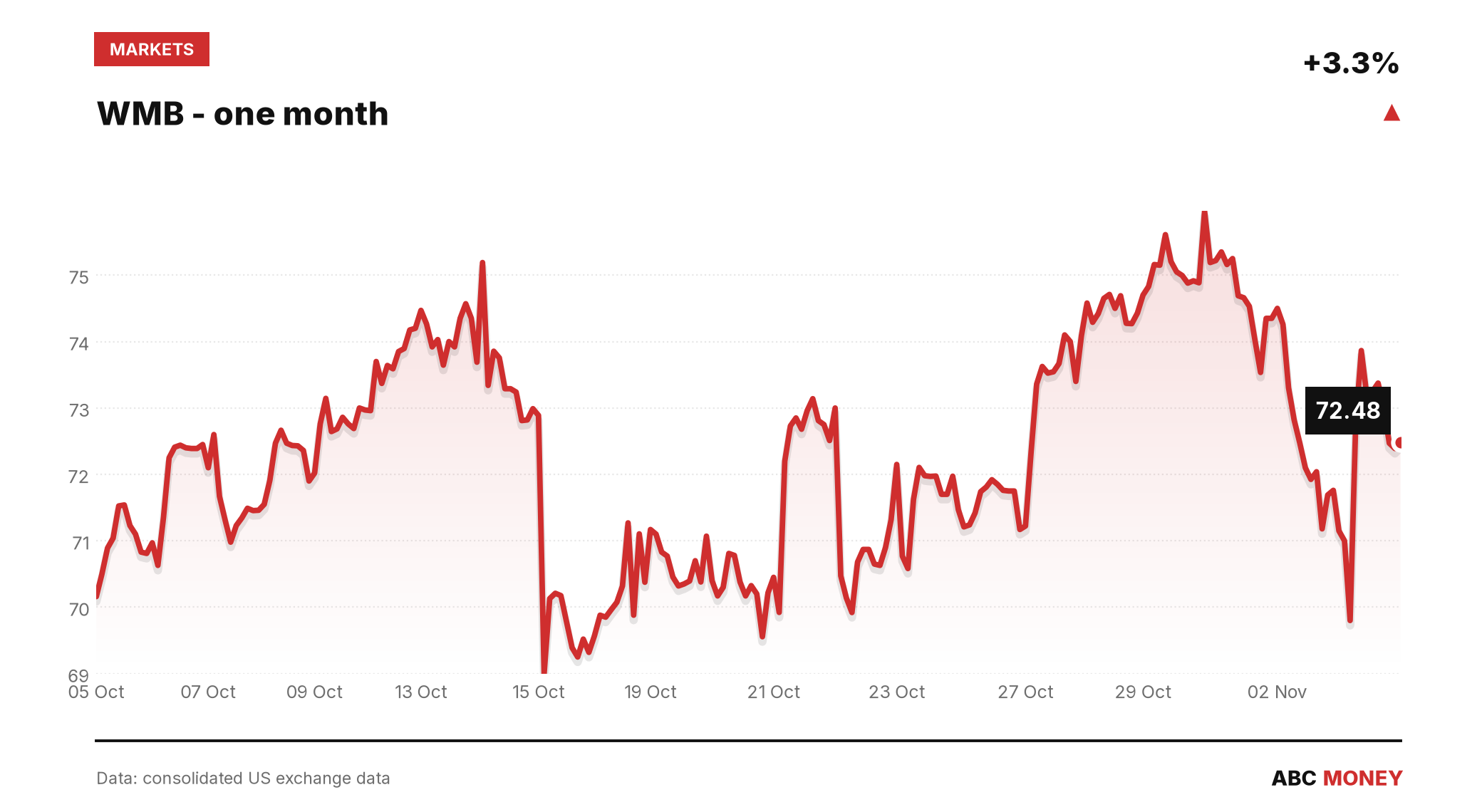
The market’s first reaction was enthusiastic: shares jumped 4.25% to $74.22 in after-hours trading from a prior close of $71.19, as investors digested the EBITDA beat and the guidance reiteration, Investing.com reported. By the close of the next full session, though, the stock had slipped back to $72.48, down 1.88% on the day and 3.6% over the trailing 20 sessions – erasing most of the overnight gain.
There’s little sign the reversal was driven by aggressive short-selling. Daily short-sale volume ratios tracked by FINRA ranged roughly between 0.30 and 0.47 across the ten sessions surrounding the results, showing no unusual spike into or out of the print. That points instead to ordinary profit-taking, or simply investors weighing the one-off gain and the new share count from the Momentum deal against the headline beat, rather than any fresh bearish positioning against the stock.
For a high-dividend-paying pipeline operator like Williams, the backdrop of US Treasury yields matters too: the 10-year yield stood at 4.91% on 2 November, a touch below the 4.94% level of the prior session, according to Federal Reserve data. A steady-to-slightly-easier rate environment tends to support demand for income-generating infrastructure stocks, even if it wasn’t enough to keep this week’s post-earnings pop intact.
The next test for the shares will be whether the Momentum Midstream integration delivers the Haynesville volumes management is counting on, and whether the $8.3bn-$8.5bn guidance range survives contact with the fourth quarter – the period in which Williams will need to show the newly completed pipeline projects and the Clay Basin expansion translating into cash flow rather than just capacity additions on a slide.
This article is for information only and is not investment advice or a recommendation to buy or sell any asset. Markets move quickly; figures are correct as sourced at the time of writing. Always do your own research before making financial decisions.