Arista Earnings Beat Belies Talk of a Q4 Slowdown
Arista earnings beat: Q3 revenue jumped 58.5% and Q4 guidance topped forecasts, even as some coverage framed the outlook as a slowdown.
In this article 4 sections
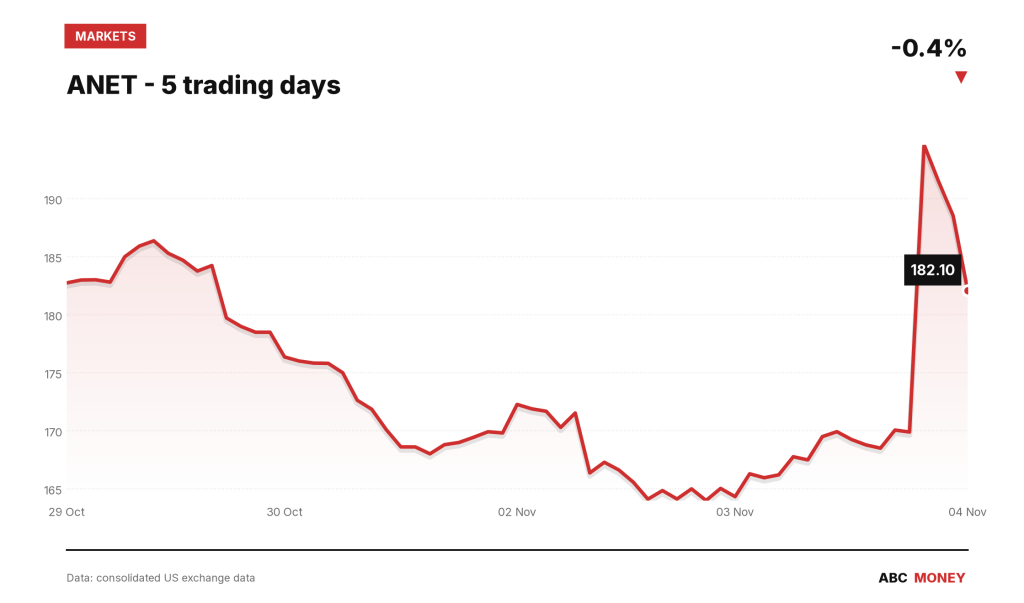
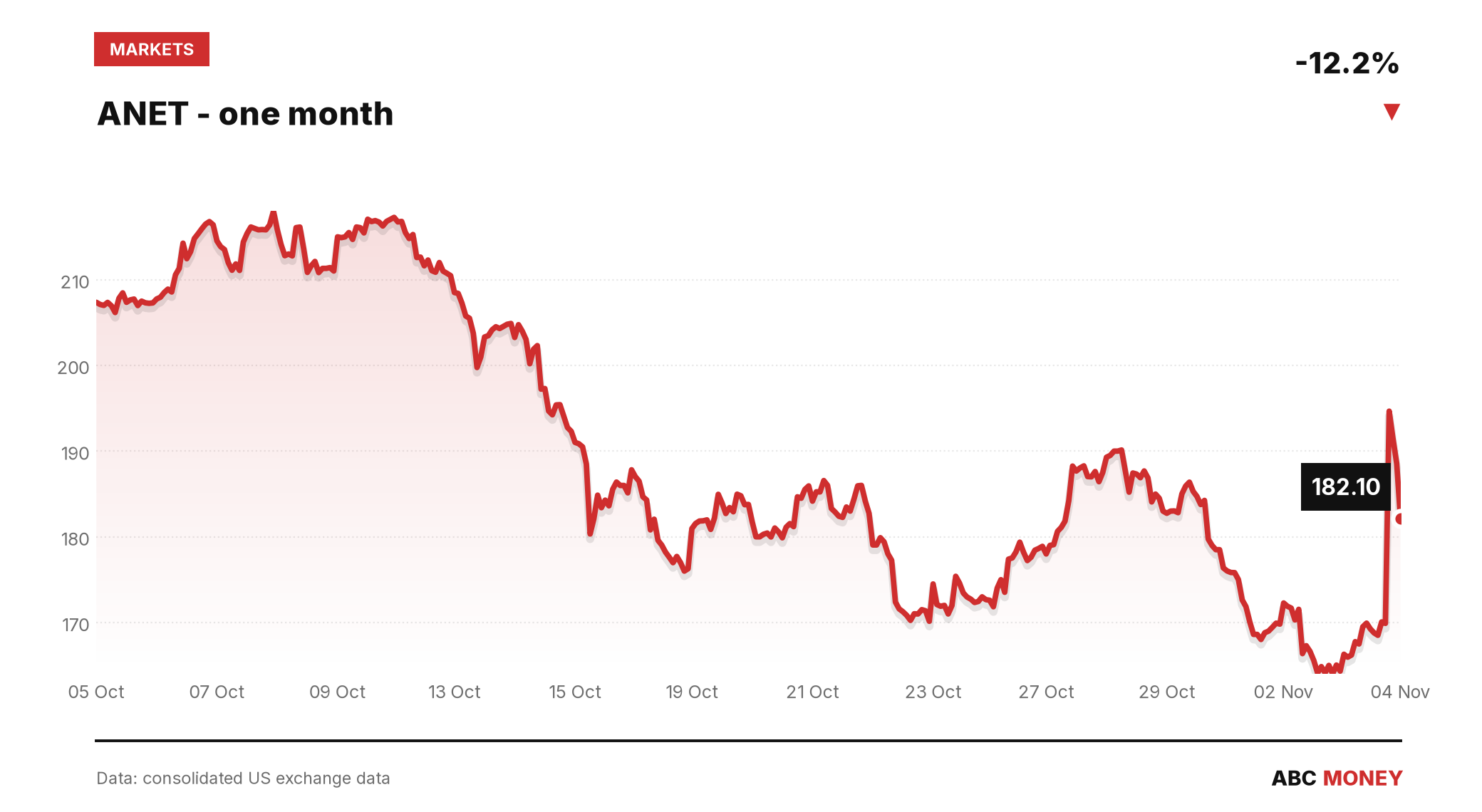
The Arista earnings beat was clean by any measure: revenue up 58.5% year-on-year to $3.66bn in the third quarter. What’s harder to square is the idea, floated in some of Monday’s coverage, that the company’s fourth-quarter outlook represents a slowdown. The market didn’t read it that way. Shares of Arista Networks (NYSE: ANET) closed up 9.41% at $184.67 on the day, on volume 2.52 times their 20-day average, according to consolidated exchange data.
The growth number checks out
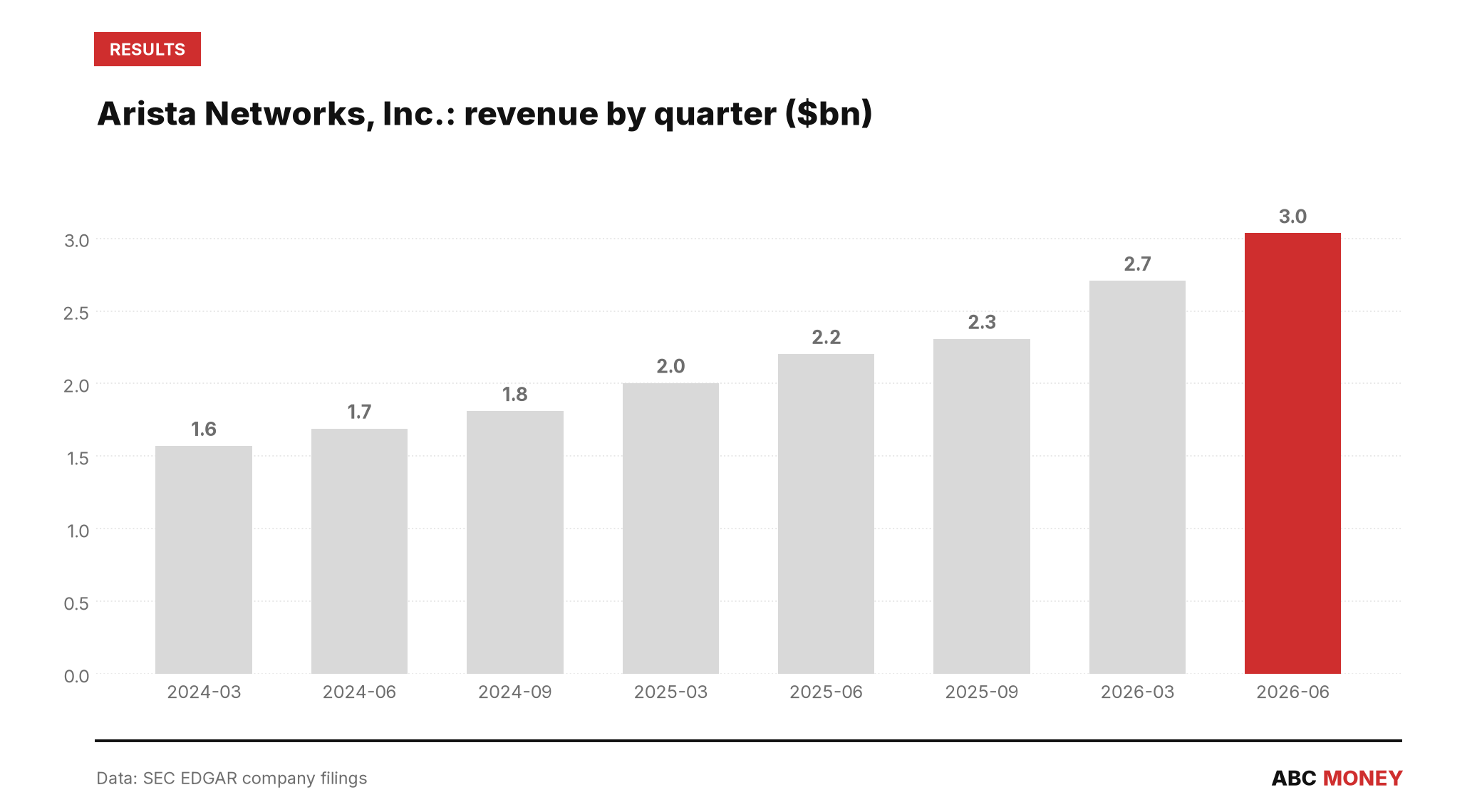
Arista’s third-quarter earnings release filed with the SEC puts revenue at $3.657bn, against $2.3083bn a year earlier – a 58.5% annual gain that also beat the company’s own guidance of roughly $3.3bn and analyst estimates clustered around $3.33bn-$3.6bn, per Investing.com. Sequentially, revenue rose 20.5% from the $3.036bn booked in the second quarter – an unusually sharp jump even by the standards of a company riding the AI-networking buildout. Quarterly revenue has climbed every single quarter since early 2024, from $1.57bn to this quarter’s $3.66bn, a run that explains why Arista joined the S&P 100 index in September, a milestone the company flagged in the same earnings release.
Where the “slowdown” framing breaks down
The confusion stems from comparing the wrong things. Arista’s guidance for the fourth quarter is $3.9bn-$4.0bn in revenue. Set against the just-reported $3.66bn, that’s sequential growth of only 7%-9% – a marked step down from the 20.5% quarter-on-quarter pace just delivered, and the basis for the “slows” framing in some headlines.
But a 20%-plus sequential jump is not a quarter you’d expect every three months, and the more meaningful comparison is annual. Fourth-quarter 2025 revenue was $2.49bn, up 28.9% year-on-year at the time, according to XTB’s market analysis. Measured against that base, Arista’s new guide implies 56.6%-60.6% annual growth for the current quarter – in line with, or ahead of, the 58.5% pace it just posted. There is no deceleration once the comparison is put on a like-for-like footing.
Management’s own actions back that reading. On the earnings call, Arista lifted full-year 2026 revenue guidance to approximately $13.3bn, implying 48% annual growth, according to a transcript carried by Benzinga – the fourth time this year the company has raised its full-year outlook. Companies bracing investors for a slowdown do not typically raise guidance for a fourth consecutive quarter.
Margins tell a more nuanced story
If there’s a genuine wrinkle in the quarter, it sits in gross margin rather than the top line. GAAP gross margin slipped to 63.6% from 64.6% a year earlier, which the Fool attributed to product sales – now 87% of revenue – growing faster than higher-margin services. Operating leverage more than offset that, though: GAAP operating margin improved to 44.9% from 42.4%, and non-GAAP operating margin edged up to 49.1% from 48.6%, per the earnings release filed with the SEC. Net income came in at roughly $1.56bn, up from $853m in the same quarter last year – a figure confirmed in Arista’s own quarterly filings.
Positioning and the paper trail
There’s little sign traders were braced for disappointment going in. FINRA’s daily short-sale data shows Arista’s short-volume ratio – the share of daily trading volume attributable to short sales, where investors bet the price will fall – held in a narrow band of roughly 0.24 to 0.40 across the ten sessions into the report, with no build-up of bearish positioning ahead of the print. Shares had actually drifted 9.15% lower over the prior 20 trading days before the results, trading between $164.00 and $204.75, which may partly explain why the post-earnings pop felt sharper than the fundamentals alone would suggest. A Form 4 filing disclosing insider share activity landed with the SEC in the early hours of 4 November, hours after the results, standard housekeeping that often follows a results-driven move in the stock.
The macro backdrop, for what it’s worth, wasn’t doing any of the work here. The 10-year Treasury yield sat at 4.91% on 2 November with a modestly positive 10-year/2-year spread, a stable enough setting that the move in Arista shares reads as company-specific rather than rate-driven.
What happens next is a function of whether Arista can keep converting AI-era networking demand into sequential quarters that beat a raised bar. The company’s guidance range for the fourth quarter – and whether it clears the upper end of $4.0bn – will be the first test of that when results land in the new year.
This article is for information only and is not investment advice or a recommendation to buy or sell any asset. Markets move quickly; figures are correct as sourced at the time of writing. Always do your own research before making financial decisions.