Cadence Q3 earnings beat as AI demand lifts backlog to $8.2bn
Cadence Q3 earnings beat forecasts on both lines, with 22% revenue growth and a record $8.2bn backlog, even as shares slipped on the quarter.
Cadence Design Systems (NASDAQ: CDNS) delivered a Cadence Q3 earnings beat on both lines on 26 October 2026, reporting non-GAAP diluted earnings per share of $2.11 against a Zacks Consensus Estimate of $2.04, and revenue of $1.633bn versus the same panel’s forecast – surprises of 3.43% and 1.43% respectively, according to Zacks Equity Research.
The headline beat is real, but the more interesting number sits underneath it. Revenue of $1.633bn was up 22% on the $1.339bn Cadence booked in the same quarter last year, and non-GAAP EPS of $2.11 compares with $1.93 twelve months earlier – a quarter of genuine acceleration, not just a narrow squeak past a forecast, according to the company’s own 8-K filing with the US Securities and Exchange Commission. GAAP diluted EPS, which strips out the adjustments non-GAAP figures smooth over, came in flat at $1.05 versus $1.05 a year earlier – a reminder that the size of any “beat” depends heavily on which profit measure, and which analyst consensus, you choose to anchor it to.
That caveat matters here. MarketBeat, citing data from FiscalAI, pegs the EPS consensus at $2.05 rather than Zacks’ $2.04 – a rounding difference that barely moves the story. But Chartmill’s revenue estimate of roughly $1.645bn would make the same $1.633bn print look fractionally light rather than a clean beat, even as it still credited Cadence’s non-GAAP EPS with clearing its own $2.09 bar. None of this undoes the beat as reported against Zacks’ numbers; it simply means the “beat” is less a blowout than a function of whose spreadsheet you trust.
What’s actually driving the Cadence Q3 earnings story
The more durable signal is the backlog. Cadence closed the quarter with a record $8.2bn of contracted future revenue, alongside $400m spent on share buybacks during the period, both disclosed in the same filing. Chief financial officer John Wall told investors that “Q3 revenue grew 22% year-over-year, with strong double-digit growth across all product categories, driven by growing momentum from AI-driven designs,” language that chimes with what chipmakers and systems companies have been saying for much of this year about design-software demand tied to artificial intelligence hardware cycles.
Recurring revenue – the subscription-like licence and maintenance income that underpins Cadence’s valuation – grew 18% year-on-year in the quarter, up from 11% growth in the same period last year, a shift Benzinga attributed in part to early adoption of agentic AI tools within Cadence’s design workflows. That acceleration is arguably the more telling number for anyone trying to work out whether this quarter was a one-off or a trend: recurring revenue is stickier and harder to flatter with timing effects than a single quarter’s headline total.
Management also raised full-year guidance. Cadence now expects 2026 revenue growth of 21% and non-GAAP EPS of $8.40 at the midpoint, up from a prior outlook of roughly 19% growth and $8.10, per the same SEC filing. Raising guidance after a beat is standard practice, but the size of the revision – two points of revenue growth and 30 cents of EPS – suggests the backlog build is feeding through into management’s own confidence about the next several quarters, not just this one.
The market’s muted reaction
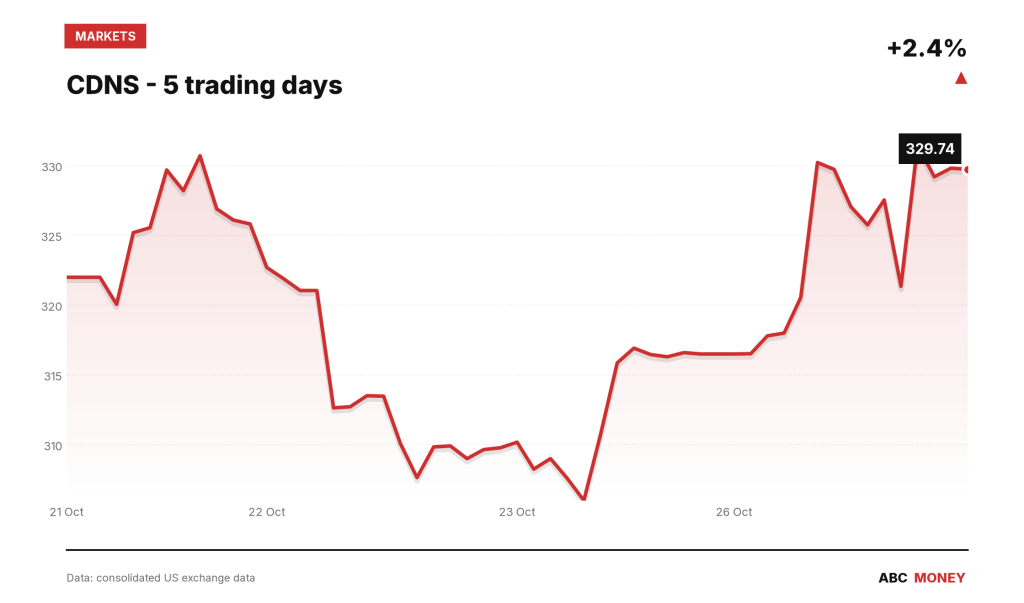
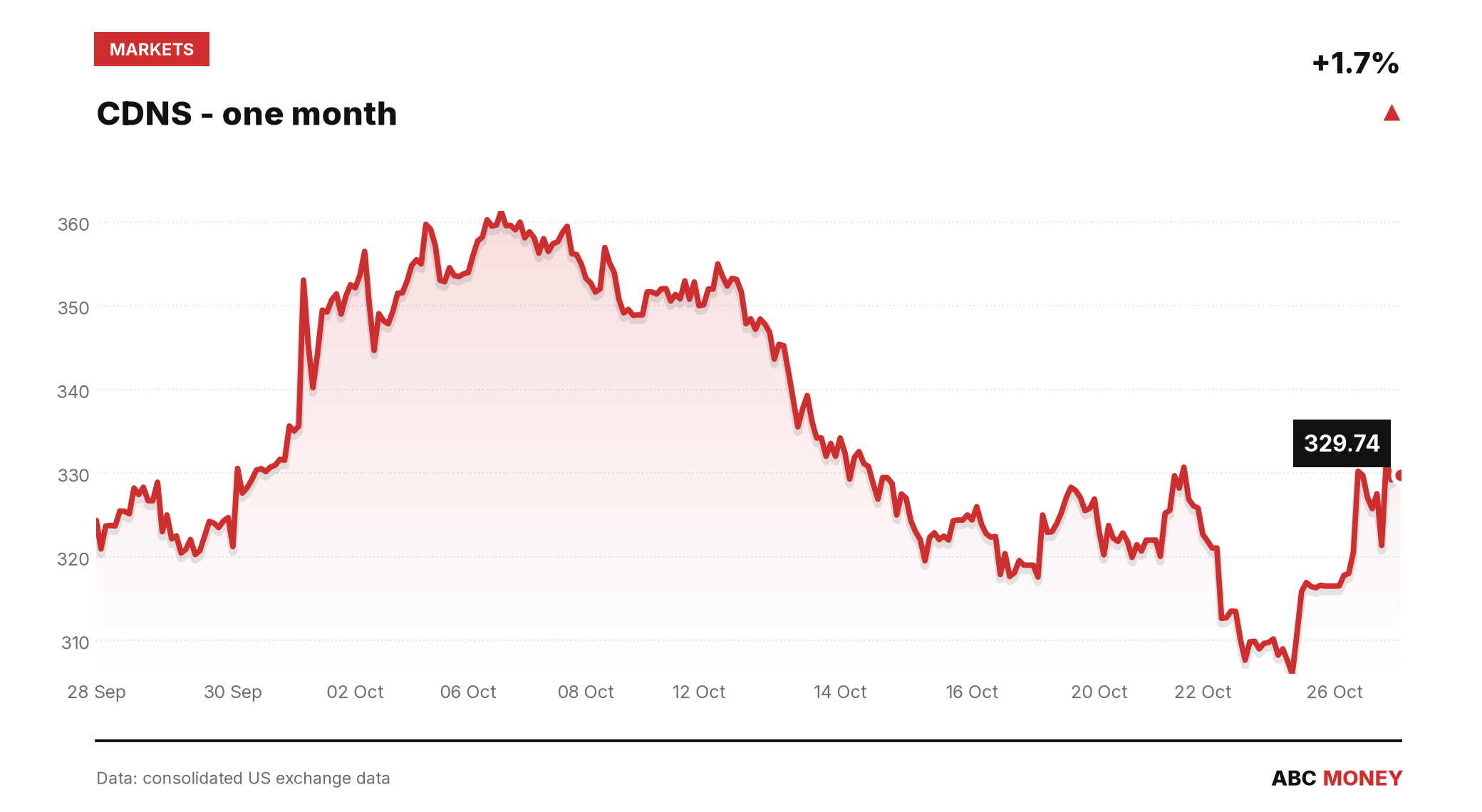
Shares closed at $329.74, up 0.82% on the day the results landed, but still down 6.85% over the preceding 20 trading sessions, with volume running at 2.31 times the 20-day average – a sign that plenty of positioning had already happened before the numbers were out. The stock’s 20-day range of $306.00 to $361.31 shows how much ground had already been given back heading into the print.
Short-side activity had also been building. FINRA’s daily short-sale volume data show the ratio of short-sold shares to total volume for Cadence climbing from 0.337 on 19 October to 0.53 by 23 October, consistent with traders hedging or betting against the stock in the run-up to results rather than piling in ahead of an expected blowout.
That caution sits against a backdrop of still-elevated borrowing costs: the 10-year US Treasury yield stood at 5.0% as of 23 October, up from 4.96% previously, according to Federal Reserve data, a level at which growth-software valuations across the sector have faced more scrutiny than they did a year ago. Against that backdrop, a Cadence Q3 earnings beat that is technically clean but modest in scale – and a revenue print that some analysts would call in-line rather than exceptional – helps explain why the shares barely moved on the news itself, even with a record backlog and raised guidance in hand.
This article is for information only and is not investment advice or a recommendation to buy or sell any asset. Markets move quickly; figures are correct as sourced at the time of writing. Always do your own research before making financial decisions.