Nike stock slides 6.3% despite new turnaround plan unveiled
Nike's turnaround plan promised 2031 targets, but shares fell 6.3% as investors fixated on two more years of pain before growth returns.
In this article 3 sections
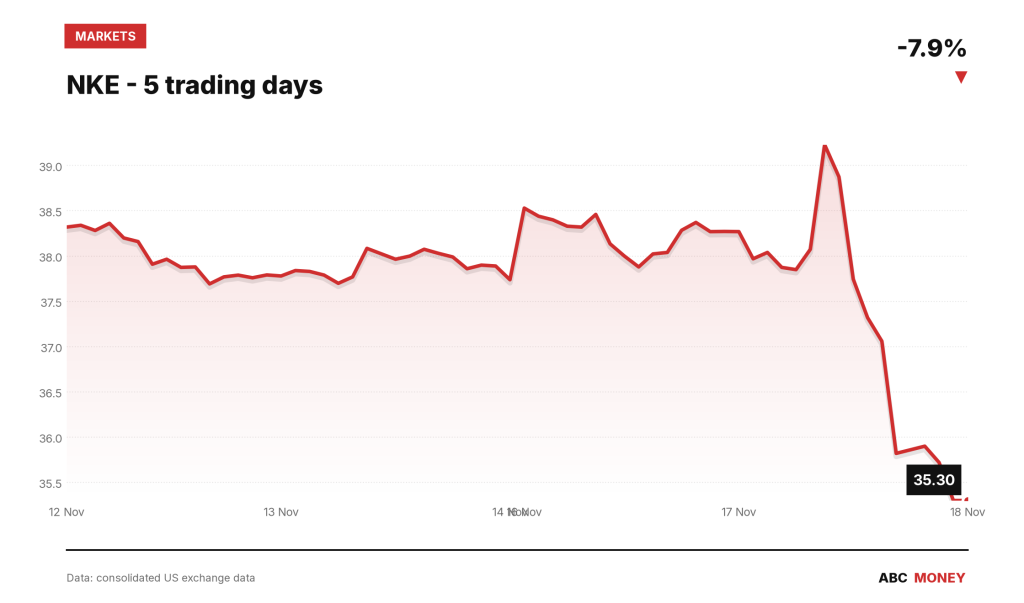
Nike (NYSE: NKE) spent its first Investor Day in nine years trying to convince shareholders it had a credible route back to growth. The market’s verdict, delivered within hours, was blunt: shares closed down 6.30% at $35.85 on 17 November 2026, on volume of 61.1 million shares against a three-month average of 33.1 million, according to Motley Fool’s same-day market wrap. The stock had briefly rallied as much as 6% intraday, touching $40.68, before investors read deeper into the detail and reversed course, per a syndicated Motley Fool report. Separate market-data recaps put the session’s decline as steep as 7.07%, citing institutional de-risking and a Berenberg downgrade alongside the investor-day disclosures.
The headline act was “Full Stride Ahead” – a new long-term strategy paired with a 2031 financial framework, unveiled at Nike’s investor event on 17 November. Using fiscal 2027 as its starting point, the company’s own release set out targets for roughly $5bn in incremental revenue growth, operating margins climbing to 12-14%, and adjusted earnings per share of $3.00-$3.50 by the end of the decade. A restructuring programme called “Pace” is pencilled in to deliver around $2.5bn in annual cost savings, according to CNBC.
Why the Nike turnaround plan spooked investors
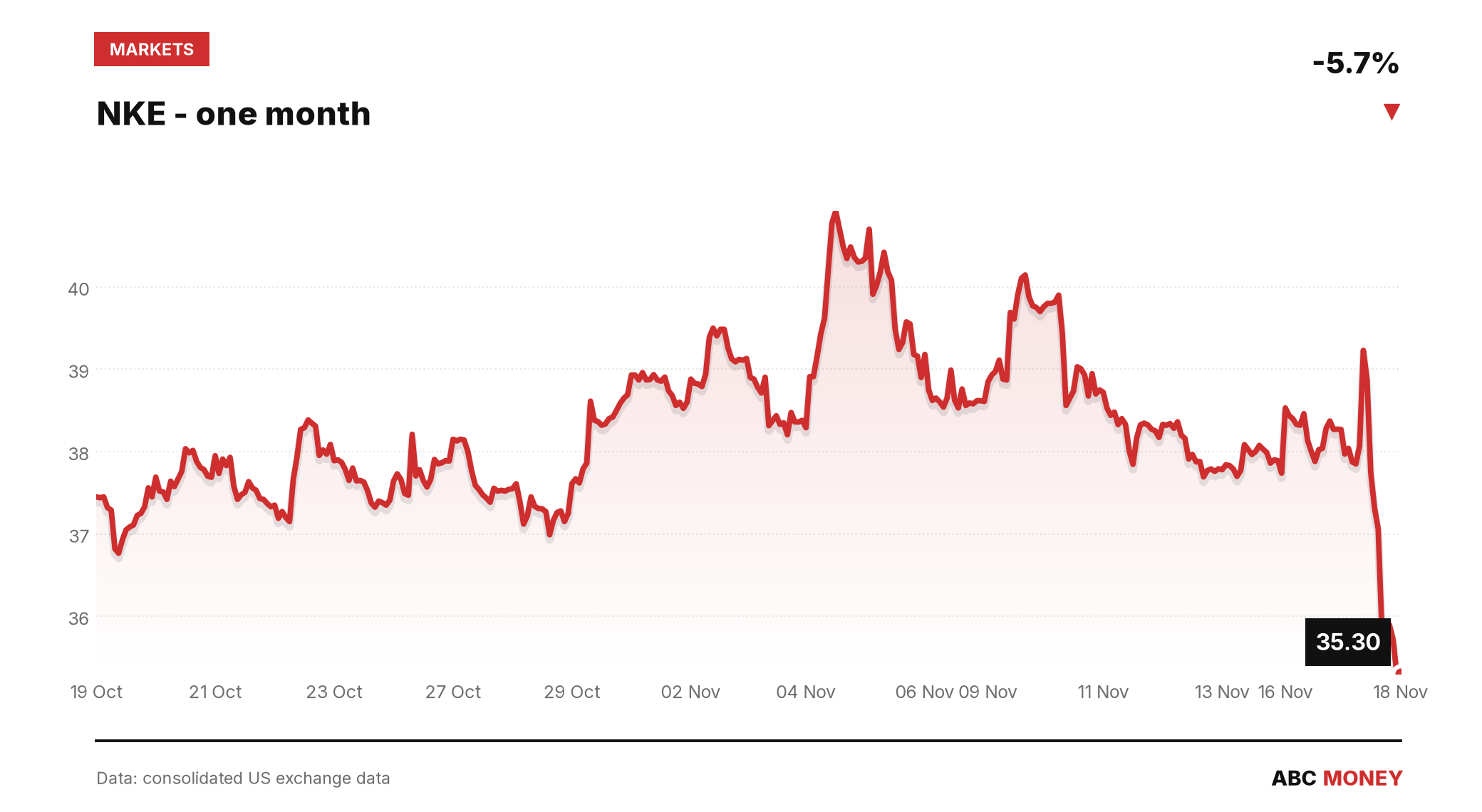
On paper, those 2031 numbers are the kind of framework that should cheer a stock down roughly 40-45% year-to-date heading into the event – what one outlet called Nike’s weakest year on record. The problem was the path getting there. Nike reaffirmed fiscal 2027 guidance for revenue to decline by a high-single-digit percentage, with an adjusted operating margin of roughly 6% and adjusted earnings per share of $1.15-$1.35, excluding about $0.15 of restructuring costs, according to Seeking Alpha. More pointedly, the company’s own framework described fiscal 2028 as a “challenging year financially,” with revenue growth not expected to return to market level until fiscal 2029 – the detail that FashionUnited and others flagged as the proximate trigger for the sell-off. Investors had come hoping for a turnaround plan that drew a line under the pain; instead they got confirmation that the bottom is still roughly two years out.
The numbers behind the slide
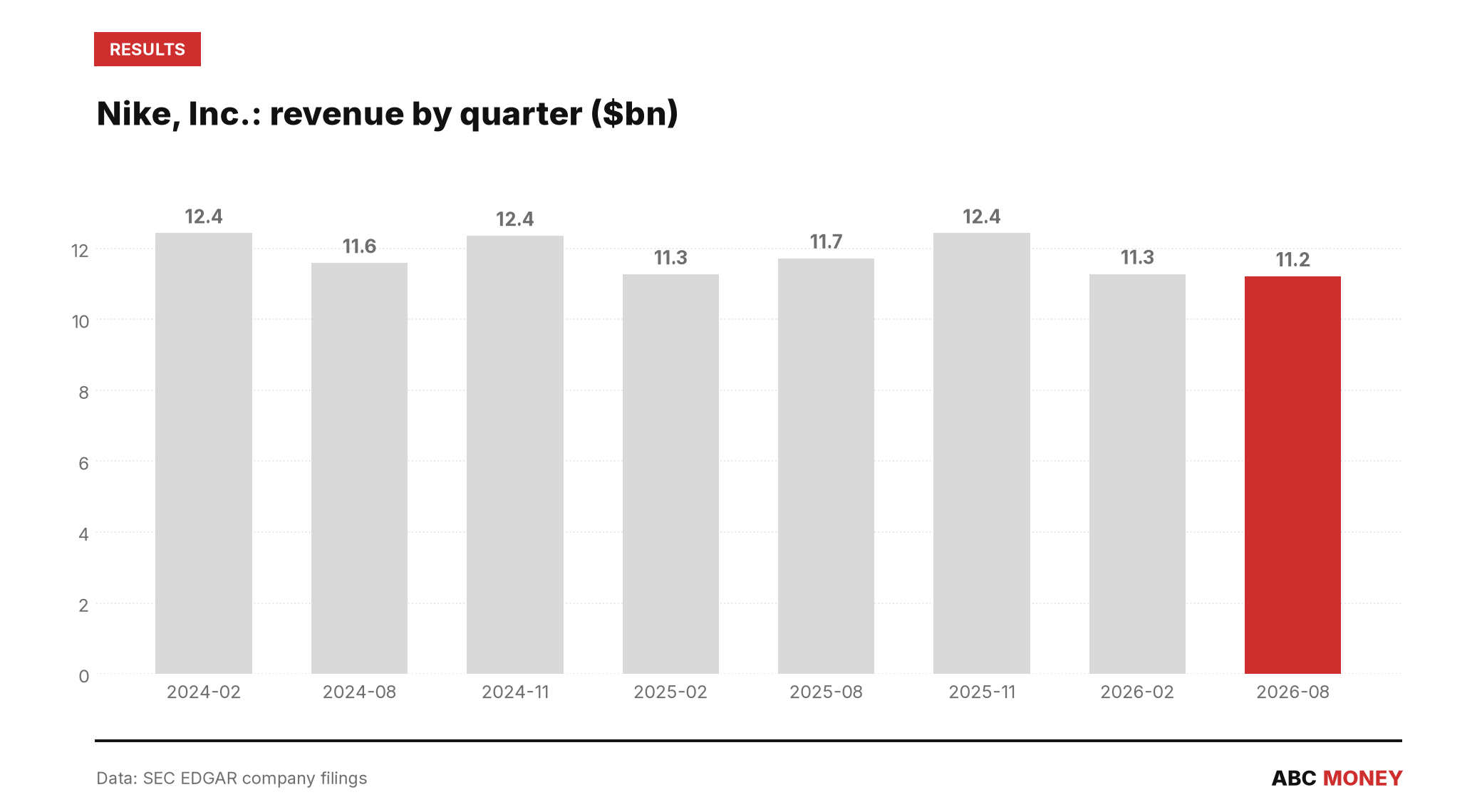
Nike’s own filings back up why that framing landed hard. Fiscal first-quarter 2027 revenue (covering June-August 2026) came in at $11,213m, down from $11,720m a year earlier, continuing a run of quarter-on-quarter softness that has defined the past two years, according to Nike’s 10-Q filed with the SEC. Diluted earnings per share for that quarter were $0.48, essentially flat against $0.49 a year prior – a result that beat near-term expectations but did nothing to dispel the broader narrative of a business still shrinking before it grows again. The pattern stretches back further: quarterly net income has slid from $1,172m in fiscal Q3 2024 to $520m in fiscal Q3 2026, before a modest recovery to $712m in the most recent quarter, per Nike’s sequential SEC filings.
Trading data suggests this was a fundamentals-driven repricing rather than a technical dislocation. FINRA’s daily short-sale ratio for Nike – the proportion of trading volume executed as short sales – stood at 0.508 on 17 November and 0.51 the day before, squarely within the 0.354-0.546 range seen over the prior fortnight. That is not the signature of an unusual short-selling spike piling onto the stock; it looks like ordinary participants, long and short alike, recalibrating around the same new information at the same time.
Insider filing adds a footnote
One filing lands awkwardly in the days around the event: a Form 4 for Mark Parker, filed with the SEC on 16 November 2026, the day before the investor day. The filing does not disclose the size of the transaction in the publicly available record, so it is impossible to say whether it amounted to a meaningful sale or a routine administrative filing – but its timing, landing squarely ahead of a share-price-moving disclosure, is the kind of detail that scrutiny-minded shareholders will want Nike to address directly.
What happens next largely depends on whether Nike’s new management team, led by chief executive Elliott Hill, can show the fiscal 2028 “challenging year” it has now pre-announced plays out better than feared. Quarterly filings through 2027 and 2028 – tracking revenue against that high-single-digit decline guidance and operating margin against the roughly 6% baseline – will be the proof points investors use to judge whether “Full Stride Ahead” is delivering, or whether the 2031 targets remain a promise deferred.
This article is for information only and is not investment advice or a recommendation to buy or sell any asset. Markets move quickly; figures are correct as sourced at the time of writing. Always do your own research before making financial decisions.