Nvidia CEO investigation follows alleged China spy link
Nvidia's board has opened a CEO investigation into Jensen Huang over an alleged Chinese intelligence contact, as shares slide and Congress circles.
In this article 3 sections
Nvidia (NASDAQ: NVDA) has opened a CEO investigation into Jensen Huang, after the chip maker’s board said it was examining reports that its chief executive had been “the target of a foreign intelligence effort” and Huang himself admitted to an extramarital affair with the woman at the centre of the claims.
The board said on Sunday 8 November 2026 that a committee of independent directors, working with outside counsel, would run an independent review, according to CBS News. In a memo to staff the same day, Huang said he had been unfaithful to his wife, apologised, took “full responsibility” and said he supported the board’s inquiry, as reported by CNN.
The woman identified in the reporting, Alice Huang, is tied to Megaspeed, a Singapore-based Nvidia customer that US media have separately reported was accused of helping restricted Chinese firms obtain Nvidia’s AI chips, according to CNBC. Nvidia’s board has said it has no reason to believe national security or company secrets were compromised, while making clear the inquiry would examine “all available information,” per Fox Business.
Congress moved before the board did
The timeline is the part of this story that deserves more attention than it has had. House Republican committee chairs wrote to Huang on 5 November demanding he brief Congress on his reported ties to the alleged spy and to Megaspeed, CNBC reported at the time. That was three days before Nvidia’s board made its own investigation public. The sequence raises an obvious question for governance watchers: whether the company acted on its own initiative, or only once political pressure made silence untenable.
China’s foreign ministry has pushed back hard. Spokesperson Guo Jiakun called the spying allegation “unsubstantiated,” CNBC reported. In Washington, the political reaction has been less uniform than the allegation’s seriousness might suggest — President Trump publicly defended Huang after the affair admission, saying he “probably has an excuse for it,” according to a Yahoo Finance live blog of the events.
A trillion-dollar company, a very large target
What makes this unusual isn’t the genre — CEOs have been felled by personal scandal before — but the scale. Nvidia closed its last session before the story broke worth roughly $4.5 trillion, versus a combined market value of around $1.1 trillion for nine previous companies that have weathered comparable chief-executive scandals, according to Yahoo Finance’s reporting. Few governance crises have ever played out at this size.
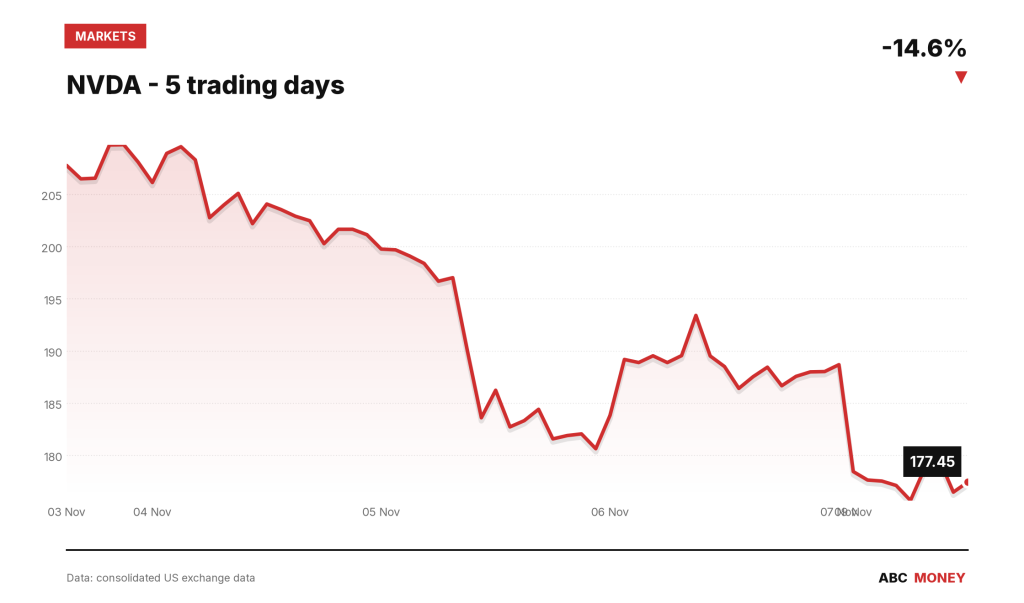
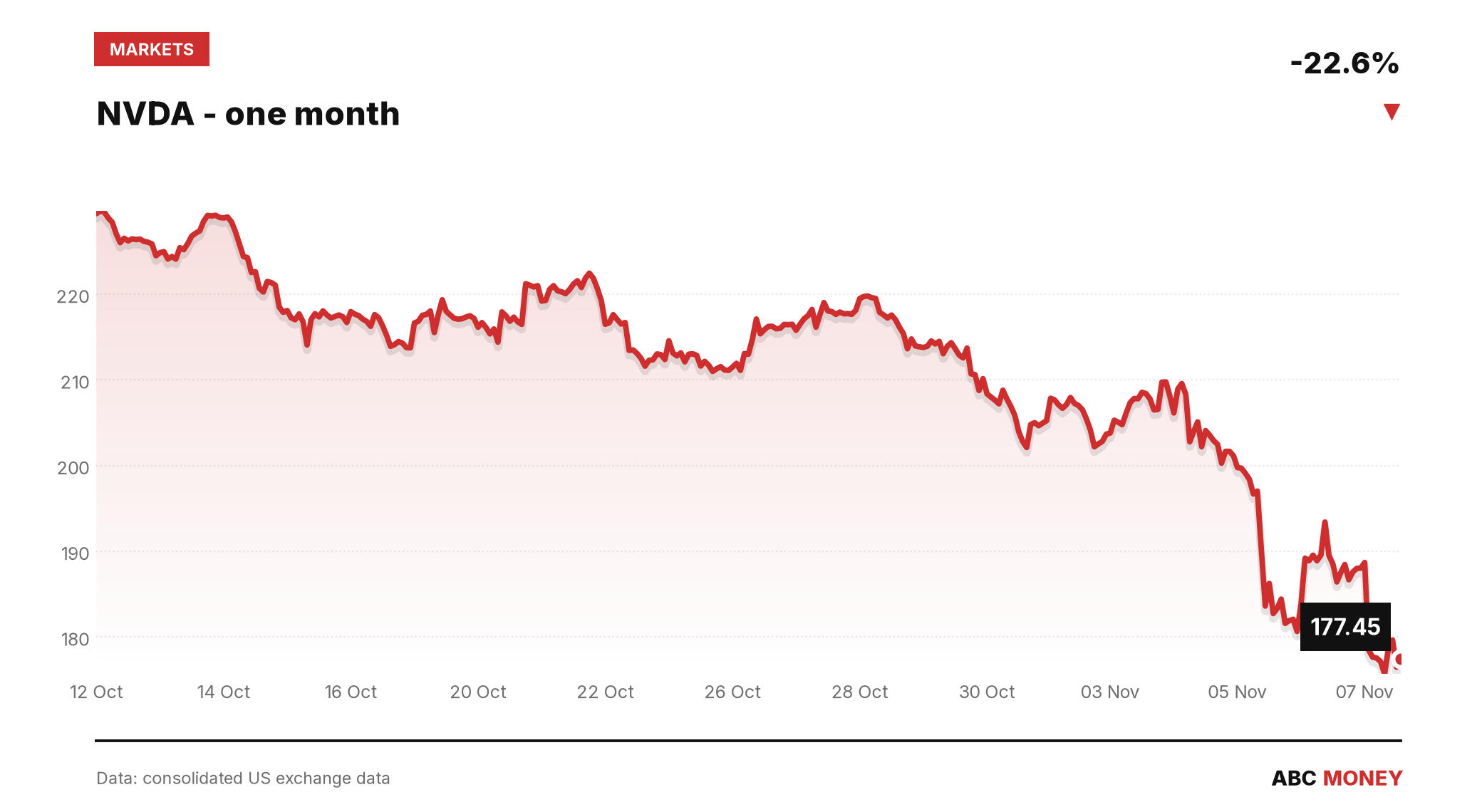
The market had already started pricing in the risk before the board spoke. Nvidia shares were down about 13% in the period from 28 October — the last close before the New York Times’ initial report on the alleged relationship — through to the board’s Sunday statement, Yahoo Finance noted. By the afternoon of 9 November, the stock was changing hands at $177.44, having fallen 18.3% over the preceding 20 trading days and touched an intraday low of $175.69 in that window, against a 20-day high of $222.46, according to consolidated exchange data. Trading volume that day ran more than four times the 20-day average, a sign of how much turnover the story has generated even before the board’s review concludes.
Daily short-sale data from FINRA shows nothing unusual in the run-up: NVDA’s short-sale ratio — the share of daily trading volume accounted for by short sales, where investors bet on a falling price — moved between roughly 0.23 and 0.38 across late October and early November, a range the exchange’s own figures suggest is ordinary for the stock rather than evidence of positioning ahead of the news.
Why the stakes are so high
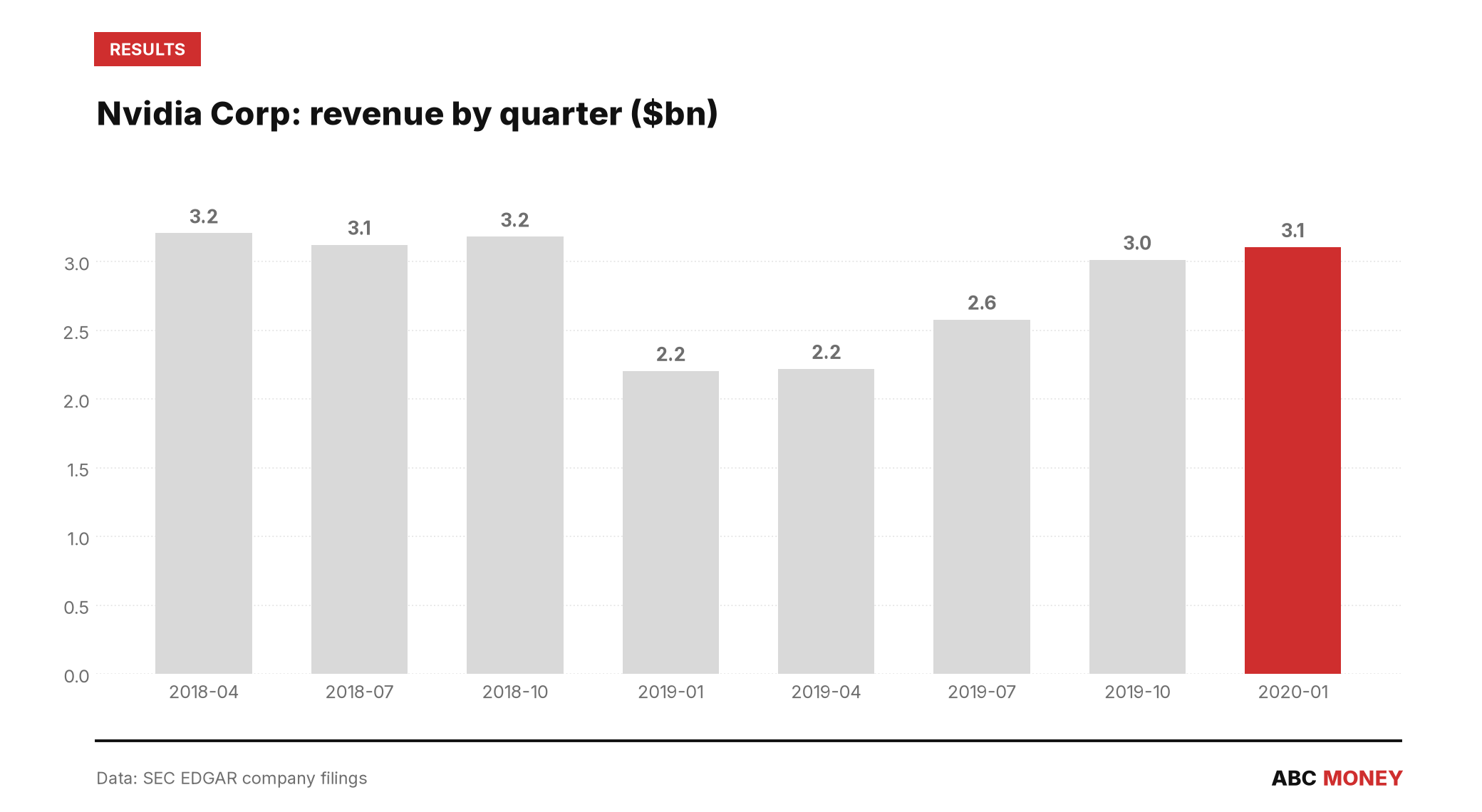
Nvidia’s financial run explains why investors are treating leadership risk here so seriously. Quarterly net income has gone from $14.9bn in the quarter ended April 2024 to $59.7bn in the quarter ended July 2026, according to the company’s own filings with the SEC — a compounding that has made Huang, who has run the company since its founding, almost synonymous with the Nvidia growth story in investors’ minds. A Form 4 insider filing by Nvidia director Tench Coxe, lodged with the SEC on 6 November, two days before the affair became public, has circulated online; nothing in the filing itself ties it to the investigation, and it should be read as routine disclosure rather than a signal.
Nvidia has not set out a timetable for when its board committee expects to conclude its review. With committee chairs in Congress already pressing for Huang to testify and Beijing disputing the premise of the allegation entirely, the company’s next public statement — whenever it comes — is likely to matter more to the share price than anything in its upcoming quarterly results.
This article is for information only and is not investment advice or a recommendation to buy or sell any asset. Markets move quickly; figures are correct as sourced at the time of writing. Always do your own research before making financial decisions.