Corning Q3 2026 Beat Hides a Widening GAAP Gap
Corning's Q3 2026 earnings beat on adjusted metrics, but GAAP figures ran lower and the stock barely moved off a near-20% monthly slide.
In this article 3 sections
Corning’s Q3 2026 earnings landed with the kind of numbers that usually move a stock: core sales up 19% year on year to $5.08 billion, and core earnings per share of $0.91, both ahead of what analysts had pencilled in. Newsquawk had the Street looking for $5.03 billion in core sales and $0.88 in adjusted earnings per share – Corning (NYSE: GLW) cleared both.
The headline framing calls it the strongest growth since the company’s “Springboard” push began, and on the adjusted, non-GAAP figures that Corning itself prefers to report, that stands up. But adjusted numbers strip out items Corning doesn’t count as part of underlying operations, and the gap to the figures filed with regulators this quarter is wide enough to matter.
What the filing actually shows
Corning’s accompanying exhibit, filed with its quarterly report, puts GAAP net sales at $4.855 billion for the third quarter – up 18% year on year, a point behind the 19% core figure being headlined. GAAP net income came to $680 million, or $0.78 per diluted share, as the Associated Press reported – comfortably below the $0.91 core EPS figure that led the press release. The two sets of numbers aren’t contradictory so much as answering different questions: core EPS strips out one-off items to show underlying trend, while GAAP EPS is what shareholders actually own a claim on. Investors reading only the top line risk conflating the two.
To be fair to Corning, the “nearly twice as fast” claim about EPS outrunning sales growth does check out on a like-for-like basis. A year earlier, in the third quarter of 2025, adjusted earnings per share were $0.67 on GAAP profit of $430 million. Measured against that base, core EPS growth comes to roughly 36% – close enough to double the 19% core sales growth to justify the phrasing.
The market shrugged
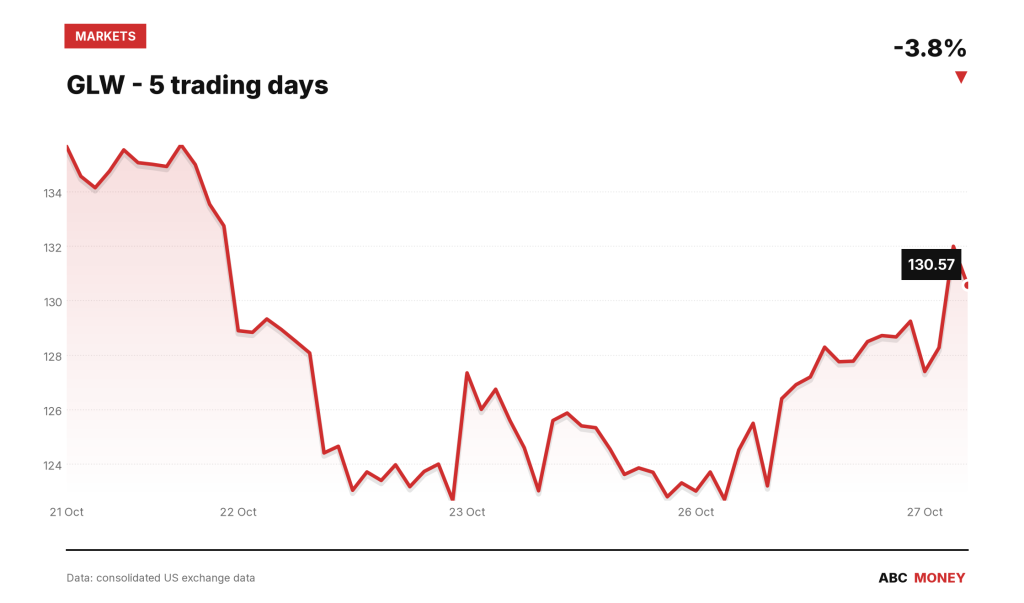
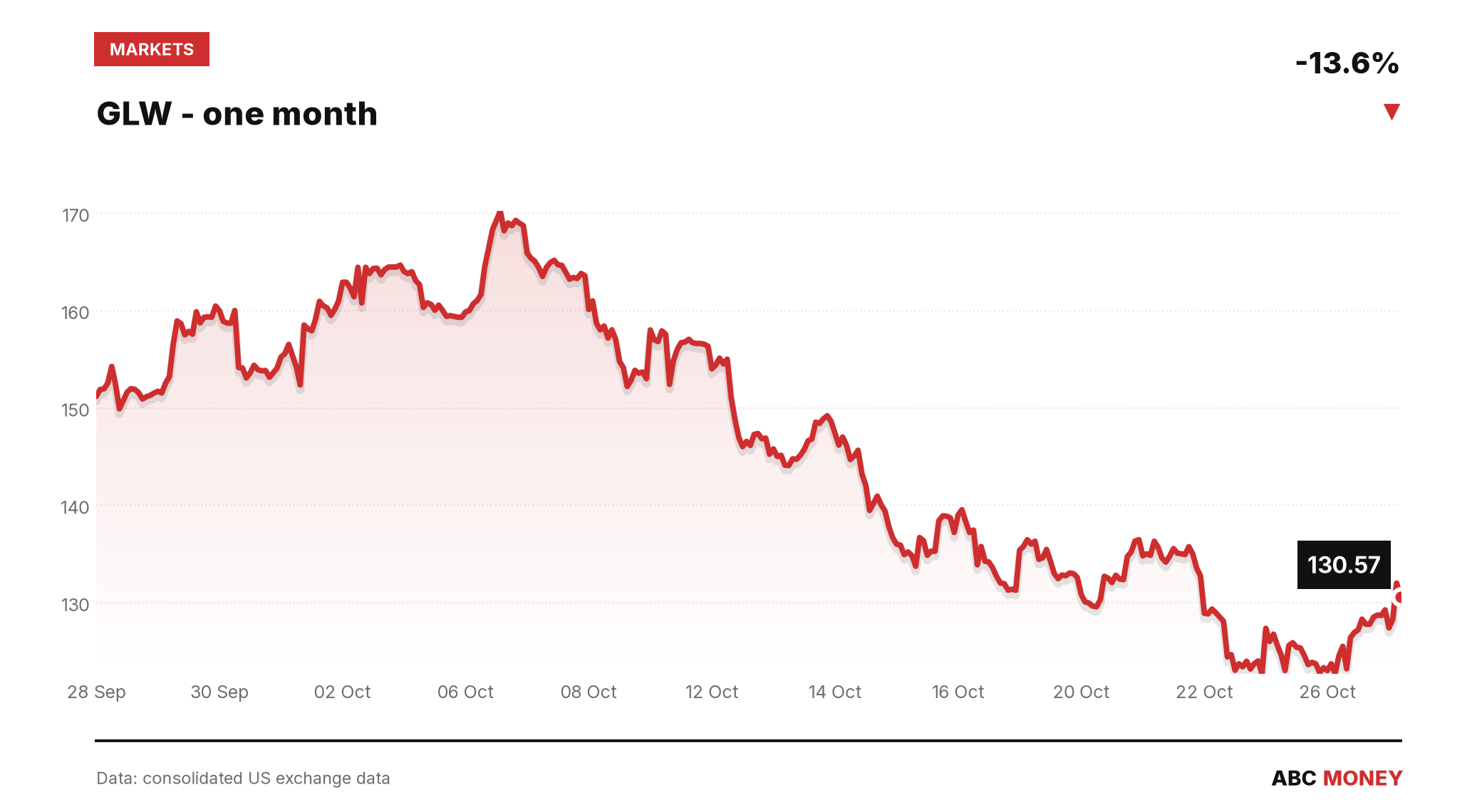
What’s harder to square with “outstanding” is how little the shares moved. GLW traded at $130.25 on the morning of the release, up just 1.36% on the day, after falling 19.42% over the prior 20 trading days. That’s a modest bounce set against a steep slide, and it comes against a backdrop that The Markets Daily describes as a near-halving from the stock’s all-time high of $271.78, hit on 30 June 2026. Corning remains up sharply for the year even after the retreat, but the pattern of a strong print followed by a tepid or negative market reaction has now shown up twice running: in the second quarter, CNBC noted the stock fell even as fundamentals looked intact, with forward guidance seen as “a tad short at the midpoint” feeding the sell-off, per CNBC‘s reporting at the time.
Positioning data gives one clue to how traders were leaning into the print. The proportion of Corning’s daily trading volume tied to short sales – bets that the stock would fall – dropped from 0.468 on 21 October to 0.292 by 26 October, according to FINRA’s daily short-sale data. That decline is consistent with some bearish positioning being unwound ahead of results, which can take pressure off a stock without necessarily producing a rally – a reasonable match for the muted 1.36% move actually seen.
The fibre story underneath it all
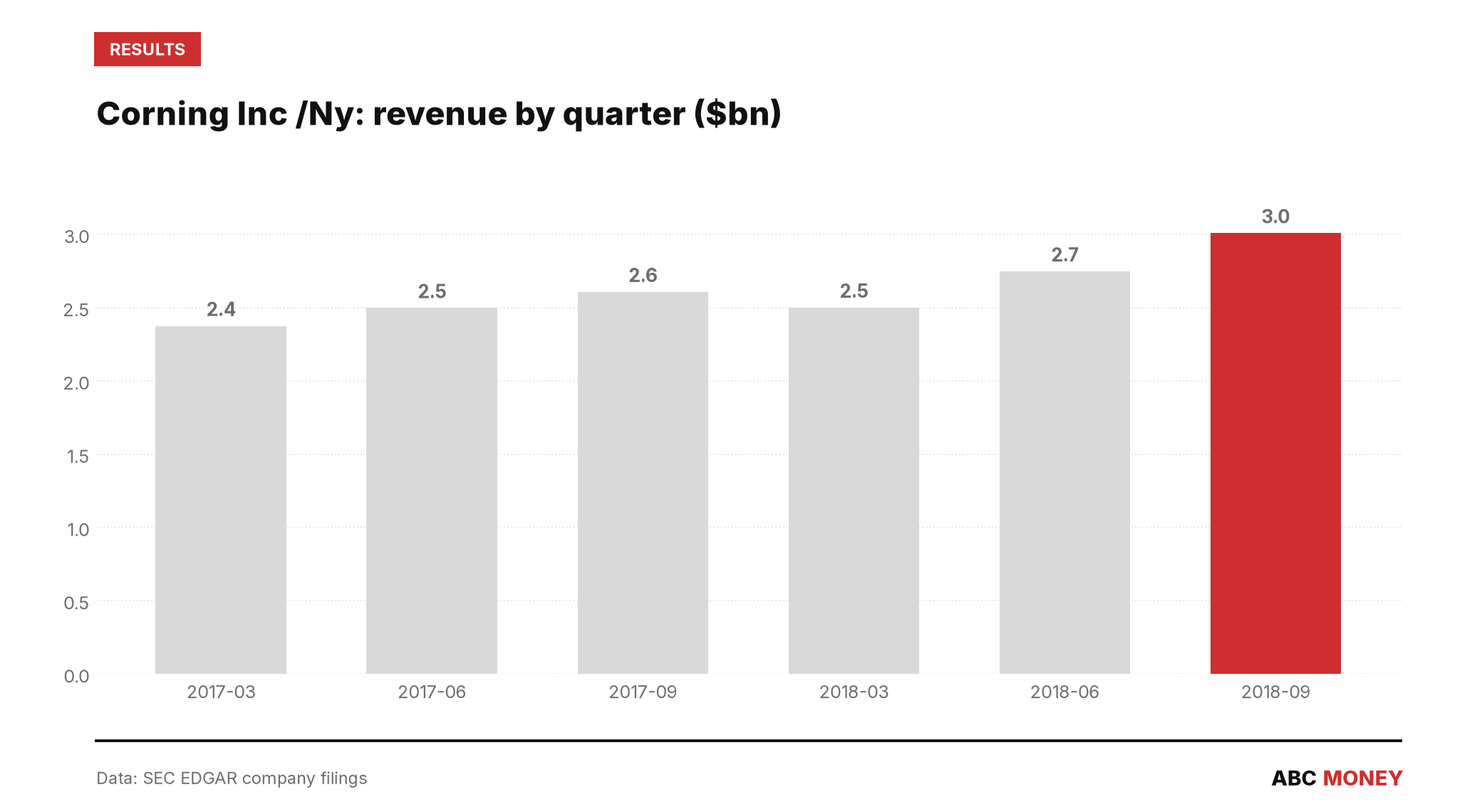
Strip away the GAAP-versus-core debate and the underlying business is genuinely accelerating. Optical Communications, Corning’s unit selling fibre and cabling largely into data centres, grew sales 44% to $2.38 billion in the quarter. Fibre products accounted for 45% of total sales in the first half of 2026, according to data compiled by BigGo Finance, which also notes that some market commentary has begun drawing parallels with the fibre-optic buildout – and subsequent bust – of the late 1990s. Corning’s current growth is tied closely to artificial-intelligence infrastructure spending, which means the stock’s fortunes are increasingly a leveraged bet on how long that capital cycle runs, not simply a reflection of quarterly execution.
That tension – a business executing well by its own adjusted metrics, a market reluctant to pay up for it, and a widening gap between core and GAAP reporting – is likely to shape how the fourth-quarter outlook Corning issued alongside these results gets received. Given the second-quarter precedent, where guidance rather than the headline numbers drove the share reaction, investors parsing this report may find more signal in what Corning said about the months ahead than in the quarter just closed.
This article is for information only and is not investment advice or a recommendation to buy or sell any asset. Markets move quickly; figures are correct as sourced at the time of writing. Always do your own research before making financial decisions.