HCA Healthcare Q3 earnings beat masks a profit decline
HCA Healthcare Q3 earnings topped estimates on revenue and adjusted EPS, but GAAP profit fell 3.9% on a payer-mix hit and buyback-driven EPS support.
HCA Healthcare’s (NYSE: HCA) Q3 earnings beat the headline numbers Wall Street was watching: revenue of $19.85bn against a FactSet consensus of $19.33bn, and adjusted earnings per share of $7.22 versus an expected $6.65. Underneath those clean beats, though, sits a less tidy story – GAAP net income attributable to the company actually fell 3.9% year-on-year, and the per-share growth investors cheered owed a fair amount to buybacks and a one-off gain rather than operating momentum.
The hospital operator’s third-quarter revenue rose 3.6% from $19.161bn a year earlier, according to its 8-K filing with the SEC. Adjusted diluted EPS climbed 3.7%, while GAAP diluted EPS – the unadjusted figure, which includes one-off items – rose 4.5% to $7.27, helped by $0.05 a share of gains on facility sales. Adjusted EBITDA (earnings before interest, tax, depreciation and amortisation, a common proxy for underlying cash profitability) ticked up just 1.2% to $3.918bn from $3.870bn.
Where the HCA Healthcare Q3 earnings beat gets complicated
Net income attributable to HCA Healthcare dropped 3.9% to $1.579bn from $1.643bn in the same quarter last year, as GuruFocus reported. The culprit was a payer-mix shift – more patients losing exchange-based insurance coverage and ending up uninsured or on lower-reimbursement plans – that cut pretax income by roughly $400m, according to StockTitan’s write-up of the release. That is a real headwind to the business HCA actually runs, distinct from the per-share arithmetic that flattered the headline.
Buybacks did much of the work in keeping EPS growing despite that pressure. HCA repurchased roughly $2.97bn of stock – about 7.23 million shares – during the quarter, shrinking the share count against which profit is divided, and declared a quarterly dividend of $0.78 per share, Investing.com reported. Fewer shares outstanding means the same (or slightly lower) profit pool generates a higher per-share number – useful for a beat-and-raise headline, but not the same thing as the underlying business growing faster.
It’s worth noting that the size of the “beat” depends on whose estimate you use. FactSet and Investing.com had revenue pegged at $19.33bn and EPS at $6.65; Zacks used $19.4bn and $6.74; another tracker cited roughly $19.525bn and $6.73. Every framework shows HCA clearing the bar, but the margin of outperformance narrows considerably once you move off the lowest estimate in circulation.
Volumes still climbing
The quarter’s more durable positive is patient volume. Same-facility admissions rose 2.7% and equivalent admissions – a broader measure that captures outpatient activity alongside inpatient stays – rose 3.0%, while emergency-room visits were up 5.1% year-on-year, extending a multi-quarter growth streak, per the transcript carried by Investing.com. That demand backdrop is why management now expects full-year 2026 results in the upper half of its previously issued guidance ranges of $77.0bn-$79.5bn in revenue and $15.4bn-$16.1bn in adjusted EBITDA.
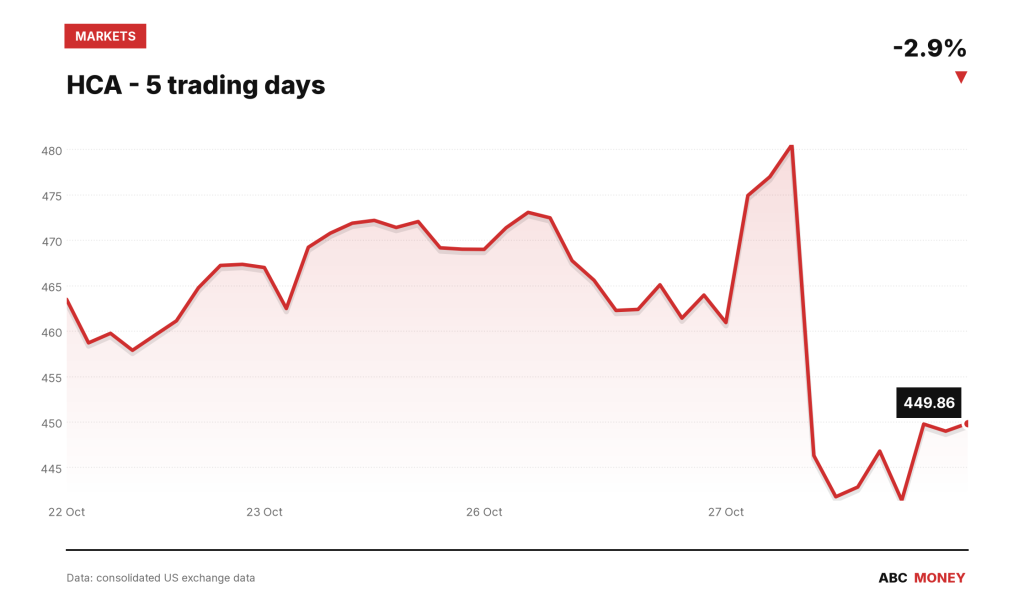
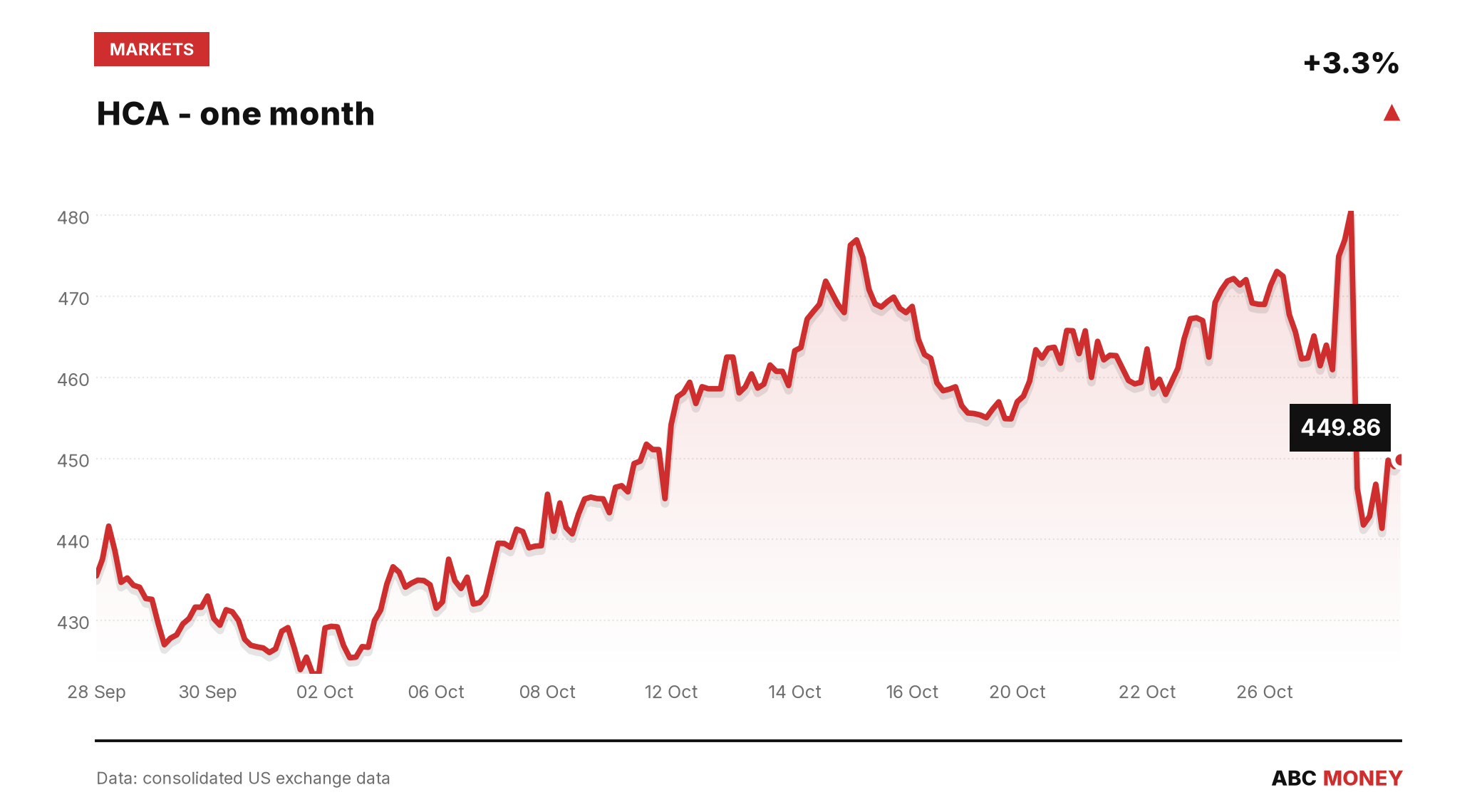
The market’s response was muted rather than euphoric. Shares were reported up as much as 4.4%-4.8% in premarket trading on the headline beat, but closed the session up a more modest 0.79% at $449.86, suggesting investors spent the day working through the payer-mix detail rather than simply buying the print. That close leaves the stock roughly 3.9% higher over 20 trading days, within a recent range of $433.10 to $480.53, on volume running at 2.58 times its 20-day average – a sign plenty of positions changed hands either way.
Positioning data gives little reason to read the move as a short-covering rally. FINRA’s daily short-sale figures show HCA’s short ratio – the share of daily trading volume attributable to short sales – oscillating between roughly 0.46 and 0.77 over the fortnight into the print, with no unusual compression that would suggest bears were rushing for the exit ahead of results.
For a company whose fortunes are tied as much to US insurance coverage trends as to hospital throughput, the next test is whether that $400m payer-mix drag widens or stabilises as HCA reports its full fourth quarter and 2026 wraps up against a labour market where unemployment has edged up to 4.2% and a Treasury curve – the 10-year yield sat at 5.00% and the 2s10s spread at 0.29 on 26 October – that offers little tailwind from falling borrowing costs.
This article is for information only and is not investment advice or a recommendation to buy or sell any asset. Markets move quickly; figures are correct as sourced at the time of writing. Always do your own research before making financial decisions.