Hubbell Q3 Earnings Beat Estimates, Yet Shares Still Fall
Hubbell's Q3 earnings beat topped EPS and revenue forecasts and lifted guidance, but shares fell anyway as investors fixated on margins.
In this article 3 sections
Hubbell’s Q3 earnings beat delivered exactly what Wall Street asked for – profit and revenue both ahead of forecasts, and a raised full-year outlook to go with it. The market’s response was to mark the shares down anyway, a split that tells you more about where investor expectations had drifted than about the quarter itself.
The Shelton, Connecticut-based electrical equipment maker reported GAAP diluted earnings per share of $4.94 for the third quarter, with adjusted diluted EPS of $5.91 – comfortably clear of the $5.75 average estimate from the five analysts tracked by Zacks, as first reported by the Associated Press. Net sales came in at $1.873bn, up roughly 25% year-on-year, against a consensus of about $1.86bn. Net income attributable to Hubbell rose to $262.5m from $255.5m a year earlier, according to the Hartford Business Journal.
Where the Hubbell Q3 earnings beat came from
The growth was not evenly spread. Hubbell’s Electrical Solutions segment – the part of the business that supplies wiring devices, connectors and enclosures increasingly destined for data centres – saw sales jump 51% to $844.7m in the quarter, with organic data centre sales up more than 80%, the company said on its earnings call. Of the overall 25% revenue increase, roughly 11 percentage points came from organic growth and 13 points from acquisitions – a useful reminder that a chunk of this quarter’s top line was bought rather than grown, even if the underlying data centre demand is real and, by Hubbell’s own account, still running ahead of the capacity it has been adding.
That capacity investment is the subtext to the whole print: a company trying to build out production fast enough to keep pace with hyperscale and AI-driven electrical infrastructure demand, while absorbing higher input costs along the way.
A beat that the market didn’t reward
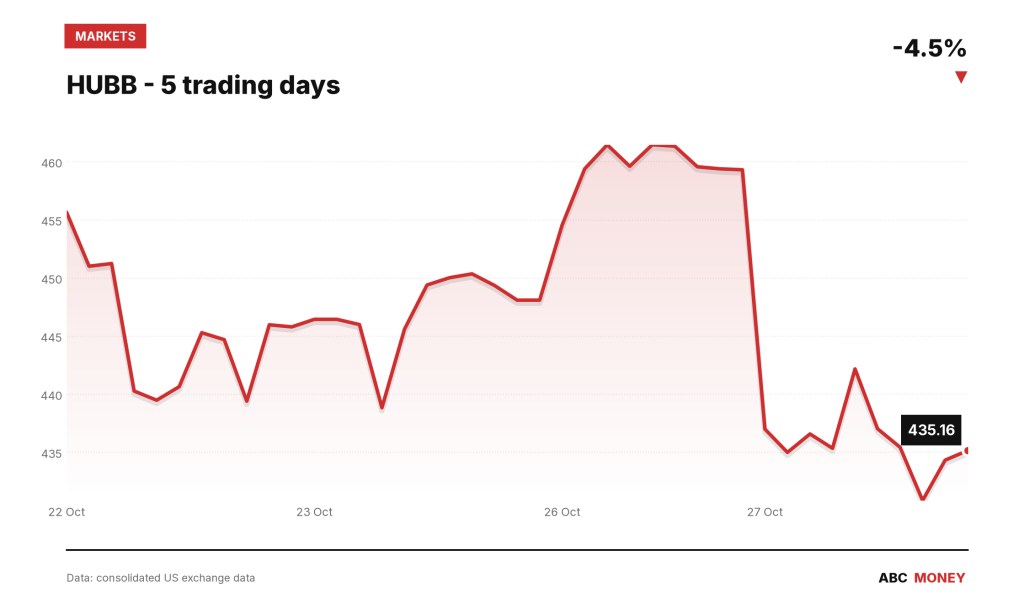
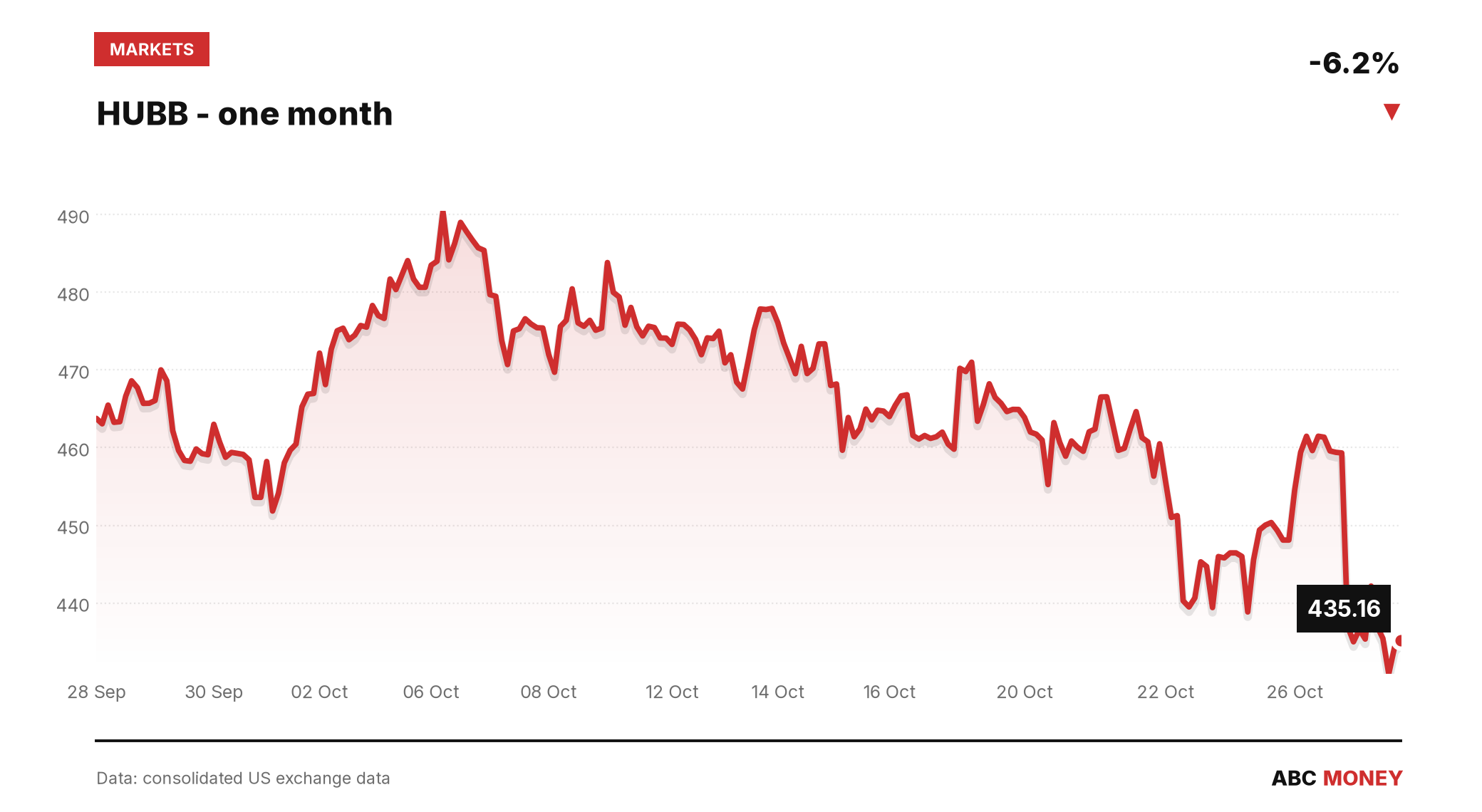
Here is the awkward part. Despite clearing both estimate lines and lifting guidance, Hubbell shares fell as much as 4.75% in premarket trading to around $437.60, according to the Investing.com transcript of the call, with one report from the TIKR Blog putting the intraday decline as steep as 6%. The stock closed the session at $435.16, having traded as low as $430.86 and as high as $483.84 over the preceding 20 trading days – a 20-day range that captures just how much ground the shares had already given up heading into the print, down roughly 9.3% over that stretch. Volume on the day ran at about 3.7 times the 20-day average, consistent with a market actively repricing the stock rather than drifting on thin trade.
The explanation, per TIKR, is that Hubbell’s raised full-year guidance – adjusted diluted EPS of $20.40 to $20.60, GAAP diluted EPS of $17.30 to $17.50 – only matched what Wall Street had already pencilled in rather than beating it. In a market that has spent much of this earnings season rewarding upside guidance and punishing in-line guidance almost as hard as a miss, “merely confirming” the consensus was apparently enough to sour sentiment, with investors instead zeroing in on margin and cost commentary from the call.
It is worth noting there was no unusual build-up in bearish positioning ahead of the report. FINRA’s daily short-sale data shows Hubbell’s short-volume ratio – the share of daily trading volume attributable to short sales, where traders borrow stock to sell it in anticipation of a price fall – fluctuating between roughly 0.38 and 0.65 in the fortnight before the print, an unremarkable range. This looks like a genuine reassessment of the growth-versus-cost trade-off rather than a short squeeze unwinding or a pile-on from bearish positioning.
The bigger picture
Set against Hubbell’s full-year 2025 results – $5.8446bn of revenue and $887.1m of net income, filed in its 10-K in February – this quarter’s growth rate is a clear step-change, driven almost entirely by the data centre buildout and the acquisitions layered on top of it. The raised 2026 guidance implies full-year adjusted diluted EPS growth comfortably ahead of last year’s $16.54, even if GAAP diluted EPS guidance of $17.30-$17.50 sits below the adjusted figure, reflecting the usual gap between reported and adjusted earnings once acquisition and restructuring charges are stripped out.
For a company this exposed to the data centre capex cycle, the next test will be whether Hubbell can keep translating that 80%-plus organic growth in data centre sales into margin expansion rather than just top-line momentum – and whether the next quarterly print offers investors a guidance raise with enough daylight above consensus to avoid a repeat of this one’s muted reception.
This article is for information only and is not investment advice or a recommendation to buy or sell any asset. Markets move quickly; figures are correct as sourced at the time of writing. Always do your own research before making financial decisions.