Coca-Cola raises guidance again, but investors sell the beat
Coca-Cola raises guidance for a third straight quarter after beating estimates, yet KO shares closed lower on 27 October 2026.
In this article 3 sections
Coca-Cola (NYSE: KO) delivered the kind of quarter that is supposed to send a share price higher: revenue and profit both beat Wall Street’s forecasts, and management raised its full-year guidance for the third consecutive quarter. Instead, the stock closed lower. That gap between the numbers and the market’s reaction is the story.
Third-quarter net revenue rose 7% year-on-year to $13.380bn, ahead of the $12.92bn analysts had pencilled in, according to the company’s earnings release filed with the SEC. Comparable earnings per share – a non-GAAP measure that strips out one-off items such as currency swings and restructuring costs – came in at $0.91, beating the $0.88 estimate tracked by CNBC. Diluted earnings per share on a GAAP basis, the figure that includes everything, grew 8% to $0.93.
Global unit case volume – the number of standardised cases of drinks shipped worldwide, Coca-Cola’s preferred gauge of underlying demand – grew 5% in the quarter, per the same filing. Operating income rose 12% to $4.465bn, lifting the operating margin to 33.4% from 32.0% a year earlier, according to a summary of the filing published by StockTitan.
Coca-Cola raises guidance for a third straight time
Management used the results to lift its outlook again. Full-year comparable earnings-per-share growth is now guided to at least 11%, up from a prior range of 9% to 10%, and free cash flow guidance was raised to at least $13.0bn from roughly $12.4bn, according to Proactive Investors. It is the third quarter running that Coca-Cola has nudged its forecasts higher, a run that speaks to a consumer still willing to pay up for Coke, Fanta and Sprite even as household budgets elsewhere tighten.
The regional picture was uneven. North America revenue grew a modest 3% to $5.4bn with volumes essentially flat, while Latin America revenue surged 25% to $2bn – though roughly 9 percentage points of that came from favourable currency moves rather than genuine demand growth, according to Yahoo Finance/Zacks. It is a reminder that Coca-Cola’s headline growth rate often owes as much to where the dollar sits as to how many bottles leave the plant.
Why the shares fell anyway
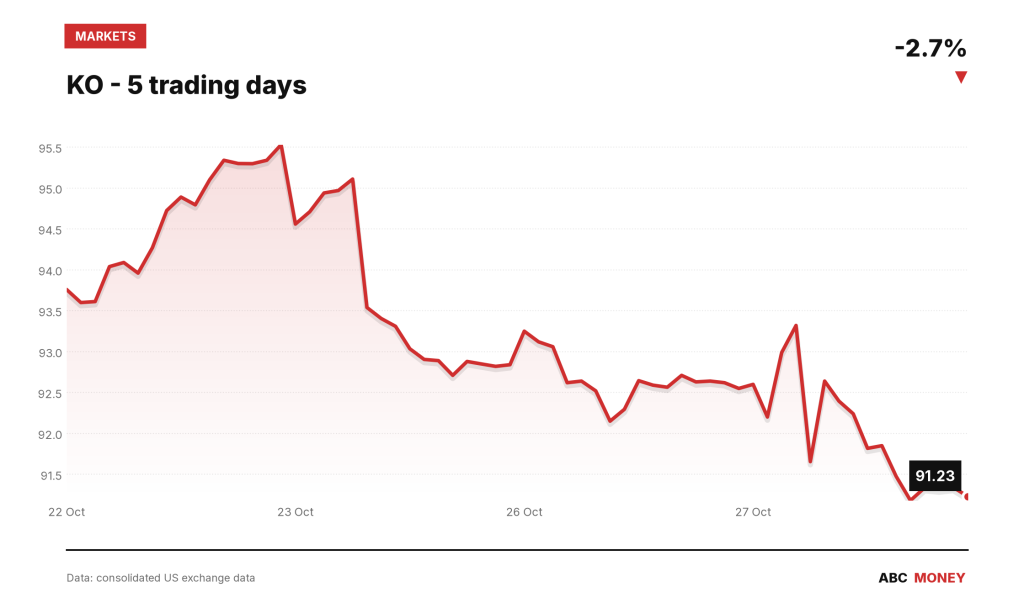
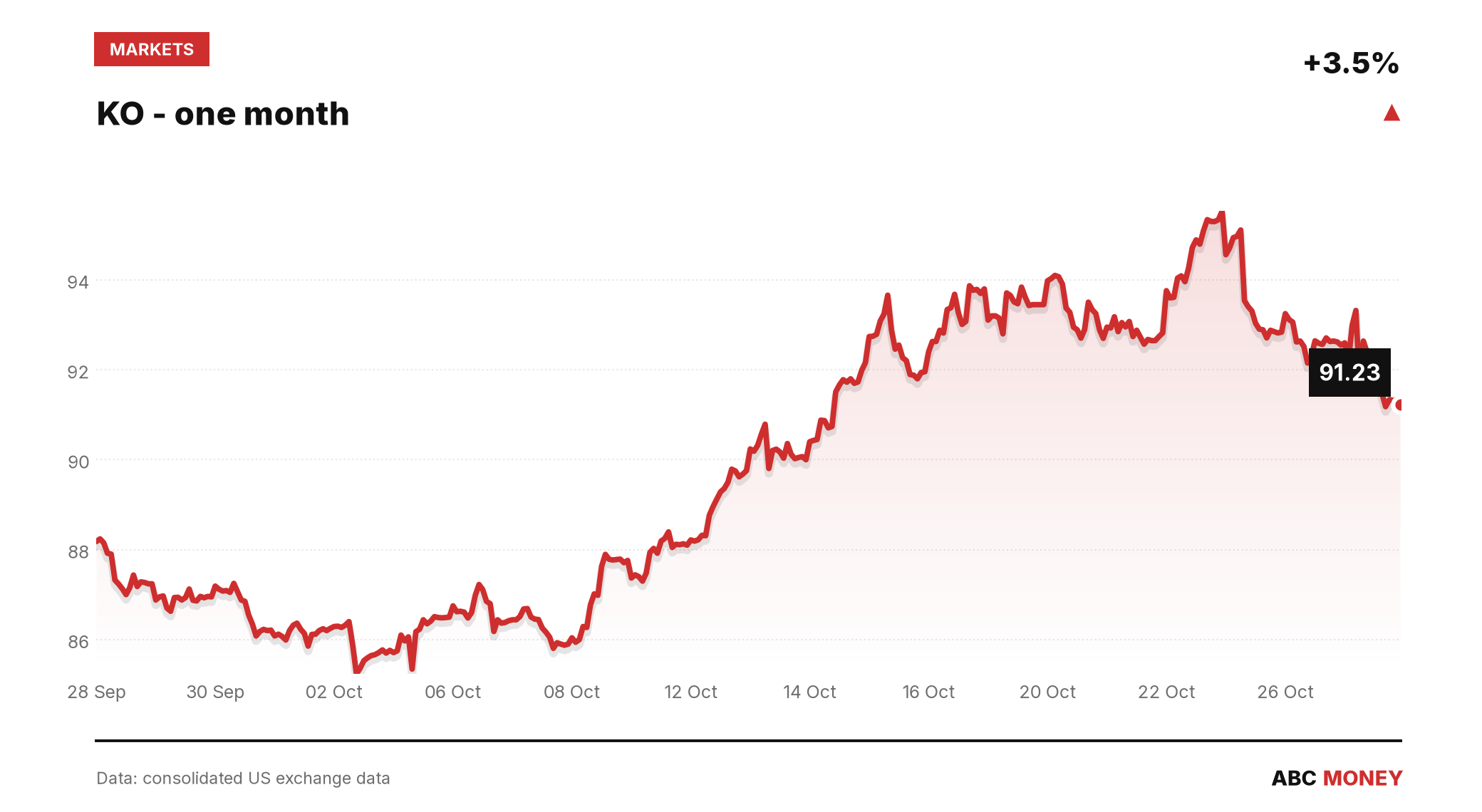
Here the record needs straightening. One report in the coverage cycle described KO as rising “slightly” on the news, but that referred only to a roughly 1% pop in pre-market trading before the US open. By the closing bell, the stock had given that back and more: shares finished at $91.23, down 0.64% on the day, having traded as much as 1.5% lower earlier in the session, according to consolidated exchange data and separate reporting from MarketBeat. A beat-and-raise quarter that ends in a falling share price is not an everyday outcome, and it suggests investors were already pricing in much of the good news – Coca-Cola shares had climbed roughly 32% over the course of 2026 heading into the print, putting the company’s market value at around $398bn, per CNBC.
Positioning data hints at some scepticism building beforehand. The daily short-sale volume ratio for KO – the share of trading volume attributable to short sales, where traders borrow and sell stock betting on a price fall – swung between roughly 0.38 and 0.58 across the ten trading sessions leading into the results, according to FINRA’s daily short-sale data. That is not an extreme reading on its own, but combined with a stock that had already run hard in 2026, it points to a market primed to take profits on good news rather than chase it further.
A 2027 headwind already on the table
Management also flagged a complication for next year. The pending refranchising of Coca-Cola Beverages Africa – essentially selling down the company’s stake in its African bottling operations to a local partner – is expected to create an 8-percentage-point drag on revenue growth and a 2-point hit to earnings growth in 2027, according to a summary of the earnings call published by BigGo Finance. It is the kind of structural, one-off item that can make year-on-year comparisons tricky for investors trying to judge the underlying trend, and it is worth filing away ahead of next year’s guidance updates.
None of this undercuts the quarter itself. Revenue, earnings and volume all came in ahead of plan, and the guidance raise was the real thing, not a modest tweak. What it does suggest is that the market had already done a good deal of the work pricing Coca-Cola for success, leaving comparatively little room for the shares to react even when the company delivers. Investors will get the next read on that dynamic when Coca-Cola updates its 2027 outlook, including the scale of the CCBA transition costs, in subsequent quarterly reports.
This article is for information only and is not investment advice or a recommendation to buy or sell any asset. Markets move quickly; figures are correct as sourced at the time of writing. Always do your own research before making financial decisions.