CrowdStrike, Dell and Nvidia Link Up on AI Factory Security
CrowdStrike and Dell unveiled integrated Dell AI Factory security with Nvidia at Fal.Con Europe, as CRWD shares slid 7.2% over 20 days.
In this article 3 sections
CrowdStrike (NASDAQ: CRWD) and Dell Technologies (NYSE: DELL) on 2 November 2026 unveiled an integrated Dell AI Factory security offering built around Nvidia’s accelerated computing hardware, the latest move in a scramble among cybersecurity vendors to attach themselves to the infrastructure layer underpinning the artificial-intelligence build-out.
The announcement came at Fal.Con Europe 2026 in Barcelona, CrowdStrike’s annual security conference, which this year sold out at a record pace with registrations up 60% year-on-year and more than 3,000 security leaders in attendance, according to a separate BusinessWire release. The scale of the gathering underlines how central AI security has become to the industry’s sales pitch this year.
Under the arrangement, customers can deploy CrowdStrike’s Falcon platform to secure enterprise AI infrastructure, workloads, agents and applications running on Dell’s AI infrastructure and Nvidia’s accelerated computing, as first reported by Yahoo Finance‘s syndication of the companies’ joint statement. The deal runs through Dell’s AI Ecosystem Program, which lets buyers purchase AI infrastructure and CrowdStrike’s security tools as a single package, aligned with what Investing.com described as Nvidia’s AI Factory Reference Architecture.
What the Dell AI Factory security bundle actually covers
The integration brings three specific Falcon capabilities into the Dell AI Factory stack: Falcon Guardian, aimed at securing AI agents and applications; Falcon Cloud Security, covering infrastructure and workloads; and Falcon Next-Gen SIEM (security information and event management, the software that aggregates and analyses security alerts across a network), which unifies security operations across the environment, according to Cyber Daily.
“Security cannot be an afterthought in an AI-powered world,” CrowdStrike chief executive and founder George Kurtz said in the companies’ statement. Nvidia founder and chief executive Jensen Huang added that CrowdStrike is bringing its cybersecurity platform to the Dell AI Factory with Nvidia and extending support to Nvidia OpenShell, according to MarketScreener.
This is not a brand-new relationship. CrowdStrike and Dell first announced their partnership a year earlier, on 5 November 2025, also at Fal.Con Europe; this week’s announcement extends that arrangement rather than starting it from scratch, according to reporting from FourWeekMBA. Notably, the same day also saw CrowdStrike strike a separate AI-security tie-up with CoreWeave at the same conference, putting Falcon alongside two of the largest AI-compute channels simultaneously.
The stock tells a different story
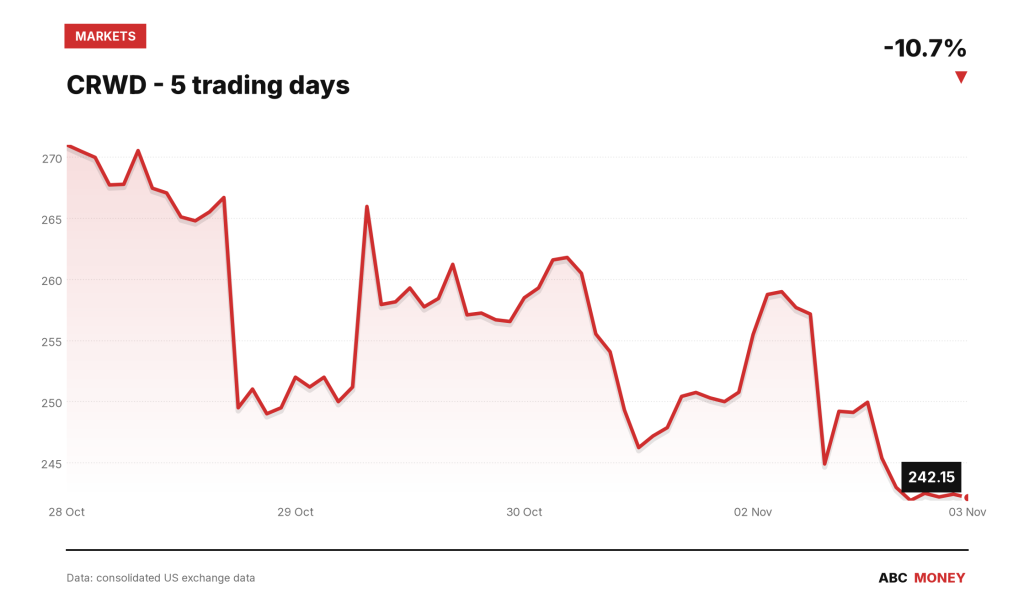
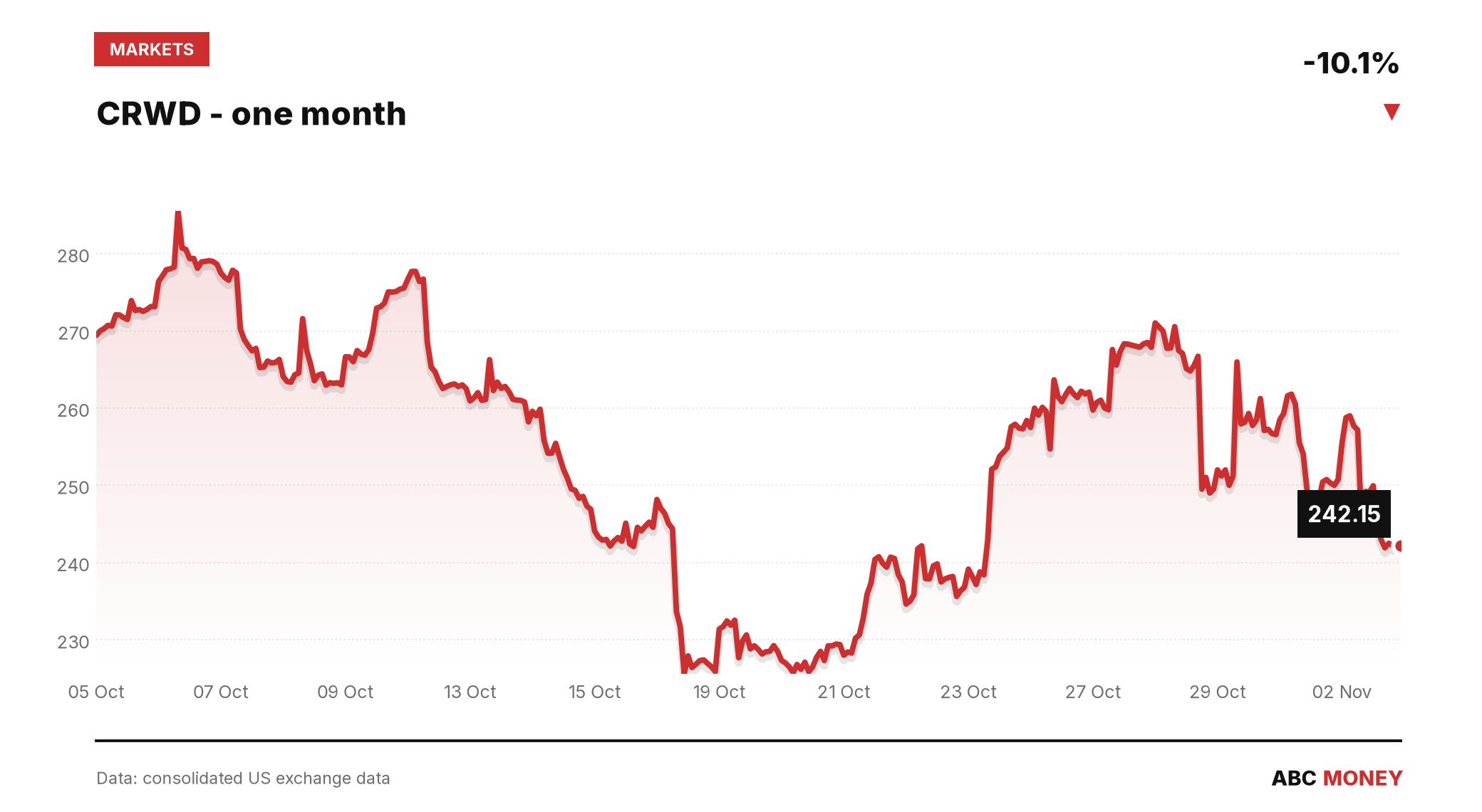
None of that AI-security land-grab has translated into share-price momentum. CRWD closed at $242.15 as of 3 November 2026, down 3.12% on the day and down 7.2% over the trailing twenty trading days to close at $242.15, within a 20-day range of $225.575 to $271.03, according to consolidated US exchange data in the pack. Trading volume was roughly in line with its 20-day average, suggesting the drift lower reflects broader positioning rather than a single shock.
Short-sellers, for what it’s worth, had been easing off rather than piling in. CrowdStrike’s short-sale ratio – the proportion of daily trading volume attributable to short sales, tracked by the Financial Industry Regulatory Authority – fell to 0.467 on 2 November, down from a recent high of 0.608 on 23 October, according to FINRA data. That decline suggests bearish pressure had been moderating into the announcement, even as the shares themselves kept sliding.
Two Form 4 filings from Kurtz, dated 3 November 2026, might look like a reaction to the week’s news at first glance, but the underlying transactions are document-dated 29 October 2026 and relate to a routine Rule 10b5-1 trading plan – a prearranged schedule executives use to sell shares on a set timetable, designed specifically to avoid any appearance of trading on inside information. They are unconnected to the Dell and Nvidia tie-up, according to CrowdStrike’s own SEC filings.
Profitability has been choppy
The partnership news also lands against a backdrop of uneven earnings. CrowdStrike swung to a net loss of $110.2m in its fiscal first quarter of 2026, followed by further losses of $77.7m and $34.0m in the following two quarters, before returning to profit with net income of $27.8m in its fiscal first quarter of 2027 and $5.3m in the quarter after that, according to the company’s 10-Q filings with the SEC. Diluted earnings per share over the same run moved from a loss of $0.44 to a loss of $0.31, then a loss of $0.14, before turning positive at $0.11 and $0.01 – a reminder that even as CrowdStrike wins high-profile infrastructure partnerships, its bottom line has only recently stabilised.
The macro backdrop offers little extra lift. The gap between 10-year and 2-year US Treasury yields – a gauge of how investors read the economic cycle – narrowed to 0.32 percentage points on 2 November from 0.38 previously, while the unemployment rate ticked up to 4.2% in September from 4.1% the month before, according to data from the Federal Reserve Bank of St Louis. None of that bears directly on the Dell and Nvidia announcement, but it is the economic tape against which the tech sector’s AI-infrastructure spending spree is now playing out.
For CrowdStrike, the near-term test is less about headlines from Barcelona and more about whether bundled deals like this one with Dell and Nvidia convert into the kind of recurring revenue that steadies the earnings swings investors have watched over the past two years.
This article is for information only and is not investment advice or a recommendation to buy or sell any asset. Markets move quickly; figures are correct as sourced at the time of writing. Always do your own research before making financial decisions.