UK-India trade deal enters force as business readiness report warns of preparedness gap
Explore how the UK-India trade deal is creating new opportunities as experts urge businesses to focus on preparedness, partnerships, and execution under CETA.
Contributed content: this article was written by a third-party contributor and does not necessarily reflect the views of ABC Money. Editorial and Advertising Policy
Sub-headline: Strategic report launched at UK Parliament urges businesses on both sides to move beyond celebration and focus on execution as CETA comes into effec
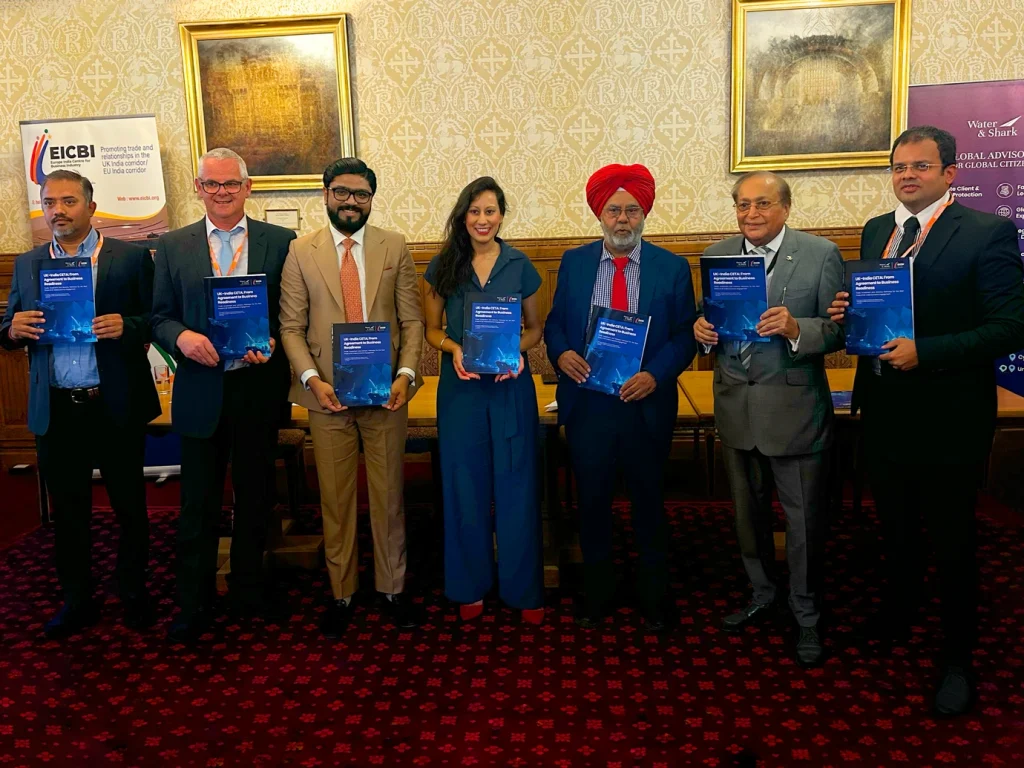
Water & Shark team and UK Parliamentarians at the launch of the “UK–India CETA” report at the House of Lords
London : The India-UK Comprehensive Economic and Trade Agreement (CETA) officially came into force on 15 July 2026, granting zero-duty access to nearly 99 per cent of Indian exports to the UK market. But as businesses on both sides began to explore the opportunities created by the agreement, a strategic report launched at the UK Parliament the previous day warned that the real work is only just beginning.
Titled “UK-India CETA: From Agreement to Business Readiness,” the report was unveiled on 13 July 2026 at the House of Lords during the UK India Leaders Conference 2026. Prepared by Water & Shark in association with the Europe India Centre for Business and Industry (EICBI), the document is positioned as a practical guide for businesses seeking to navigate the new trade landscape.
The preview release was attended by Members of the UK Parliament of Indian origin, including Sonia Kumar MP, Lord Rami Ranger and Lord Kuldip Sahota, alongside Baroness Pola Uddin (of Bangladeshi origin) and Navendu Mishra MP (of Indian origin). From Water & Shark, the team present included Founder & CEO Advocate CA Harsh Girish Patel, Mr Sujit S. Nair, and Dr David Bozward, Chair of Global Research Board.
Addressing the Preparedness Gap
Dr David Bozward, who leads the research board at Water & Shark, has observed the development of trade relations between the UK and India over several years. He was among the speakers at the UK Parliament event, where he addressed the gap between the signing of trade agreements and business readiness.
“There’s always a gap between the signing of an agreement between two nations and what we do on the ground to try and help you with that gap,” Bozward said during the discussion. The report, he explained, was designed to sit down with businesses and outline practical steps they should take to prepare.
Bozward emphasised that while governments may sign agreements, the real work lies in helping businesses understand how to benefit from them. The report, he said, was developed to bridge that gap between policy and practice.
The Three Ps Framework
Addressing the gathering, Advocate CA Harsh Girish Patel, struck a note that contrasted with the prevailing optimism. “The corridor is open, but are we really ready?” he asked.
Patel recalled witnessing the signing of the agreement a year earlier, describing it as a moment of pride. But he cautioned that the agreement itself is merely the foundation. “And that is what today we are translating the Agreement into Action Plan,” he said.
Patel urged businesses to look beyond the tariff numbers. “Behind the corridor of the FTA, it is more than that – developing corridors for defence, supply chain, finance, technology, pharma, and so on. Because in order to be completely self-reliant, you need a reliable partner.”
He introduced a framework tailored for the UK-India corridor: the Three Ps.
Preparedness: Patel stressed the importance of regulatory alignment, governance, cultural integration, and people-to-people connect. “Both the governments might have cemented the partnership and they might have reduced the tariff, but whether the product can seamlessly flow to the consumer market of the other country – that’s a qualitative factor which is extremely important,” he said.
Partnership: He warned against treating the relationship as transactional. “When we look at Indian exporters, we look at British only as just a customer or supplier or vendor… then this will be a transactional partnership, and that will obviate the very much objective of the long-term sustainable partnership between two nations.”
People: For the first time, Patel noted, the agreement enables seamless mobility of professionals – lawyers, chartered accountants, medical professionals, and engineers. “That will create new avenues for the professionals in UK and professionals in India to connect more, interconnect a market and provide the services to larger businesses.”
The Importance of Personal Relationships
Bozward also touched on the importance of understanding local nuances and building personal relationships. “The thing is, trading in Italy is not like trading in the UK, and trading in India is not like trading in any other place,” he said. “You have to go and make friends in India. You have to understand the culture, the language, and the way business is done.”
He added that while the agreement opens doors, success will ultimately depend on businesses’ willingness to invest in understanding their counterparts. “Procurement is going to be bigger. To be part of the procurement process in India, you are in a good situation, but you have to be there, you have to be present, you have to build relationships.”
Sectoral Opportunities
According to the UK India Business Council, the UK will eliminate tariffs on 99 per cent of Indian exports, while India will reduce tariffs on 90 per cent of UK exports. Sectors including textiles, leather, gems and jewellery, engineering goods, marine products, chemicals, and processed foods are expected to benefit significantly.
Patel was emphatic about the breadth of the agreement’s scope. “Opportunities, my dear friends, there are no sectors that are left except a couple of one small industries. Right from the SMEs to a top business – be it defence, be it gems and jewellery, be it financial services, technology, automobile, and everything, including whisky and so on. Everything has been taken care of.”
The question, he argued, is no longer about what the agreement offers. “What is pending is our readiness and our action.”
A Note of Caution
The report’s emphasis on business readiness echoes concerns raised earlier by the UK Parliament’s Business and Trade Committee. In January 2026, the committee warned that billions of pounds of tariff savings from the UK-India trade deal could be jeopardised by deep cuts to UK export support staff responsible for helping firms use the agreement in practice.
The committee stressed that ratification should not be treated as the conclusion of the process – a sentiment echoed by both Patel and Bozward in their remarks.
Closing Remarks
Patel concluded with a message that resonated across the chamber. “To British friends, businesses, and my lords and employees, India is not just a country with which the world is doing business. India is a country where the world can rely and trust.”
To his fellow Indians, he issued a challenge: “The corridor is ready. You have immense opportunity. Walk into this corridor with the confidence, capability, and with a long-term vision, not just for export.”
“The FTA opens the door. Preparedness walks through it. But partnership can only make us long-term success.”