Verizon Q3 Earnings Beat Estimates, but Shares Fall 4%
Verizon's Q3 earnings beat on profit and margins, but a revenue miss sent VZ shares down roughly 4% despite raised guidance.
In this article 3 sections
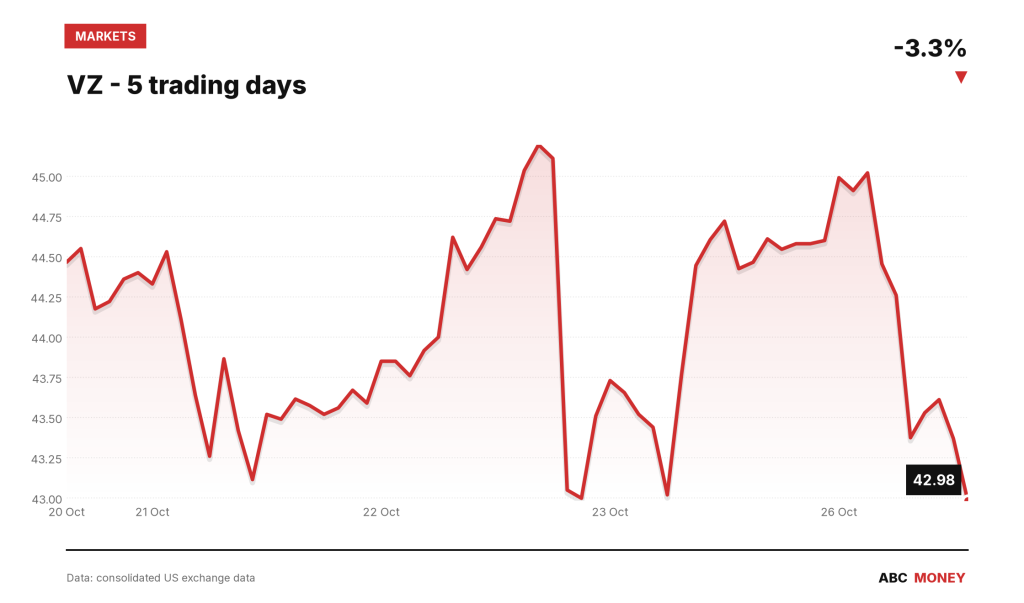
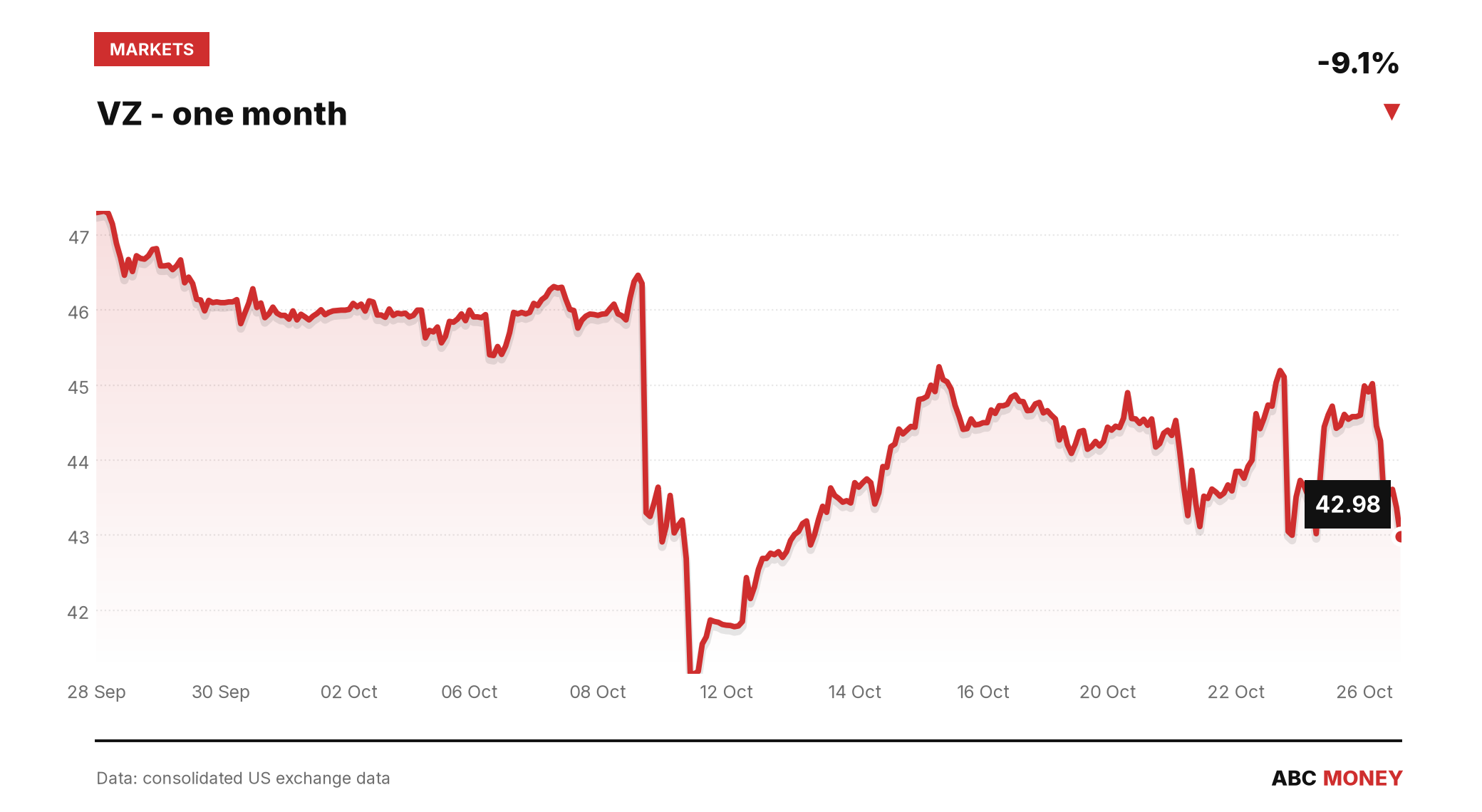
Verizon Communications (NYSE: VZ) delivered the kind of quarter that sell-side analysts like to call “mixed” – and the stock’s reaction left no doubt which half of that word the market cared about. Verizon’s Q3 earnings beat estimates on profit and margin, with adjusted earnings per share of $1.31 against a consensus of roughly $1.27, according to the company’s own third-quarter results filed with the SEC. Shares still fell about 4% to close at $43.205, having traded as much as $46.47 over the prior twenty sessions.
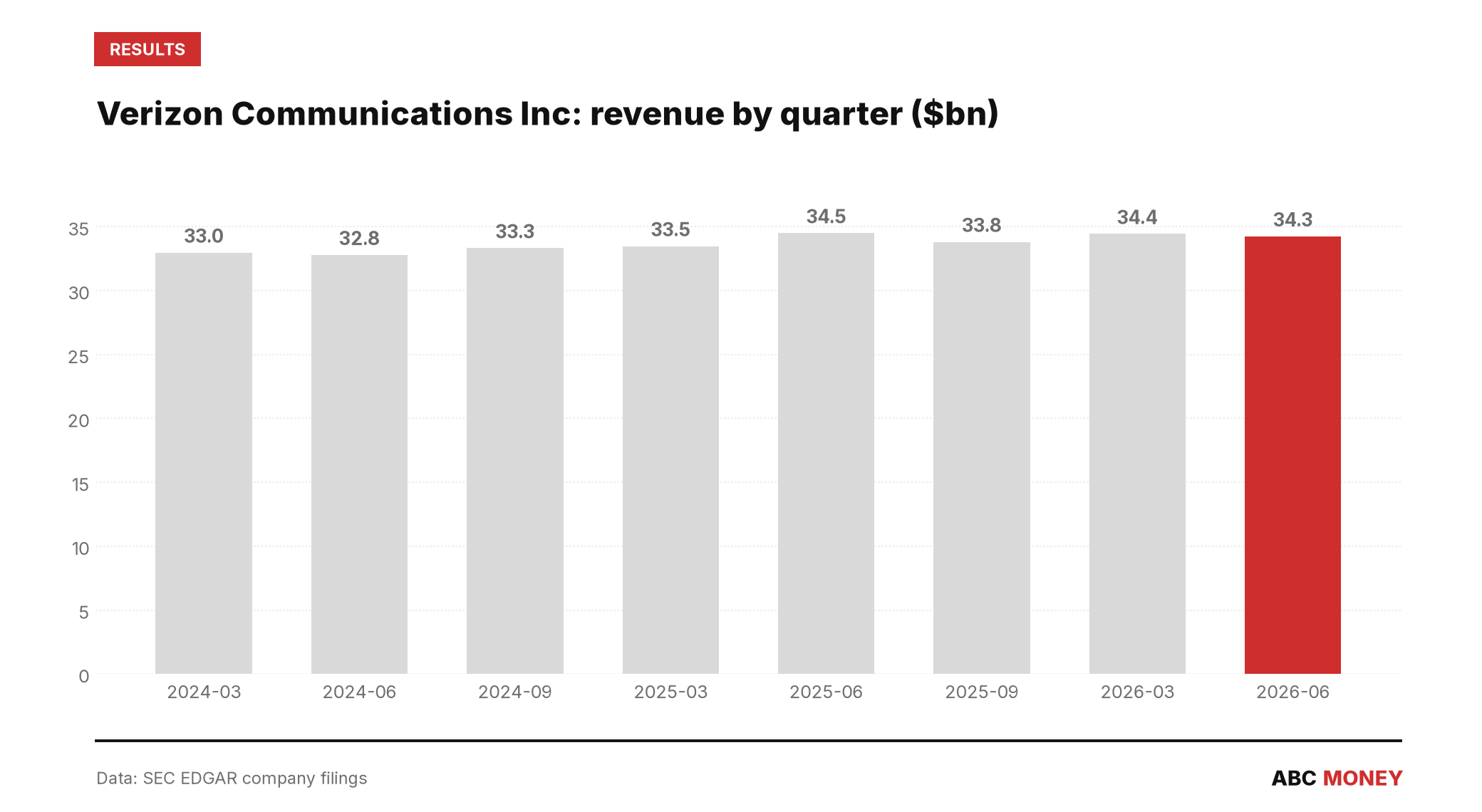
The gap between the headline beat and the share-price reaction is the real story here. GAAP diluted earnings per share came in at $1.25, up 6.8% from $1.17 a year earlier, while the adjusted figure – which strips out one-off items – rose 8.3% to $1.31. Both numbers were ahead of where they stood twelve months ago and ahead of what analysts had pencilled in. But revenue of $34.31bn missed consensus estimates that had clustered closer to $34.8bn-$34.85bn, as TipRanks reported. That shortfall, not the profit line, is what investors chose to punish.
Why a beat-and-raise quarter still sold off
Verizon’s underlying operating performance was, by most measures, strong. Adjusted EBITDA – earnings before interest, tax, depreciation and amortisation, a proxy for underlying cash profitability – rose 8% year-on-year to $13.8bn, with margin hitting a record 40.2%. The company added 406,000 postpaid phone subscribers in the quarter, its strongest third-quarter net-add figure in five years. Management also raised full-year adjusted EPS guidance to a range of $5.04-$5.06 a share.
None of that stopped the stock falling roughly 4% on the day. Part of the explanation is simple arithmetic: with a wireless business increasingly judged on top-line growth as competition for subscribers intensifies, a revenue print that undershoots expectations tends to overshadow a profit beat, however clean the margin story underneath it. A roughly $2bn infrastructure and cloud arrangement with Amazon, announced around the same time, barely registered against the revenue disappointment, per TipRanks.
It also looks company-specific rather than sector-wide. Shares in rivals AT&T and T-Mobile were roughly flat the same day, a contrast that frames Verizon’s decline as a Verizon problem rather than a telecoms-wide repricing, as noted by 24/7 Wall St.
The numbers behind the headline
Context matters here. Verizon’s quarterly revenue has moved in a fairly narrow band for two years – $32.98bn in the first quarter of 2024, climbing gradually to $34.44bn in the first quarter of this year and $34.25bn in the second, according to Verizon’s own SEC filings. Against that backdrop, $34.31bn in revenue represents steady, low-single-digit growth rather than stagnation – just not quite enough growth to meet where Wall Street had set the bar.
Net income, meanwhile, has been choppier: $4.6bn in the first quarter of 2024, down to $3.3bn by that autumn, before recovering to $5bn-plus through most of 2025 and into early 2026. On that trajectory, a reported net income gain to roughly $5.3bn this quarter continues a broadly improving trend rather than marking a step-change. The quarter’s strength, in other words, sits mostly in margin discipline and subscriber retention rather than in a revenue acceleration investors had been pricing in.
What the market’s plumbing shows
One thing the sell-off does not appear to reflect is pre-earnings positioning against the stock. FINRA’s daily short-sale data – a measure of how much trading volume comes from investors betting on a price fall – showed Verizon’s short-volume ratio at 0.471 on 23 October, comfortably within the 0.35-0.53 range it had occupied over the prior fortnight. There was no visible build-up of bearish positioning ahead of the print, per FINRA’s short-sale volume data, which suggests the reaction was driven by the numbers themselves on the day rather than by investors who had already placed their bets.
The broader bond-market backdrop, if anything, was unhelpful to the bears’ case. The 10-year US Treasury yield eased to 4.96% from 5.13% in the run-up to the results, according to Federal Reserve data – a move that typically supports high-dividend telecom names like Verizon by making their yields more attractive relative to government debt. That Verizon still fell despite friendlier rates underscores how specifically the sell-off was tied to the revenue line rather than to the macro weather.
For investors parsing the quarter, the distinction matters: Verizon’s cost discipline and subscriber momentum are real, and the guidance raise suggests management is confident enough in the trend to put a number on it. But a stock that fell 4% on a quarter management is calling its strongest in years is a reminder that in telecoms, growth – or the lack of it – still sets the tone more than margin ever can.
This article is for information only and is not investment advice or a recommendation to buy or sell any asset. Markets move quickly; figures are correct as sourced at the time of writing. Always do your own research before making financial decisions.